By Pat Elder
November 20, 2026
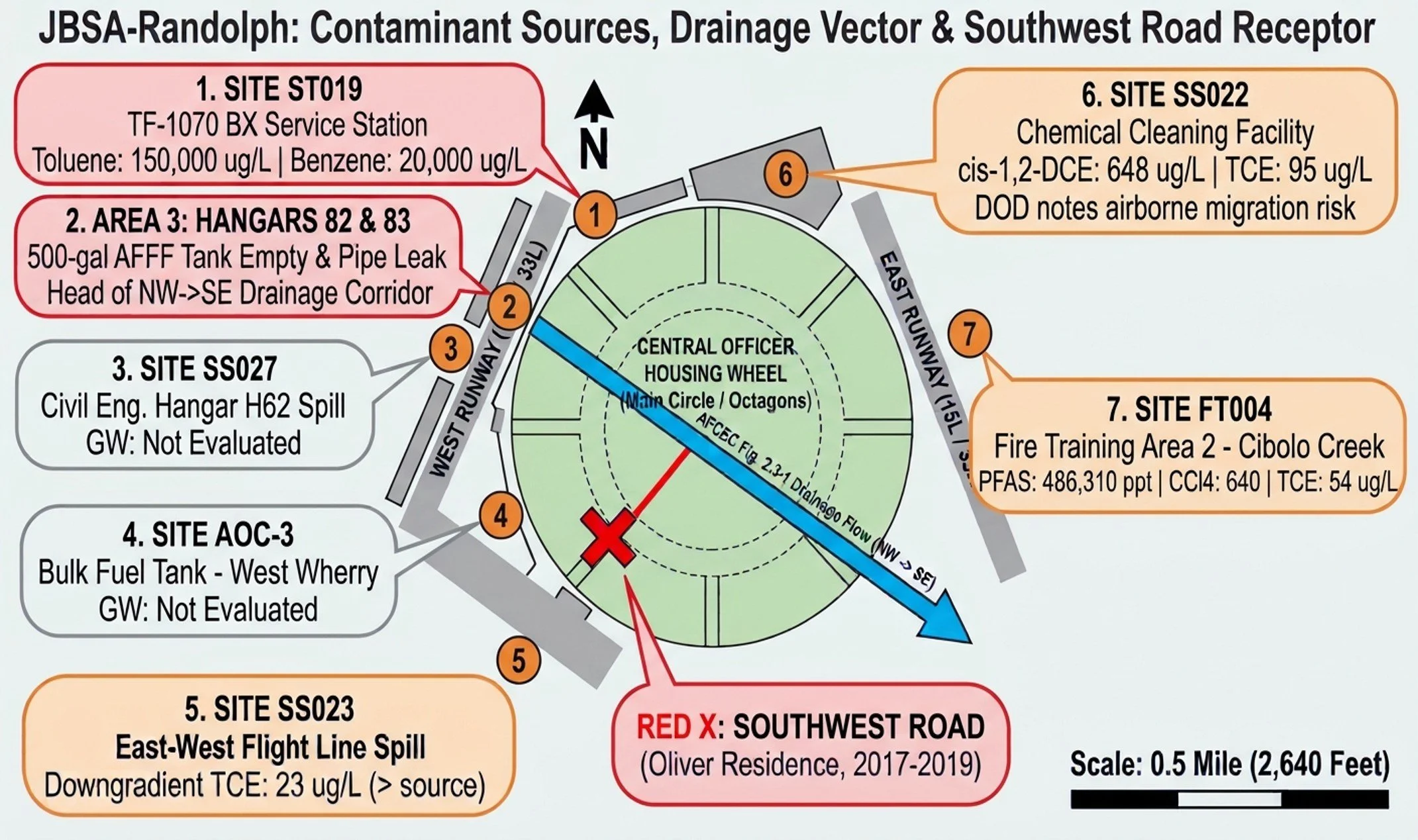
The Air Force reports these toxic sites surrounding the Oliver’s residence on Southwest Road within the Central Officer Housing Wheel. Surface water and groundwater generally flow southeasterly.
Bradley and Deborah Oliver
Air Force Col. Bradley Oliver, his wife Deborah, and their two children left their home on Randolph Air Force Base on April 12, 2019, after nearly two years of issues such as mold, rodent infestation, and poor ventilation. Maintenance workers insisted the issue was mildew, not mold. The landlords failed to address the excessive moisture in the home or the rodent infestation during the time they lived there, according to the lawsuit the Olivers joined with others against Hunt Military Communities that is currently stayed, meaning the court has put proceedings on hold.
In October 2026, Military.com reported on Deborah Oliver’s four diagnosed conditions:
· COPD and severe breathing difficulty
· Mixed connective tissue disease (MCTD), a systemic autoimmune disorder
· Pericarditis, inflammation of the sac surrounding the heart.
· Atrial fibrillation (AFib), an irregular and often rapid heart rhythm
The article presents mold as the cause more firmly than the evidence it describes can establish. It reports her account of dampness, visible mold, and rats, followed by illness. But the article does not present medical records, environmental test results, or an independent medical assessment linking her specific diagnoses to the mold or the home. An Air Force spokesperson quoted in the story says officials cannot determine if a medical condition is associated with a particular residence. That phrasing is standard boilerplate in Department of Defense and Air Force responses to claims linking base housing to cancers and other diseases.
We should be skeptical about attributing MCTD, COPD, pericarditis, and atrial fibrillation to mold. Evidence does support links between damp or moldy indoor spaces and respiratory or allergy symptoms, and worsening asthma in susceptible people. But authoritative reviews have found insufficient evidence to establish a link with these diseases and immune diseases. This may not rule out a role in an individual case; it means the article’s timeline and her account do not, by themselves, prove that mold caused these conditions.
This raises the critical question of whether multiple hidden chemical exposures at Randolph compounded her illness.
The article’s mold-only causal framing and alarmist tone leaves out a host of potentially important exposure questions unique to her residence. “She has experienced severe and continued health damage triggered by recurring mold exposure in that home, with the toxic conditions exacerbated by the presence of rats..” These conditions are hardly unique in US military housing.
The Federal Enclave statute
The lawsuit the Olivers joined with others against Hunt Military Communities was stayed when Hunt Military Communities invoked the Federal Enclave statute. The 5th Circuit Court of Appeals readily agreed. That ruling basically means that state and local tenant protection laws enacted after the land was acquired by the military do not apply to the on-base homes like the one Oliver inhabited. A three-judge panel affirmed that the U.S. Constitution's Federal Enclave Clause freezes state law in place at the moment Texas ceded exclusive jurisdiction over the Randolph AFB land to the federal government in 1951.
Article I, Section 8, Clause 17 is the Enclave Clause. It says Congress has power “to exercise like Authority over all Places purchased by the Consent of the Legislature of the State in which the Same shall be, for the Erection of Forts, Magazines, Arsenals, dock-Yards, and other needful Buildings.”
It gives Congress power to exercise “exclusive legislation” over the District of Columbia and places acquired with a state legislature’s consent for federal purposes like military installations.
This legal shield strips military families of modern state consumer-protection and health-safety laws that protect off-base renters, reducing pressure on private contractors to remediate environmental hazards quickly.
The legal architecture that shields private housing contractors at JBSA-Randolph through the Federal Enclave law invoked in 1951 shares the exact same Cold War DNA—and legal mechanics—as the Status of Forces Agreements (SOFAs) signed in Europe and Japan during that very same window.
In both cases, Cold War legal frameworks designed to streamline military operations froze legal accountability. Today, those frameworks strip affected communities, whether U.S. military families on domestic bases or local citizens living near bases in Okinawa and Germany, of modern environmental and legal protections.
Jurisdictional walls built in 1951–1952 to insulate US military command from local interference now insulate military bureaucracies and private contractors from modern environmental and public-health accountability worldwide.
DoD Inspector General audits covering JBSA-Randolph have confirmed systemic moisture intrusion, uninspected crawlspaces, and deficient humidity-monitoring tools in Hunt-managed housing. This follows federal lawsuits that document severe respiratory and immune harms linked to pervasive indoor mold. Hunt Military Communities has not been stripped of its 50-year privatization contract at JBSA-Randolph, nor has it been hit with direct federal regulatory fines over the Randolph mold complaints.
Now, let’s examine environmental conditions that likely contributed to Deborah Oliver’s ill health.
1. Site Storage Tank (ST) 019
Site Storage Tank ST019 was the underground fuel storage tank farm located at Building 1070. Most of the Underground Storage Tanks (UST’s) buried by the Air Force around the world in the 50's, 60’s and 70's eventually leaked. These single-walled, bare-steel USTs routinely corroded and leaked over time. The Air Force was aware of the problem and the threat to public health but did not act.
Civil engineering squadrons and Pentagon environmental planners tracked leaking tank inventories and groundwater plumes starting in the 1980s, but families assigned to on-base quarters were rarely notified of subsurface plumes unless a drinking water well exceeded federal Maximum Contaminant Levels.
Things got worse when military housing was transferred to private developers, such as Hunt Military Communities at JBSA-Randolph. Environmental disclosures focused on indoor lead-based paint and asbestos rather than legacy subsurface plumes located across base utility corridors. Consequently, residents like the Olivers on Southwest Road experienced unexplained indoor moisture, odors, and chronic health symptoms between 2017 and 2019 without any warning that upgradient fuel, solvent, and AFFF plumes sat along the installation's drainage pathways.
The extreme groundwater detections of Toluene (150,000 µg/L), Benzene (20,000 µg/L), and xylenes have poisoned the shallow alluvial water table (20–25 feet below ground).
Concentrations of this magnitude indicate undissolved liquid fuel trapped in subsurface soil pores—a persistent reservoir that continues leaching toxic vapors and dissolved contaminants into shallow groundwater for decades even after tank removal. These toxins are carried southeastward along the installation’s natural hydraulic gradient and permeable stormwater and utility trenches. They are further mobilized by other solvents and AFFF surfactants! (And this is well worth the exclamation point.) This unmonitored plume carries volatile soil gases directly toward the central officer housing district and Southwest Road, where compromised sub-floor crawlspaces leave residents vulnerable to indoor vapor intrusion without warning.
2. Area 3: Hangars 82 and 83
AFCEC Figure 2.3-1 (AFFF Release Areas) maps a continuous Surface Water drainage pathway originating directly at Area 3 (Hangars 82 and 83) on the northwestern apron and traveling straight through the central officer housing district. This mapped drainage corridor directly intersects Southwest Road, where the Oliver family resided from 2017 to 2019. In developed airfield environments, mapped surface-water conveyances traversing residential sectors correspond to stormwater culverts and subsurface utility trenches whose permeable gravel bedding acts as a preferential fast-track pathway for shallow groundwater and runoff.
An inspection of the west mechanical room at Hangar 83 revealed that one of two 500-gallon aboveground storage tanks containing AFFF concentrate was empty for unknown reasons, with a suspected leak in the underground piping connecting Hangars 82 and 83. Although this unquantified subsurface release sits immediately upgradient of the central housing district, the 2018 Site Inspection collected no groundwater analytical samples at Area 3, leaving the downgradient plume core uncharacterized during the 2017–2019 period.
Mixed at its standard 3% proportioning ratio, the missing 500 gallons of AFFF liquid concentrate equates to 16,667 gallons of liquid foam solution—capable of generating 133,333 gallons (17,824 cubic feet) of standard finished foam (enough to bury a 2,000-square-foot home nearly nine feet deep) or more than 3.3 million gallons (445,000+ cubic feet) of high-expansion hangar deluge foam.
445,602 cubic feet of foam is enough to cover a 2-acre hangar floor (87,120 square feet) to a depth of over 5 feet—which is the exact design target of military high-expansion hangar deluge systems.
One teaspoon of the foam introduced to a mid-sized city’s drinking reservoir could cause the water system to be shut down for exceeding EPA guidelines. Based on the PFOS concentration measured in AFFF concentrate at Brunswick, Maine, roughly a teaspoon could raise about one million gallons of water to 4 ppt PFOS.
PFAS is in a league of its own.
Although most PFAS compounds themselves do not volatilize into soil gas like benzene or TCE, a 500-gallon AFFF release at Hangars 82 and 83 still threatens downgradient housing through three distinct mechanisms: first, the glycol ether solvents and surfactants in AFFF act as chemical detergents that mobilize trapped petroleum hydrocarbons and degreasers, accelerating volatile vapor migration toward residential foundations; second, stormwater surges deposit PFAS onto surface soils and sub-floor dirt, where it dries into fine particulate dust drawn indoors through unsealed crawlspace openings and tracked in from yards.
Systemic PFAS exposure suppresses immune and endocrine function, compounding the health impact of indoor volatile chemicals.
3. Site SS027 Civil Engineering Hangar Spill Site
This spill site is positioned along the western residential/support perimeter flanking the West Flight Line corridor, where legacy fuel and spill sites sit closest to family housing tracts without completed groundwater risk evaluations.
In the ProPublica / DOD Defense Environmental Restoration Program (DERP) database, SS027 stands out not because of high published chemical numbers, but because no analytical contaminant concentrations or groundwater risk evaluations are listed in the public summary record—despite its proximity to the western flight-line corridor and central housing district.
Spill sites at Civil Engineering hangars and maintenance shops (SS prefix) typically involve localized releases of petroleum fuels (diesel/gasoline), hydraulic fluids, lubricating oils, paints/thinners, or degreasing solvents.
Every environmental medium tracked in the public DERP table—Groundwater, Soil, Surface Water, and Sediment—is marked "Risk Not Evaluated," and the public summary lists no specific chemical names or concentration values.
4. Site AOC 3
Positioned along the western residential/support perimeter flanking the West Flight Line corridor, where legacy fuel and spill sites sit closest to family housing tracts without completed groundwater risk evaluations.
Right next to the West Wherry family housing neighborhood at JBSA-Randolph, an April 2008 environmental investigation into a former bulk fuel tank (Site AOC03) confirmed that gasoline, diesel, and heavy oil had soaked deep into the ground across nineteen different test locations. While the highest diesel measurement (89.4 mg/kg) exceeded standard residential soil safety benchmarks of 50 mg/kg, the bigger concern for nearby residents is how deep the fuel traveled. At Randolph, shallow groundwater sits roughly 20 to 25 feet below the surface, and contractors detected gasoline, diesel, and oil all the way down at 15 to 20 feet—meaning the fuel plume penetrated straight through the soil to the top of the underground water table. Despite proving that petroleum hydrocarbons had reached groundwater depth right beside family quarters, the Air Force closed the site in January 2009 without ever testing the groundwater underneath. Because gasoline and diesel evaporate easily into invisible chemical vapors, fuel trapped near the shallow water table and along underground utility trenches can seep upward through foundation cracks and unsealed crawlspaces, posing a hidden indoor air risk for families living nearby.
5. Site SS023 East-West Pipeline Spill
Site SS023, (East-West Flight Line) recorded: TCE at 23 parts per billion. (4 times EPA maximum allowed which is already inflated.) Because TCE evaporates easily from shallow groundwater, levels above 5 µg/L near buildings trigger standard regulatory screening for indoor vapor intrusion.
The detection of cis-1,2-dichloroethylene at 10 µg/L is a critical forensic clue! Some things in this realm are actually exciting. Bacteria in underground water create cis-1,2-DCE as they slowly break down TCE—proving that a legacy TCE release sat in the flight-line groundwater long enough to undergo biological degradation while still migrating outward. Housing was threatened by TCE.
6. Site SS022 - Chemical Cleaning Facility
Hundreds of thousands of veterans exposed to volatile organic compounds (VOCs) and Aqueous Film-Forming Foam (AFFF) have filed disability claims with the VA.
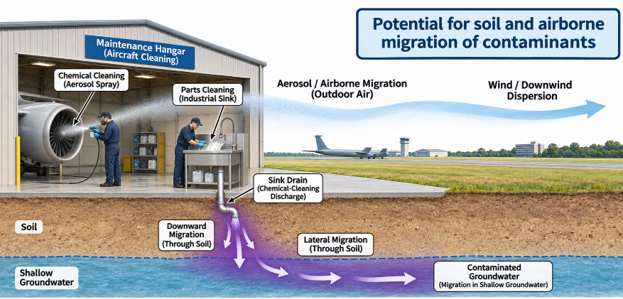
The Air Force identifies SS022 as the Chemical Cleaning Facility, an industrial area associated with chemical cleaning and degreasing. The groundwater detections of TCE, PCE, cis-1,2-DCE, and trimethylbenzenes, along with the report’s warning about potential soil and airborne migration make it important to examine where the contaminants move beyond groundwater.
Finding 648 µg/L of cis-1,2-DCE, more than nine times the federal safety limit, proves a massive, long-term solvent spill occurred here and began breaking down into dangerous byproducts. All four chemicals listed above are volatile organic compounds (VOCs), meaning they evaporate out of shallow groundwater (only 20–25 feet below ground at Randolph) like steam rising off warm water. Their vapors rise through dry soil and travel along underground sewer and utility pipes—explaining why the Department of Defense explicitly warned of a "Potential for soil and airborne migration of contaminants," although they don’t advertise the fact. The Air Force knows the score, but they don’t want to cause a panic and they don’t want to add to the liability they already have.
The point is that officers and their families at Randolph Air Force Base are vulnerable because of the air they breathe.
7. Site FT004 Fire Training Area
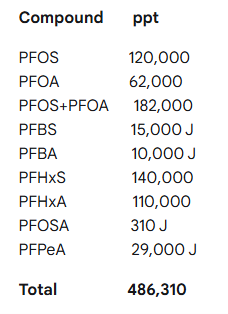
AFFF Site Inspection Report JBSA Randolph AFB and Seguin Auxiliary Airfield, Texas. (J means approximate)
Superlatives can’t describe the alarm. The EPA is trying to keep drinking water below 4 parts per trillion for PFOS and PFOA. These chemicals never go away and they are deadly. The entire food chain is poisoned for miles around. Rivers and fish are contaminated.
Residents may not be drinking water with PFAS, and the compounds are not expected to enter homes as vapor. However, when groundwater loaded with PFAS reaches surface water and residential yards or gardens, it creates dangerous pathways to exposure through air, soil and dust that the Pentagon would rather not discuss. Groundwater plumes containing PFAS may be close to the surface, with little soil separating them from low-lying areas. During torrential rain, a rising water table and runoff may carry contaminated groundwater to surface water, yards, or flooded basements in poorly maintained housing, creating potential contact with contaminated soil and dust or ingestion of locally grown food. This is a credible pathway to investigate.
Connecting the toxicity to Deborah Oliver's diagnoses

Oliver reports suffering from chronic obstructive pulmonary disease (COPD), mixed connective tissue disease (MCTD), inflammation of the sac surrounding the heart (pericarditis), and atrial fibrillation (AFib). While no published DOD study proves that underground vapors infiltrated Randolph family housing or directly caused her specific diagnoses, peer-reviewed toxicology shows that the volatile organic compounds (VOCs), solvents, and PFAS documented across the base target the exact respiratory, autoimmune, and cardiovascular systems failing her—creating a medically plausible "multiple-hit" exposure that likely compounded the harms of severe indoor mold.
COPD: Inhaled fumes from cadmium, benzene, toluene, and xylenes deeply irritate delicate lung tissue, setting the stage for permanent breathing conditions. PFHxS, PFNA, PFOA, and PFOS were found in increased levels in COPD patients.
MCTD: Solvents like trichloroethylene (TCE), vinyl chloride, aromatic hydrocarbons toluene, xylenes, and benzene are known to disrupt immune regulation, sparking systemic autoimmune reactions like MCTD that are known to inflame the lining of the heart. The compounds are all prevalent at Randolph.
Pericarditis is the single most common cardiac manifestation of Mixed Connective Tissue Disease (MCTD) and systemic lupus. Therefore, the solvents associated with triggering scleroderma- and lupus-spectrum autoimmunity—trichloroethylene (TCE), tetrachloroethylene (PCE), vinyl chloride, and benzene—are the primary environmental chemicals connected to her pericarditis.
AFib: Peer-reviewed cardiology and toxicology studies link AFib and related cardiac arrhythmias to several toxins documented at JBSA-Randolph, most notably fine particulate air pollution (PM2.5/dust), volatile organic compounds like benzene, toluene, TCE, carbon tetrachloride, and heavy metals (arsenic, cadmium), and chronic lung/autoimmune inflammation.
A review of publicly available records for U.S. Air Force installations has not uncovered a single case in which the Air Force or ATSDR determined that indoor-air VOC exposure was associated with diagnosed disease. Meanwhile, we have witnessed that the Army and the state of California have allowed Cal State University Monterey Bay to be built over a toxic Army Superfund site with several documented deadly plume, without conducting volatile air testing. It is not surprising that kids on campus are reporting leukemia.
Legacy of Unanswered Questions
Deborah Oliver’s medical ordeal cannot be reduced to a simple binary choice between indoor mold and underground chemicals. Instead, the public record at Joint Base San Antonio-Randolph points to a dangerous convergence of an aging, poorly maintained home with unsealed crawlspaces and water streaming down interior walls, sitting directly downgradient from decades of leaking fuel tanks, industrial degreasers, and fire-fighting foam. While toxic mold and rodent infestations clearly ravaged the air inside the Olivers' residence, peer-reviewed toxicology shows that chronic exposure to benzene, trichloroethylene, and PFAS targets the exact respiratory, autoimmune, and cardiovascular systems now failing her.
Yet because the Air Force closed key fuel and solvent sites decades ago without ongoing groundwater or soil-gas monitoring—and because a 1951 Federal Enclave shield strips military families of modern state tenant protections—neither Hunt Military Communities nor the Pentagon has ever been forced to test the indoor air inside those Southwest Road quarters for subsurface vapor intrusion. Until military housing oversight pairs structural mold remediation with independent indoor air and sub-slab chemical testing, service members and their families will continue living on top of Cold War environmental legacies with no way of knowing what they are breathing.
===============================
Methodology & Sources
How This Investigation Was Compiled
To evaluate potential subsurface chemical exposure pathways near Southwest Road at Joint Base San Antonio-Randolph, this report cross-referenced Department of Defense (DoD) environmental restoration records, Air Force Civil Engineer Center (AFCEC) site inspections, U.S. Environmental Protection Agency (EPA) health benchmarks, and federal housing litigation records.
Referenced Installation Sources (DoD DERP Records)
Site ST019 (TF-1070, BX Service Station Leaks): Closed December 1997
Site SS022 (Chemical Cleaning Facility): Closed January 2002
Site AOC-3 (Bulk Fuel Tank, West Wherry Housing): Closed January 2009 (following the April 2008 SAIC Site Investigation)
Site SS027 (Civil Engineering Hangar H62 Spill Site): Closed February 2014 (monitoring ended June 2014)
Site SS023 (East-West Flight Line Spill): Closed June 2014 (monitoring ended September 2016)
Site FT004 (Fire Protection Training Area No. 2): Final cleanup action listed August 2018 (remains an active site)
Primary Environmental & Technical Documents
U.S. Department of Defense / ProPublica DERP Dataset: DoD Defense Environmental Restoration Program (DERP) Installation Restoration Program (IRP) Database for JBSA-Randolph (TX657152411700), compiled via FOIA in ProPublica: Bombs in Your Backyard — JBSA-Randolph (published 2017; cost figures updated December 5, 2017).
Air Force Civil Engineer Center (AFCEC): Final Site Inspection Report for Aqueous Film-Forming Foam (AFFF) Release Areas, JBSA-Randolph AFB and Seguin Auxiliary Airfield, Texas (November 2018), including Page 10 (Area 3: Hangars 82 & 83), Figure 2.3-1 (Surface Water Pathway), and Table 3.1-3 (Summary of Groundwater Analytical Testing Results, Sample ID FT004MW082), archived in the AFCEC CERCLA Administrative Record Portal.
Science Applications International Corporation (SAIC): Preliminary Assessment / Site Investigation, Former Bulk Fuel Tank AOC03 – West Wherry Site, prepared for Headquarters Air Education and Training Command and Randolph AFB, Texas (Contract No. F41689-02-D-0001, Task Order 0097, April 2008).
Investigative Journalism & Litigation Reporting
Karen Jowers, "Five More Military Families Sue Privatized Landlord Alleging Mold, Vermin, Lead Paint and Raw Sewage," Military Times, January 7, 2021.
Nick Mordowanec, "Ex-Air Force Colonel's Wife Details Chronic Illnesses, Ongoing Legal Fight from Base Housing Mold," Military.com, October 26, 2026.
=======================
Thank you to a small handful of readers for contributing after my last appeal. Thank you for standing with me all these years. Please donate here.
Here’s something you could do to help me! Please forward this email/link to people and encourage them to send me an email to request being added to my distribution list. Thank you, Pat.