New testing found 504,381 ppt total PFAS in the
Hangar 4 oil-water separator
By Pat Elder
September 15, 2026
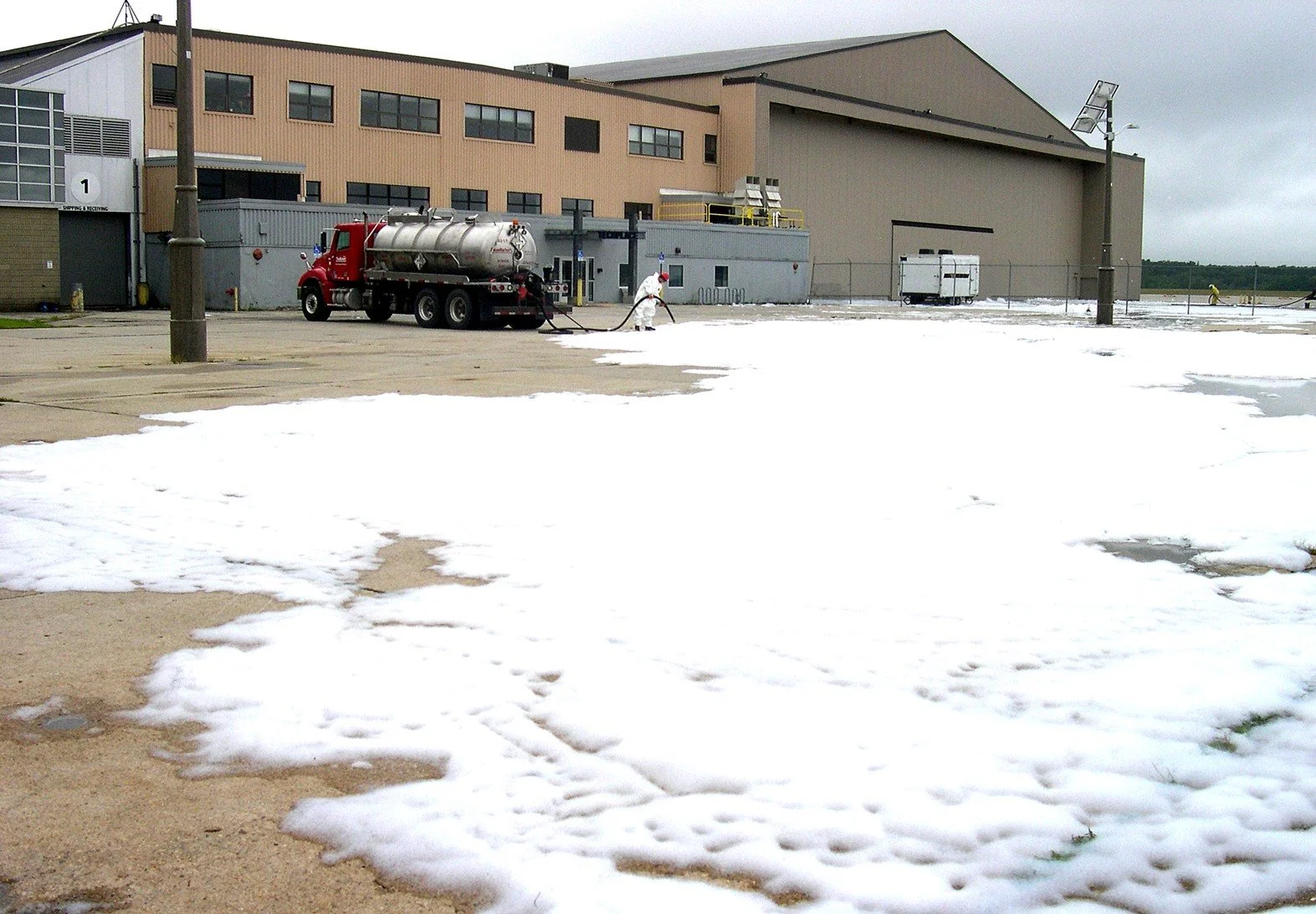
Cleanup crews remove AFFF from the apron outside Hangar 4 at Brunswick Executive Airport on August 19, 2024, after an accidental discharge of the hangar’s foam fire-suppression system.
An August 18, 2026, sanitary system-water sample collected from the Hangar 4 oil-water separator at Brunswick Executive Airport revealed a staggering 504,381.3 parts per trillion (ppt) of total PFAS.
This finding is up 23% from sampling of the pit a year ago and exposes a severe, ongoing environmental emergency, highlighting the inadequacy of current site remediation and containment measures.
Friends of Merrymeeting Bay, ME August 18 and 19, 2026 PFAS Testing
In Parts per Trillion
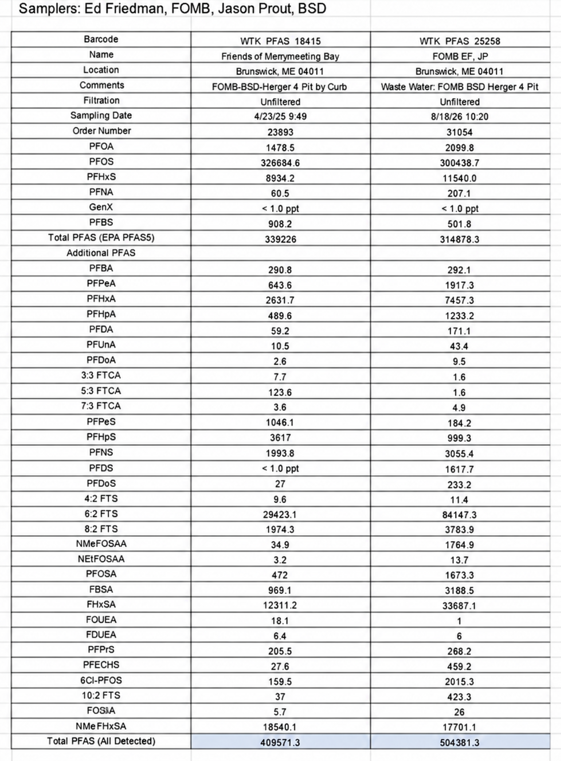
The results from testing performed on April 23, 2025 and August 18, 2026 from the Hangar 4 oil-water separator are shown here.
The recent results contain an exceptionally large PFOS concentration (300,438.7 ppt).
The sample identifies an extraordinarily dangerous PFAS pathway. Surface water from Hangar 4 drains into the Pond A/Picnic Pond drainage area and down Mare Brook to Harpswell Sound [the ocean].
Whereas, wastewater flowing into the separator makes its way to the Brunswick Sewer District plant and from there into the Androscoggin River or into a sludge product.
Two years later, the situation demands immediate containment, removal, and treatment!
Mainers are asleep at the switch.
On the day of the spill, Midcoast Regional Redevelopment Authority, (MRRA) assured the public that its response would use a “multi-phase approach to ensure thorough remediation,” pledged “utmost urgency and transparency,” and promised regular public updates. Two years later, the 504,381‑ppt PFAS result from the Hangar 4 separator raises a basic question: what, exactly, was removed, contained, treated, or allowed to remain in that system?
Facing public and legislative calls for her resignation after the Hangar 4 spill, MRRA Executive Director Kristine Logan stepped down in October 2024. In her departure statement, Logan said she was removing herself as a “focal point” so the response could proceed “unimpeded by outside politics and the political agendas of others.”
What the August 2026 sample shows
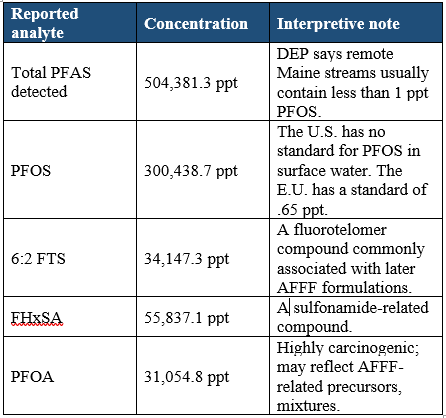
The laboratory report labels this PFAS sample “wastewater.” A separator is not a treatment system designed to destroy PFAS. When water leaves the pit during storms or is conveyed to the Brunswick Sewer District system, the relevant question is not whether it is technically “surface water” or “wastewater,” but whether it is being contained, characterized, and prevented from carrying PFAS to receiving waters or sludge.
The chemical pattern
The PFOS-PFHxS-PFOA portion of the mixture is compatible with legacy electrochemical-fluorination chemistry used by 3M and other older PFOS-era products. This points directly to the Navy and will likely be compelling in likely future litigation.
Why the pathway matters
MRRA is the Midcoast Regional Redevelopment Authority, the Maine public authority that manages Brunswick Landing and the Brunswick Executive Airport. MRRA’s 2024 financial statements confirm that the August 19, 2024 release entered the sanitary sewer collection system through the oil-water separator, storm drains, and retention ponds.
PFAS are not conventionally removed by a typical municipal wastewater plant - although they could and should filter PFAS out. Influent is redistributed between effluent and sewage sludge rather than destroyed. Fish and wildlife exposure therefore depends on actual discharge volumes, frequency, sediment interactions, and uptake, not on the separator concentration alone. In any case, Brunswick is in serious trouble.
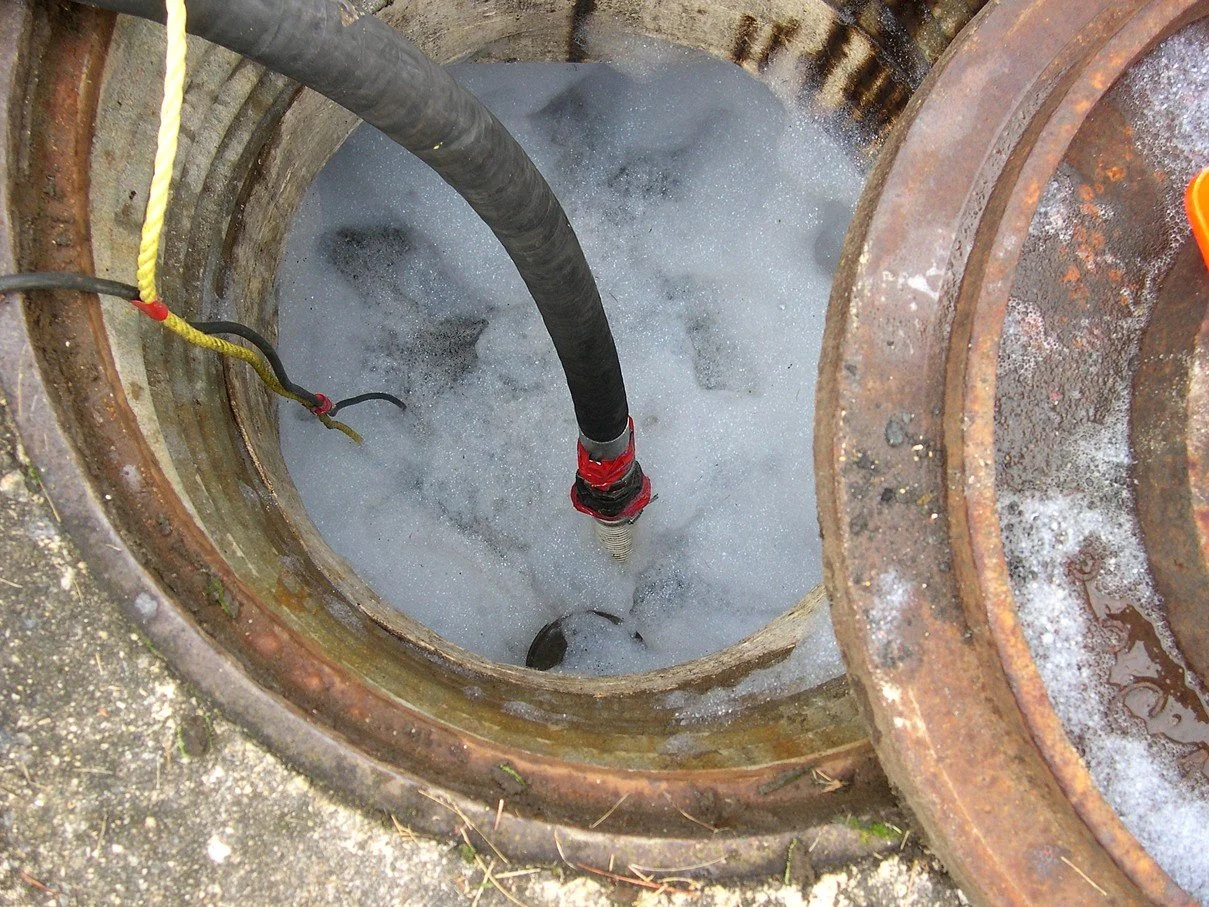
Hangar 4 separator pit - 8/19/24 - the day of spill
The August 19, 2024 accident released approximately 1,450 gallons of AFFF concentrate mixed with roughly 50,000 gallons of water. Maine DEP, EPA Region 1, and the Brunswick Fire Department directed the immediate response. It is reprehensible that the dangerous materials still have not been removed from Hangar 4 wastewater system. This is a serious embarrassment for Maine.
We sounded a warning in 2021 that fell on deaf ears.
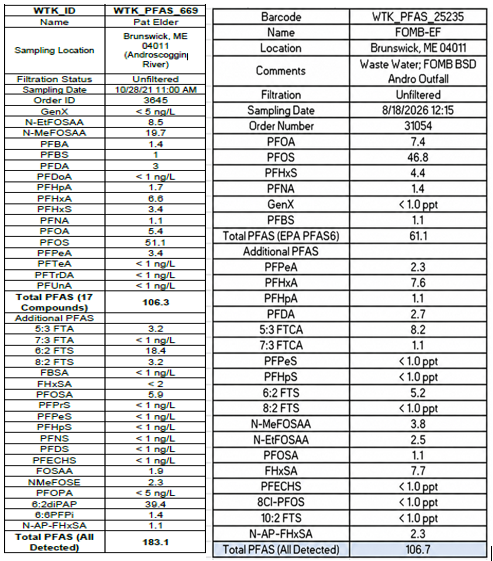
I teamed up with Friends of Merrymeeting Bay on October 28, 2021 to test the sewer outfall draining into the Androscoggin River for PFAS.
We reported dangerous levels of the chemicals and pointed to the airport as the likely source of the contamination. We shared our results with The Portland Press Herald. PFOS totaled 51.1 ppt while total PFAS was measured at 183.1.
Friends of Merrymeeting Bay tested the same sewer outfall last month and again found dangerous levels draining into the river. PFOS measured 46.8 ppt while total PFAS was 106.7 ppt.
This should stop! Maine has the technology to remove these deadly toxins from the waste stream.
I explained to the newspaper that the PFOS concentration of 51.1 parts per trillion was particularly worrisome because the EPA had reported that the compound may bioaccumulate in fish up to 4,000 times the levels in the water.
(According to the Maine Department of Environmental Protection, a brook trout caught in a stream near the former Loring Air Force Base, contained 1,080,000 ppt of PFOS.)
They didn’t mention the impact on fish in the story. They downplayed the threat and questioned our methodology. Their headline reported, Groups claim ‘alarming levels’ of ‘forever chemicals’ found in Brunswick. A Maine Department of Environmental Protection project manager said that while the findings shouldn’t be dismissed, the testing method used by the local groups is not in line with state standards.
The Cyclopure PFAS water-test kits we used in Maine have been used internationally for years. The kits are also used by federal and state agencies, and the U.S. Navy.
Two years after the spill, extraordinarily PFAS-contaminated water remained in the Hangar 4 oil-water separator. The system connects to both stormwater drainage and the Brunswick Sewer District conveyance system. The responsible agencies should immediately isolate the separator and connected conveyance piping, then remove and characterize their contents.
We need your support more than ever.
Please consider donating to support our work,