

Artist’s rendition of PFOA. Students should not be drinking PFOA on campus.
October 3, 2026
Dear President Vargas and CSUMB administrators,
California State University Monterey Bay was created on the grounds of former Fort Ord. That history brings an obligation larger than ordinary campus management: the University must insist that the soil, water, and construction zones used by its students, staff, and neighbors are investigated with current science—not assumptions made by the Army before PFAS was even part of the regulatory vocabulary.
Independent September screening identified PFAS at four locations connected to campus life and former Fort Ord land uses.
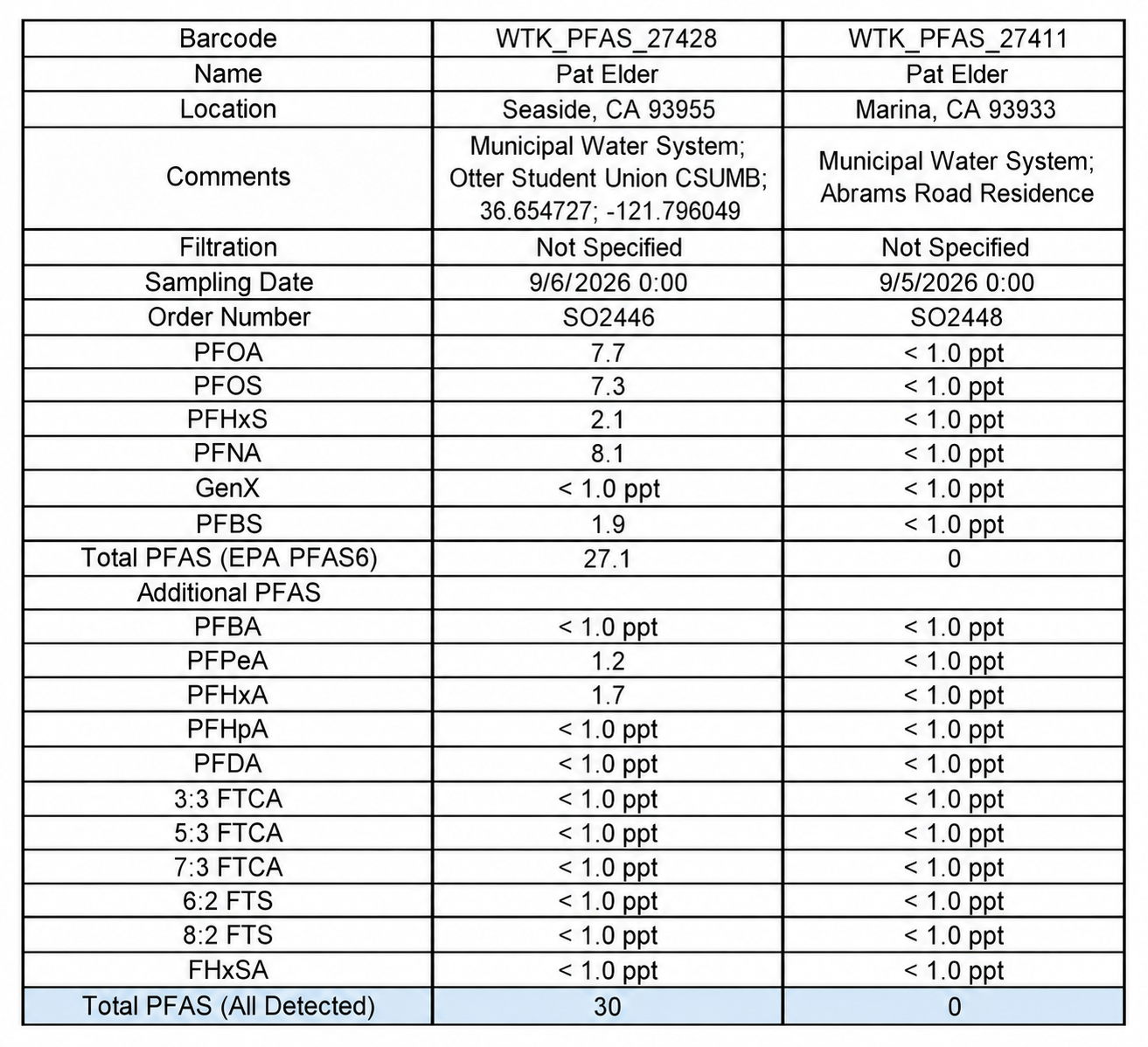
A tap-water sample from the Otter Student Union contained 7.7 parts per trillion (ppt) of PFOA and 7.3 ppt of PFOS. Both exceed the EPA’s current individual drinking-water maximum contaminant level of 4 ppt. The same sample contained PFNA, PFHxS, PFBS, and other measured PFAS, with 30 ppt total detected PFAS.
Another sample collected from a residence on Abrams Drive in Marina, a litttle more than a mile away showed no detection of PFAS. How could that be?
Certainly, one sample does not establish system-wide compliance or prove anyone’s illness was caused by water at the Student Union. It does, however, require prompt confirmatory sampling, disclosure of the source water and distribution route, and a public explanation from CSUMB and Marina Coast Water District.
PFOA deserves particular attention.
PFOA is not simply another PFAS on a laboratory printout. The International Agency for Research on Cancer classifies PFOA as carcinogenic to humans—a conclusion based on sufficient evidence of cancer in laboratory animals, strong evidence of carcinogenic mechanisms in exposed people, and very strong human evidence for kidney and testicular cancer. The National Toxicology Program has also concluded that PFOA, like PFOS, is presumed to be an immune hazard to humans. California lists PFOA as causing cancer and reproductive harm. It is fair to say that PFOA is among the most thoroughly studied and consequential PFAS compounds.
A 2025 peer-reviewed journal article published in Journal of Exposure Science & Environmental Epidemiology, funded by the NIH, tracked millions of US residents. It observed where PFAS drinking water contamination corresponded with elevated incidences of hematologic malignancies, including leukemia and myeloma, especially in male populations.
A Maximum Contaminant Level Goal, (MCLG) is the EPA’s non-enforceable, health-based drinking-water goal, set at the level where no known or anticipated health effects are expected. For PFOA, EPA set it at zero. Students should not be drinking these carcinogens.
When I spoke with Dr. Linda Birnbaum, the former director of the National Institute of Environmental Health Sciences and National Toxicology Program, she warned that the relevant question is not whether a concentration looks small on paper, but what repeated exposure can mean for a chemical that persists in the body. That perspective helps explain EPA’s extraordinary 2022 interim PFOA health-advisory number of 0.004 ppt. EPA has since superseded that interim advisory with its 2024 final toxicity assessment, but the history matters: it reflected the agency’s conclusion that very low, lifelong PFOA exposure warranted concern. A 7.7-ppt PFOA finding is almost 2,000 times that former interim benchmark and exceeds EPA’s 4-ppt drinking-water standard. It does not establish that a student drinking water with this level of PFOA will develop cancer. It does, however, establish a compelling need for immediate confirmation, source-tracing, and public disclosure.
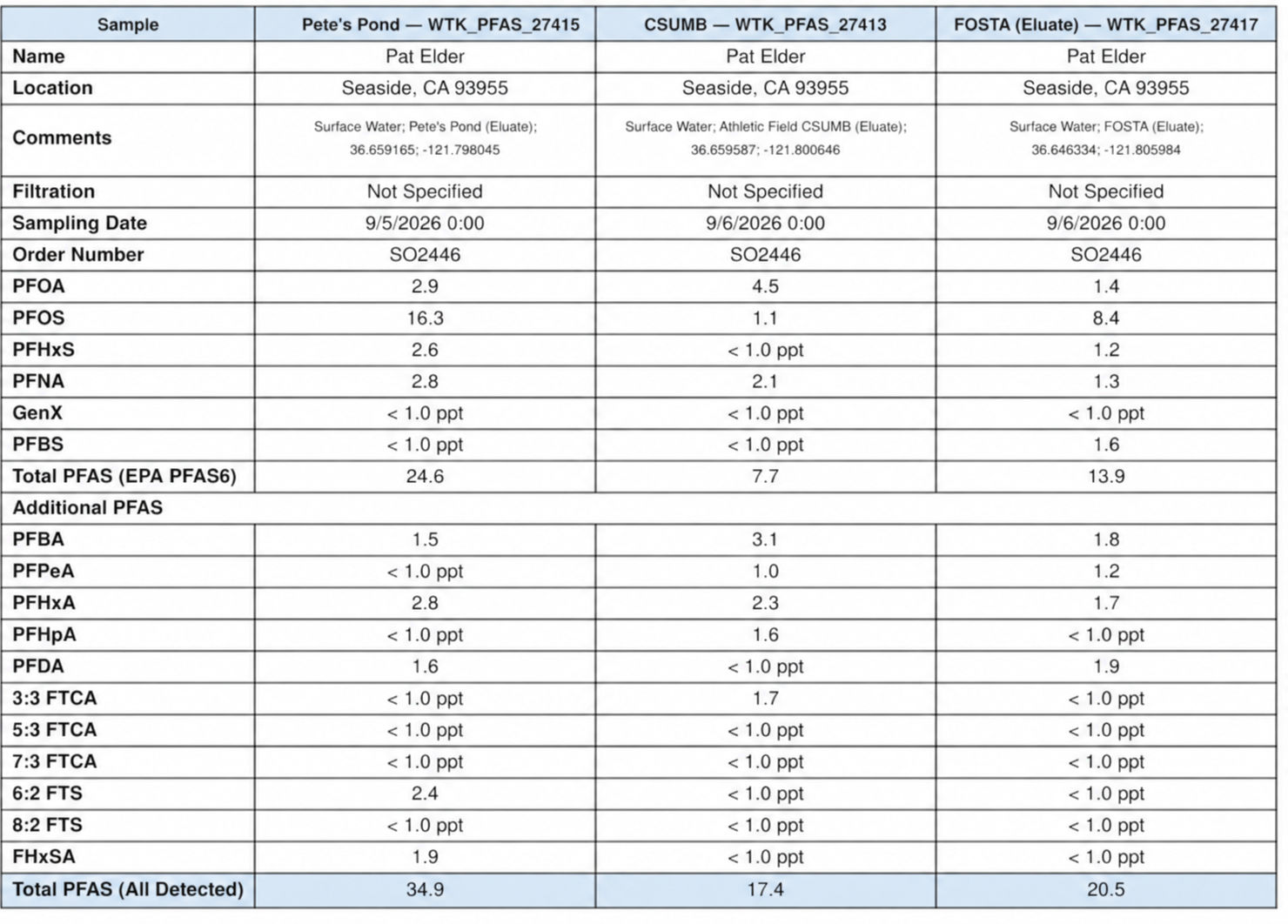
Screening samples found PFAS at the notorious “Pete’s Pond”, south of Eighth Avenue beside Promontory Housing; at the Athletic Field west of Pete’s Pond; and at the former Fort Ord Soil Treatment Area (FOSTA), located between the baseball and soccer fields. These results were from German-method eluate tests. It measures PFAS in liquid leached from the sampled material, not a direct soil concentration.
It should not be misrepresented as proof that people are breathing a stated concentration of PFAS. But it does show that PFAS were present and mobile under the conditions tested, and it warrants a real investigation of surface soil, subsurface soil, dust, stormwater, and groundwater. This concern is sharpened by the 1994 EPA Record of Decision. Section 2.10.
It allowed treated or untreated Fort Ord soil that met the standards of that era and was classified as “inert” to be reused as clean fill, road base, and landfill-cover material. PFAS were not among the contaminants characterized in that reuse scheme. PFAS-contaminated soil was likely spread across large areas of today’s campus. The “inert” classification cannot be used today as evidence that reused soil was free of PFAS. The Army and the agencies that approved reuse did not test for them.
PFAS are not all alike. PFOA, PFOS, PFHxS, PFNA, PFHxA, and fluorotelomer compounds differ in mobility, persistence, and affinity for soil and organic matter. Generally, longer-chain sulfonates such as PFOS and PFHxS tend to bind more strongly to soil, sediment, and organic carbon than shorter-chain acids. Compounds such as PFOA and PFHxA are often more mobile in water. None of this means PFOS or PFOA simply evaporates from soil. The real concern is contaminated soil becoming particulate dust when it is scraped, hauled, graded, or tracked into campus buildings.
That pathway is not speculative in the abstract. ATSDR identifies accidentally swallowing or breathing contaminated soil or dust as important PFAS exposure routes; EPA identifies contaminated soil and dust among the environmental media through which PFAS exposure may occur. NIH likewise recognizes that PFAS can move through water, air, and dust. These agencies say the pathway must be evaluated with site-specific sampling—precisely what has not yet been done at the locations where students live, recreate, and where construction is ongoing. ATSDR
The former Site 10 fire-training area near General Jim Moore Boulevard and Gigling Road presents a separate but related concern. AFFF and fuel-burning training occurred there from 1972 to 1991. The question is not whether a legacy fire-training area should be presumed to have harmed a particular person. The question is why potentially affected soil, groundwater, and dust pathways have not been fully characterized before redevelopment and construction were allowed to proceed.
CSUMB should therefore publicly request and support four immediate actions:
1. Confirm the Otter Student Union water results through repeated, independently validated tap and source-water sampling, with full laboratory reports, detection limits, methods, and results released to the public.
2. Conduct a transparent PFAS investigation at FOSTA, Pete’s Pond, the adjacent athletic field, and Site 10: surface and depth-discrete soil, leachability, settled dust, stormwater, and groundwater. Generate an analyte list of the 40 EPA compounds reported by EPA method 1633.
3. Pause soil-disturbing work throughout the campus and call for the same at the Campus Town/Site 10 area until a site-specific soil-and-dust management plan is public. That plan should include dust suppression, truck decontamination, perimeter monitoring, and worker protection. Appropriate respiratory protection should be mandated for workers.
4. Create a public Fort Ord–CSUMB PFAS dashboard that maps sampling locations, distinguishes official results from independent screening, identifies data gaps, and reports all results—not only PFOA and PFOS.
CSUMB need not declare a public-health emergency to act responsibly. It must acknowledge that a campus built on former Fort Ord cannot rely on a 1994 “inert soil” designation to answer a 2026 PFAS question. The University’s duty is simple: test thoroughly, disclose honestly, and protect the people who learn, work, play, and live here.
Thank you,
Pat Elder, Director,
Military Poisons
St. Mary’s City, MD
"No one lights a lamp and puts it in a cellar or under a basket. Instead, he sets it on a stand, so those who enter can see the light."