PFAS: Denmark Exposes the Gap Between European Science and European Policy
By Pat Elder
June12, 2026
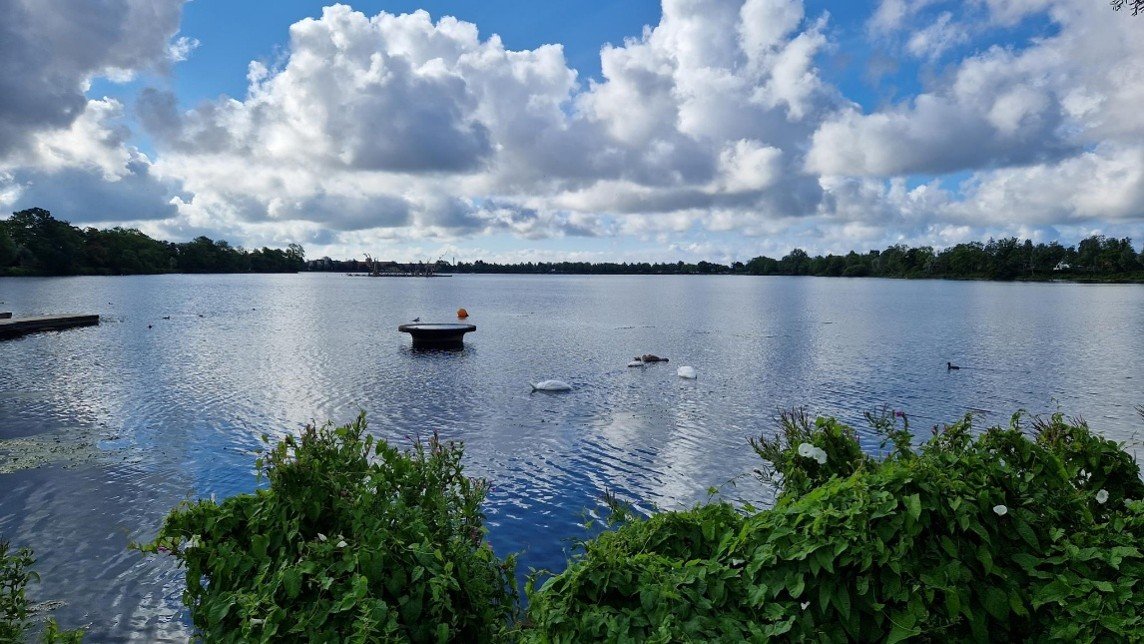
Damhussøen, a large lake in the heart of Copenhagen,
is lovely, but the water and fish are poisoned.
Denmark may possess some of the most extensive PFAS monitoring data in Europe, yet the results from the Forever Pollution Project reveal contamination levels in fish, sewage sludge, and surface waters that challenge the assumptions underlying European PFAS policy itself. Thousands of measurements collected by Danish authorities show that PFAS contamination is not confined to a handful of industrial sites or military installations, although they are leading sources of contamination.
The chemicals appear throughout military, industrial and residential wastewater systems. Urban watersheds, aquatic food webs, and agricultural waste streams are profoundly impacted across the country. The Danish data reveal a simple but troubling reality. PFAS get around. They move through wastewater systems, surface waters, fish, wildlife, sewage sludge, and agricultural landscapes with remarkable efficiency. The picture that emerges is of contaminants that have become embedded in modern society, spreading through environmental systems like a cancer that has metastasized.
The Danish results are alarming. Fish collected from Copenhagen's Damhussøen contained approximately 355,000 nanograms per kilogram of total PFAS. That’s the same as 355,000 parts per trillion. In the absence of fish consumption advisories, many people assume the fish are safe to eat. But the government's silence should not be mistaken for a declaration of safety. At the same time, Denmark and the European Union are working to keep these chemicals below 100 parts per trillion in drinking water.
Sludge, Surface Waters, and Fish
Sewage sludge samples in Denmark reached concentrations exceeding 70,000 nanograms per kilogram (parts per trillion) of total PFAS while Denmark continues to recycle sewage sludge to agricultural land. In contrast, the state of Maine banned the land application of sewage sludge entirely after PFAS contamination from biosolids was shown to cause widespread contamination of milk and eggs. Several U.S. states have now adopted legislation. Michigan allows land application only when combined PFOS/PFOA concentrations are below 20 µg/kg, although many in the scientific community claim this is too high.
The PFAS in sludge poisons soil, crops, farm animals, humans, groundwater, and surface water. The chemicals may never break down, so it is miserable public policy to allow these carcinogens to be spread on agricultural fields. When the rains come, the contaminants act like a giant coffee percolator, creating a witch’s brew of lethal leachate.

Macbeth’s three witches chanting “double double toil and trouble. For a charm of powerful trouble, Like a hell-broth boil and bubble.
Surface waters throughout Denmark show dangerous levels of PFOS that wildly bioaccumulate in plant and animal living tissue. Yet, while the European Food Safety Authority has established a low health-based threshold for PFAS exposure, European Union regulations continue to permit the sale of fish containing PFAS concentrations that exceed the threshold after only a few grams of some fish are consumed. Denmark's data-rich record therefore exposes a question that extends far beyond its borders: are European governments measuring a public-health crisis that existing policies are simply not equipped to address?
Denmark's monitoring network has revealed widespread PFAS contamination, but it fails to provide a complete picture of where contamination originates or how it moves through the environment. The available data provide little insight into military sources, despite decades of military activity at air bases, naval facilities, and training grounds that have recklessly contaminated our world.
The Danish data reveal contamination that should command public attention. Fish collected from Damhussøen contained approximately 311,000 ng/kg PFOS and roughly 355,000 ng/kg total PFAS.
(Let's identify these pesky acronyms. PFAS represent all 40,000 per-and poly fluoroalkyl substances known to exist, while PFOS is an abbreviation for per fluoro octane sulfonate, a particularly deadly PFAS compound.)
A review of publicly available reporting and government communications found no evidence that the astonishing Damhussøen fish results has been reported in the press.
Such concentrations are alarming because PFOS are carcinogenic and fish are typically the leading pathway to human ingestion. According to U.S. EPA research, PFOS concentrations in fish tissue can reach 4,000 times the concentrations found in surrounding water. PFOS levels in the single digits in lakes and streams may therefore produce heavily contaminated fish.
SLUDGE
The top five PFAS sludge concentrations in Denmark based on the Denmark wastewater-treatment-plant dataset used in the Forever Pollution / Le Monde project.
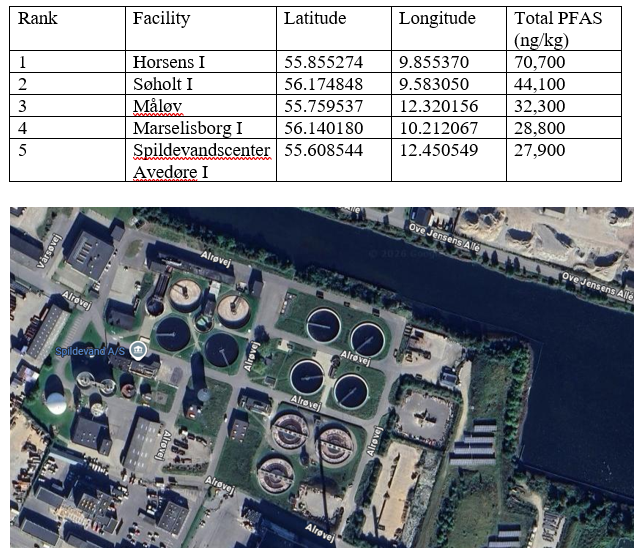
Photo - Horsens Central Wastewater Treatment Plant, (Horsens Centralrenseanlæg)
Four of the five highest concentrations in Denmark were associated with large urban wastewater systems serving major population centers.
Sewage sludge can be transported long distances by truck or ship before land application. The location of a wastewater treatment plant, therefore, does not indicate where PFAS-contaminated biosolids are ultimately spread.
The location of the plant does not reveal the military bases, airports, or industrial sources responsible for initially introducing PFAS into the sewer system.
The Le Monde/Forever Pollution data reveal that PFAS contamination in Danish sewage sludge is widespread and, in many locations, extraordinarily high. Analysis of the Danish wastewater-treatment-plant dataset identified several sludge samples containing tens of thousands of nanograms per kilogram of total PFAS.
Sewage sludge serves as a major reservoir for PFAS collected from households, industry, commercial activities, and urban runoff. The sludge data also demonstrate that PFAS contamination is not limited to a handful of military and industrial locations but is distributed across wastewater systems throughout the country.
Because Denmark has historically recycled sewage sludge to agricultural land, these findings raise important questions about the long-term movement of PFAS from wastewater systems into soils and drainage waters.
SURFACE WATER - Top 5 PFAS Surface Water Sites in Denmark
Highest reported total PFAS concentrations in surface water samples from the Denmark EPA dataset.
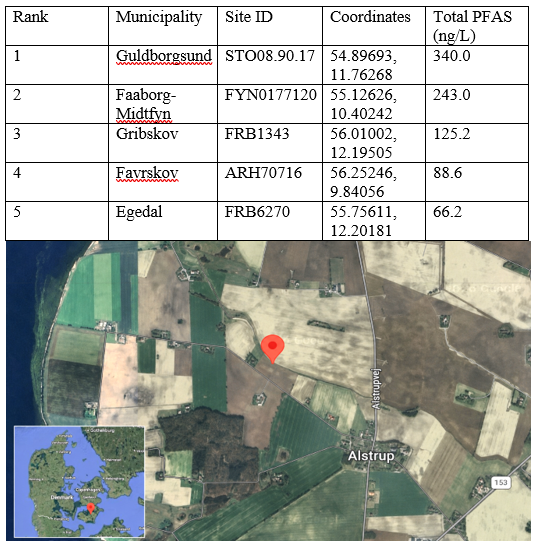
Given the rural setting and the apparent absence of industrial or military activity, the contamination near Alstrup (Guldborgsund) may be more consistent with historical sewage sludge application or other wastewater-derived sources that have dispersed PFAS across agricultural land.
At first glance, PFAS concentrations in surface waters may seem modest when compared to the extraordinarily high concentrations found in sewage sludge, where levels can be several orders of magnitude greater than those measured in streams, rivers, and lakes. Yet these findings are highly significant because PFAS, particularly PFOS, can accumulate dramatically in aquatic food webs. The U.S. Environmental Protection Agency has reported bioaccumulation factors for PFOS in fish of up to 4,000 times the concentrations measured in surrounding water.
Because PFAS are highly persistent and continuously transported through rivers, lakes, and coastal waters, contamination that appears modest in the water column can ultimately result in substantial concentrations in aquatic, terrestrial, and human life.
BIOTA
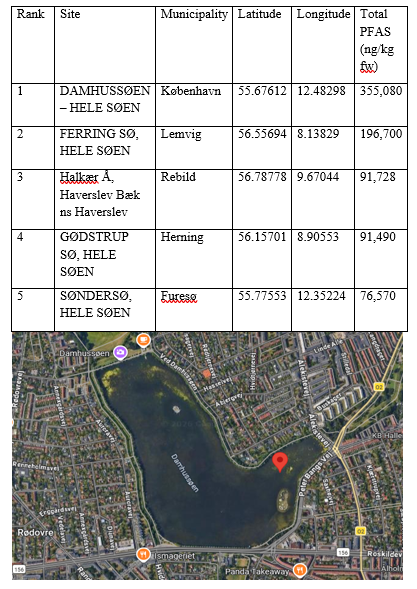
Top Five PFAS Biota Concentrations in Denmark
The highest PFAS concentrations in Danish biota were recorded in samples collected from lakes and stream systems.
The most contaminated sample was collected from Damhussøen in Copenhagen, where total PFAS concentrations reached 355,080 ng/kg fresh weight, including approximately 311,000 ng/kg of PFOS alone.
Although the PFAS Data Hub classifies these samples only as 'biota,' the reporting units, monitoring locations, and PFAS profiles strongly suggest that many represent fish collected under Denmark's national environmental monitoring program.
The absence of species information in the publicly available dataset limits interpretation because PFAS accumulation can vary substantially among fish species, shellfish, and aquatic invertebrates.

The European Food Safety Authority (EFSA) is the European Union's independent scientific agency responsible for assessing risks related to food, animal feed, nutrition, animal health, and environmental contaminants. The agency has developed guidelines for PFAS consumption.
The EFSA’s “tolerable weekly intake” is 4.4 nanograms per kilogram of body weight per week for the sum of PFOS, PFOA, PFNA, and PFHxS. Increasing numbers of scientists argue that no levels of PFAS are safe because the carcinogens bioaccumulate in our bodies. The EFSA’s tolerable weekly intake is a scientific health benchmark, not a legal limit.

.
Damhussøen Fishing in Denmark is a nationally supported Danish fishing portal that publishes fishing regulations and site-specific guidance.
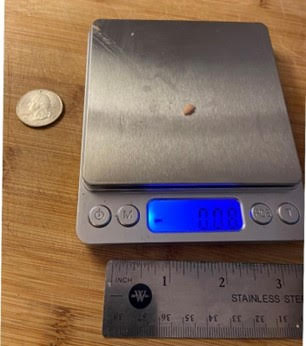
How much PFOS is in this tiny piece of contaminated fish?
The piece of fish shown on the scale weighs 0.08 grams.
Fish from Damhussøen have been reported to contain 311,000 nanograms per kilogram (ng/kg) of PFOS.
That is the same as 311 ng PFOS per gram of fish.
Therefore, the tiny piece of fish shown here contains approximately 25 nanograms of PFOS. (311 ng/g × 0.08 g = 24.88 ng PFOS)
EFSA’s Tolerable Weekly Intake = 4.4 ng/kg body weight/week
Child's weight = 25 kg
Child’s weekly intake = 4.4 × 25 = 110 ng/week
PFOS in fish piece = 24.88 ng
24.88 ÷ 110 = 0.2262
The 25 nanograms of PFOS in the tiny piece of Damhussøen fish represents approximately 23% of EFSA's recommended maximum weekly intake for a 25-kilogram child. The child could consume four of these tiny pieces a week.
Now, let’s consider a meal
A typical serving of fish weighs about 200 grams.
A 200-gram serving of Damhussøen fish would contain approximately 62,200 nanograms of PFOS.(311 ng/g × 200 g = 62,200 ng)
For a 25-kilogram child, that is about 191 times EFSA's recommended weekly intake. (62,200 ng ÷ 325 ng = 191)
"Bon appétit!"
The concern is not that a child becomes sick after eating a single meal. Rather, the concern is that PFOS accumulates in the body over time. Prenatal and childhood exposures have been linked to reduced vaccine effectiveness, impaired immune function, behavioral problems, elevated cholesterol, and developmental effects. Scientists have found that even very low levels of PFOS in the blood affect children's health, which is why European regulators established the threshold in the first place.
EFSA does not regulate food. It provides scientific advice to the European Commission and member states. The tolerable weekly intake is essentially a warning threshold developed by toxicologists and epidemiologists. Exceeding it does not trigger a fine or make a fish illegal to eat. Instead, it indicates a level of exposure that EFSA believes may pose health concerns, particularly over a lifetime,
There are no obvious virtual public records of specific, prominent Danish public fish advisories for Damhussøen and other bodies of water comparable to the advisories commonly issued by U.S. states around military bases. Denmark has focused more on environmental monitoring rather than fish consumption bans or advisories.
Europe's leading scientific health benchmark for PFOS exposure
Commission Regulation (EU) 2023/915 on food contaminants sets maximum concentrations for high-profile PFAS in food. The limits apply to four compounds: PFOS, PFOA, PFNA, and PFHxS.
These ten PFAS are frequently found in fish. Their combined total may exceed that of the four EU-regulated compounds: PFUnDA, PFDA, PFTrDA, PFDoDA, PFHpS, PFDS, PFPeS, PFBS, 6:2 FTS, FOSA
See Table 1 below. If higher concentrations are discovered in laboratory tests, the product must be removed from the market.
We already saw that the EFSA says a 25-kg child should not exceed 110 nanograms per week from these four PFAS combined.
Now, let’s look at the Commission's legal maximum for perch, whitefish, char, eel, roach, smelt, etc.:
45 µg/kg (sum of the four PFAS).
Convert that to nanograms: (or ng/g)
A fish at the legal limit would therefore contain 45 ng PFAS per gram of fish.
How much fish would a 25-kg child need to eat to reach EFSA's weekly limit?
110 ng ÷ 45 ng/g = 2.4 grams of fish.
In other words:
A perch or whitefish containing PFAS at the maximum concentration allowed under EU food law would cause a 25-kg child to reach EFSA's entire weekly intake after eating only about 2.4 grams of fish.
That's less than a bite.
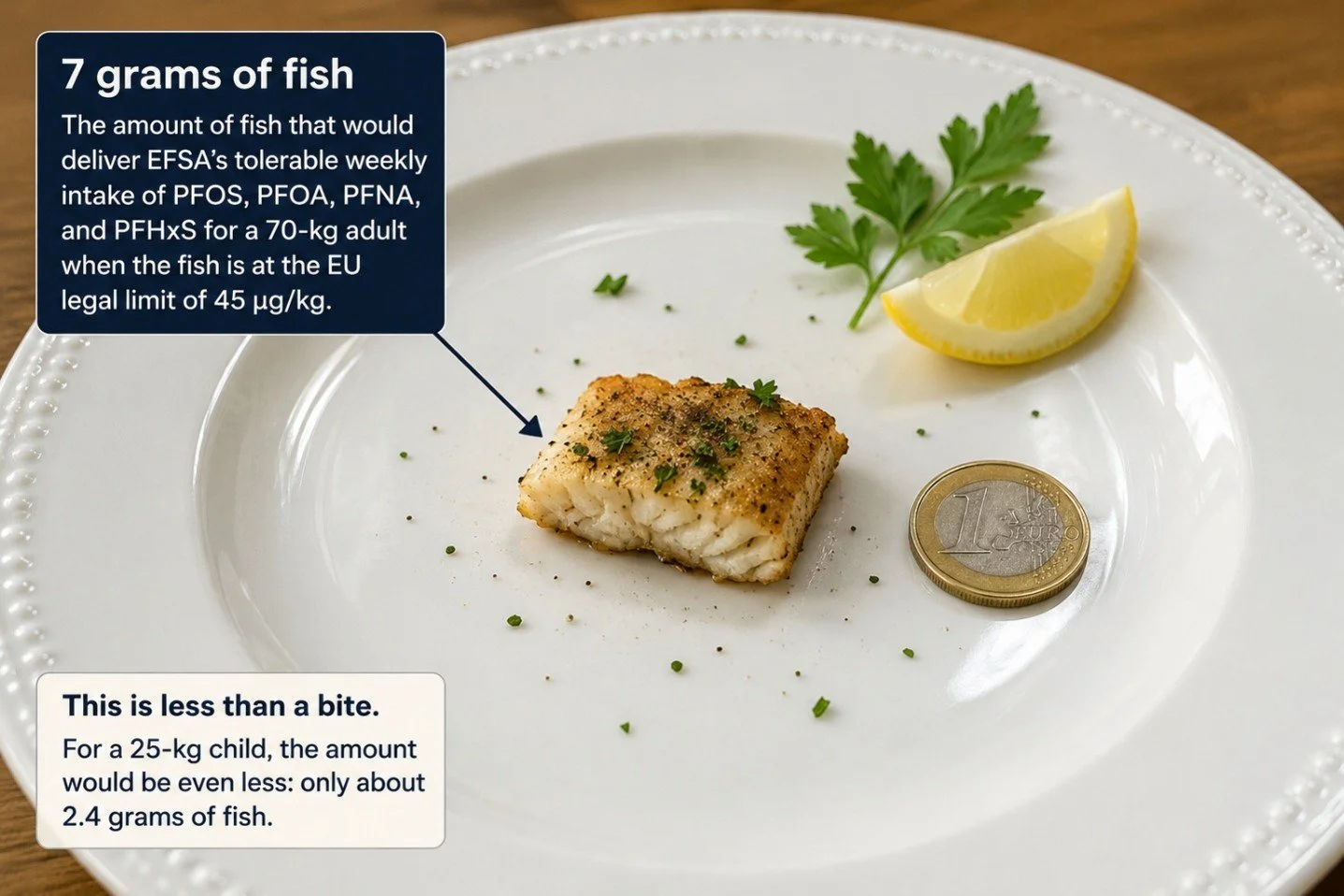
For a 70-kg adult: 4.4 × 70 =3 08 ng/week
308 ÷ 45 = 6.8 g
An adult would reach EFSA's weekly intake after eating only about 7 grams of fish at the legal limit.
Again, that's a tiny amount of fish.
It’s time for Europe to wake up to the nightmare of PFAS. The EFSA reports that for PFOS and PFOA, "Fish and other seafood" was the most important contributor to dietary exposure. EFSA's 2018 assessment estimated that up to 86% of dietary PFAS exposure from food came from "fish and other seafood."
According to EPA research, PFOS concentrations in fish tissue can reach thousands of times the concentrations found in surrounding water. Even relatively modest PFOS levels in lakes and streams may therefore produce heavily contaminated fish.
The sludge data are equally troubling. The highest concentration identified in the Danish dataset occurred in Horsens, where sewage sludge contained approximately 70,700 ng/kg total PFAS, including about 67,000 ng/kg PFOS. The median sludge concentration in the Danish data is approximately 24,900 ng/kg total PFAS, indicating that elevated contamination is not confined to a handful of isolated locations. Because sewage sludge has historically been spread on agricultural land, PFAS contained in sludge may migrate into soils, crops, groundwater, drainage systems, and nearby surface waters.
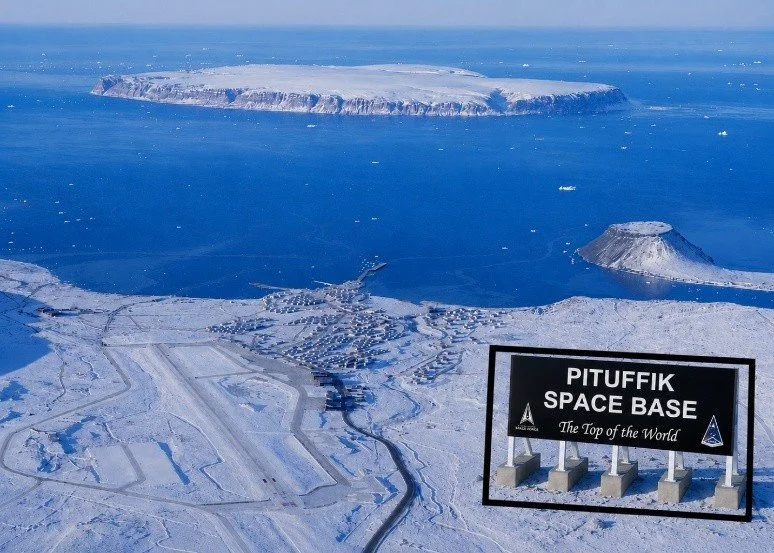
Denmark's extensive monitoring effort raises an obvious question: if so much attention has been devoted to PFAS elsewhere, what do we know about Greenland? Coming up in Part 2.