
Maryland county allows dense development over fire training area
By Pat Elder
June 16, 2026
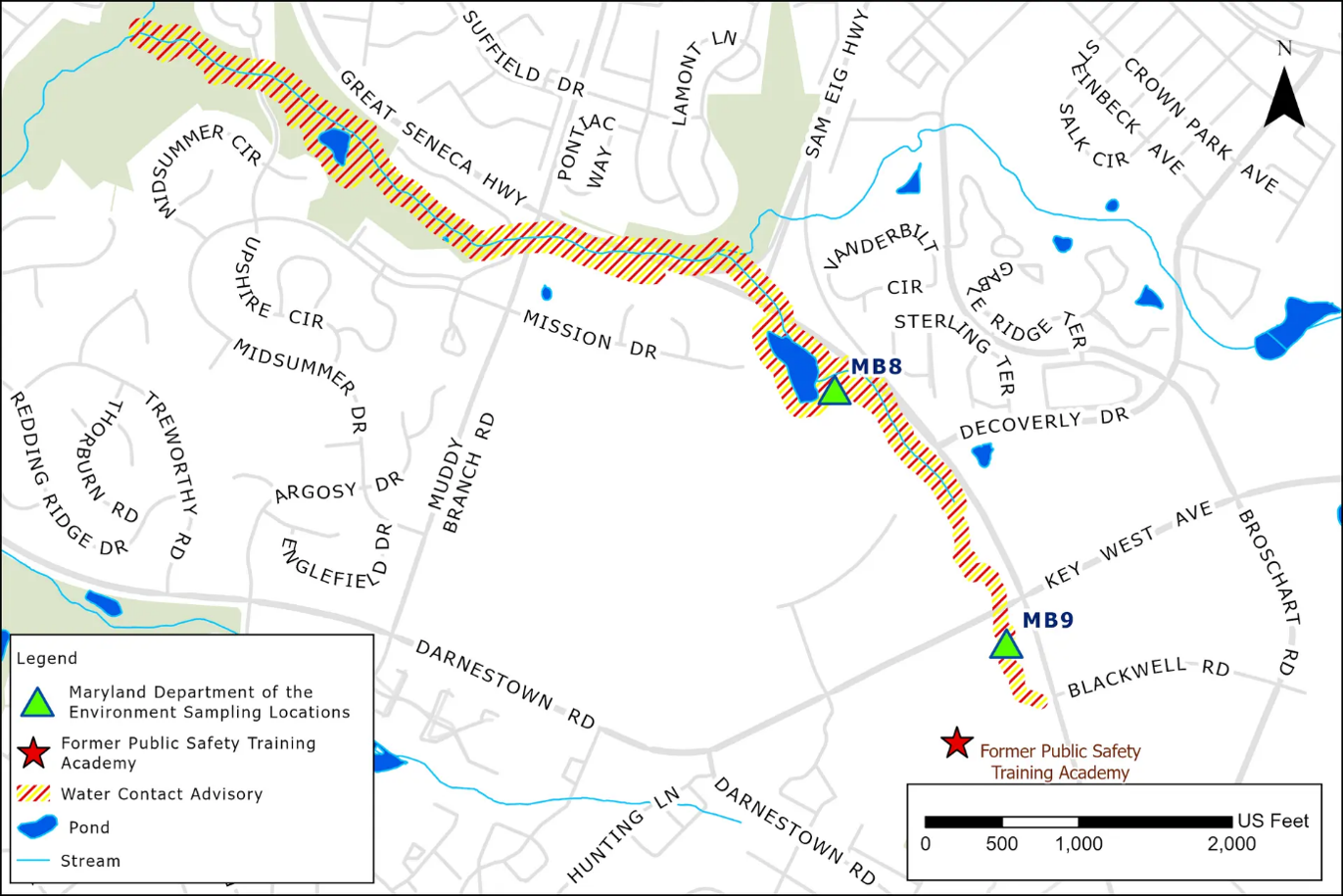
This map shows PFAS contamination in surface waters downstream of the former Montgomery County Public Safety Training Academy in Rockville, Maryland, where firefighting foams containing PFAS were historically used during training exercises. The striped corridor marks the Maryland water-contact advisory area along Muddy Branch Creek, while sampling locations MB8 and MB9 document contamination extending through a residential watershed near the former training grounds.
NBC4 Washington recently reported that PFAS contamination has been discovered in a creek and pond system near the former Montgomery County Public Safety Training Academy in Rockville. The report included a map showing contaminated surface waters, sampling locations, and a water-contact advisory area. The contamination has been traced to historical firefighting activities at the former academy, where firefighting foams containing PFAS were used during training exercises for decades.
Maryland maintains a statewide firefighter training network through the Maryland Fire and Rescue Institute (MFRI), which operates six regional training centers serving every part of the state. In addition to these state-supported facilities, many counties operate their own fire academies and public safety training centers, including facilities in Montgomery, Carroll, Anne Arundel, Baltimore, Howard, Prince George's, and Washington counties. These facilities have trained generations of firefighters and emergency responders, often using live-fire exercises and, historically, firefighting foams containing PFAS.
Dozens of firefighter training grounds, burn pits, foam-training areas, airport fire-training facilities, and military fire-training sites have operated throughout Maryland over the last fifty years. These facilities routinely discharged aqueous film-forming foam (AFFF), the same PFAS-laden foam responsible for widespread contamination at military bases throughout the state.
Military Poisons has documented PFAS contamination at Aberdeen Proving Ground, Joint Base Andrews, Fort Meade, Fort Detrick, Naval Air Station Patuxent River, Webster Field, the Naval Research Laboratory Chesapeake Bay Detachment, Forest Glen Annex, and several former military facilities throughout Maryland. At the same time, the organization has repeatedly warned that firefighter training academies, airports, and other non-military facilities have also created contamination patterns similar to those found on military bases.
The Maryland Department of the Environment has been reluctant to investigate, publicize, regulate, or clean up any of this. Maryland is behind many states in this regard.
Mongomery County planning documents provide disturbing details.
The former Montgomery County Public Safety Training Academy property consisted of approximately 44.84 acres at 9710 Great Seneca Highway in Rockville, Montgomery County, approved the disposition of essentially the entire site for private redevelopment as "The Elms at PSTA," (Public Safety Training Academy) a project containing roughly 630 residential units plus retail and open space. The academy closed in 2016, and the county subsequently sold or agreed to sell the property to the developer.
Montgomery County still owns land immediately adjacent to the former academy. Planning documents identify a 6.25-acre county-owned parcel south of the redevelopment site, currently occupied by the County Innovation Incubator and the National Cybersecurity Center of Excellence. The county also retained and received additional land associated with a potential future school site (Parcel V), which planning documents describe as approximately 6.5 acres.
Hundreds of homes are being built on property that served as Montgomery County's primary police and firefighter training facility for roughly forty years. The question that now demands an answer is whether Montgomery County or MDE investigated the property for PFAS contamination associated with historical firefighting activities before approving the redevelopment.

Given the well-established association between firefighter training facilities and PFAS contamination, it is difficult to understand how a comprehensive PFAS investigation was not publicly discussed before the site was approved for redevelopment. Firefighter training centers have been recognized nationwide as major PFAS source areas for years.
The planning documents note that a stream and approximately 3.35 acres of stream buffer run through the eastern portion of the former academy property and drain toward Muddy Branch.
The Maryland Department of the Environment recommends that all private well owners, regardless of location, have their well water tested at least once a year to ensure that their water is safe to drink and to include PFAS in that testing. The agency ought to be identifying well owners much further away and it ought to be providing these services. They dropped the ball.
It is important that the public be provided with the analytical results for each PFAS compound detected in the creek, pond, groundwater, and air. This is precisely the type of information the Maryland Department of the Environment has been hesitant to release at other severely contaminated PFAS sites around the state.
Although most PFAS compounds are not volatile, several compounds, especially PFOS, which is likely to dominate the chemical signature here, can attach to soil particles and become airborne. The carcinogens saturate the banks of the creek. When the water recedes, the toxins dry in the sun and are lifted by the wind into our lungs and into our homes as dust. The dust is a major PFAS pathway to small children. People living nearby should have their houses tested and they should change their air conditioner filters regularly. Sweeping and vacuuming ought to be traded for wet-mopping.
Since 2019, I have been writing about Maryland’s PFAS contamination associated with firefighter training activities. In 2021, when elevated PFAS levels were discovered in drinking water wells serving Westminster and Hampstead, I publicly questioned whether the Carroll County Public Fire Training Center was contributing to the contamination. At the time, I argued that Maryland should move beyond testing drinking water wells and begin identifying actual contamination sources through groundwater and surface-water investigations. My concern was that firefighter training facilities had used PFAS-containing foams for decades and were being overlooked as potential contributors to contamination. I sent all of my work to the Maryland Department of the Environment. They know the score.
The analytical data collected from Muddy Branch are essential for a host of reasons, but mostly because PFAS compounds can accumulate in fish. The EPA has reported that PFOS may bioaccumulate in fish up to 4,000 times the amount in the water. Streams and retention ponds near firefighter training facilities have been documented with PFOS concentrations in the hundreds and thousands of parts per trillion. Under such conditions, fish may contain PFAS concentrations in the hundreds of thousands or even millions of parts per trillion. One fish outside a fire training area in Michigan had 10 million parts per trillion in its filet.
The county health department must strive to identify those who have consumed fish from these waters. The county should also offer blood testing to individuals who may have been exposed to PFAS through consumption of the fish. The state will not do it.
The National Academies of Sciences, Engineering, and Medicine has established guidance for PFAS blood levels and recommends clinical follow-up for individuals with more than 2 parts per billion of seven different PFAS compounds. Residents should not be forced to pay out of pocket to determine whether they have been exposed to chemicals released from a government-operated facility. But, government agencies may balk at the idea, so If people living in these nice new homes ought to know a PFAS skin prick test is available for $279 from Empower DX.
We must demand complete transparency. The state and the county should release the full analytical results for every PFAS compound detected at each sampling location, including surface water, groundwater, sediment, fish tissue, and any other environmental samples collected during the investigation. The public cannot adequately assess the risks posed by this contamination without access to the underlying data.
The contamination discovered near the former Montgomery County Public Safety Training Academy is not an isolated incident. It is the predictable consequence of decades of PFAS use at firefighter training facilities throughout Maryland. The question is no longer whether these facilities contaminated groundwater, streams, ponds, fish, and nearby communities. The question is how many sites remain uninvestigated, how many people have been exposed, and why state regulators failed to act sooner despite years of warnings.
——————————
I’ve written 80 articles on PFAS contamination emanating from fire training areas in Maryland. Here are two:
Bad News for Westminster (MD) and the Surrounding Region – February 2, 2021
Here, I identified the Carroll County Public Fire Training Center as a potential PFAS source and asked, "Where's the PFAS coming from in Westminster?"
https://patelder.weebly.com/westminster-md--pfas.html?utm_source=
——————————————————
Small Naval Facility in Southern Maryland Causes Massive PFAS Contamination - April 15, 2021
This article connected extremely high PFAS concentrations to a naval fire station and historical firefighting foam use.