
Data now shows PFAS nearly 3 times the levels reported by local media
By Pat Elder
June 24, 2026
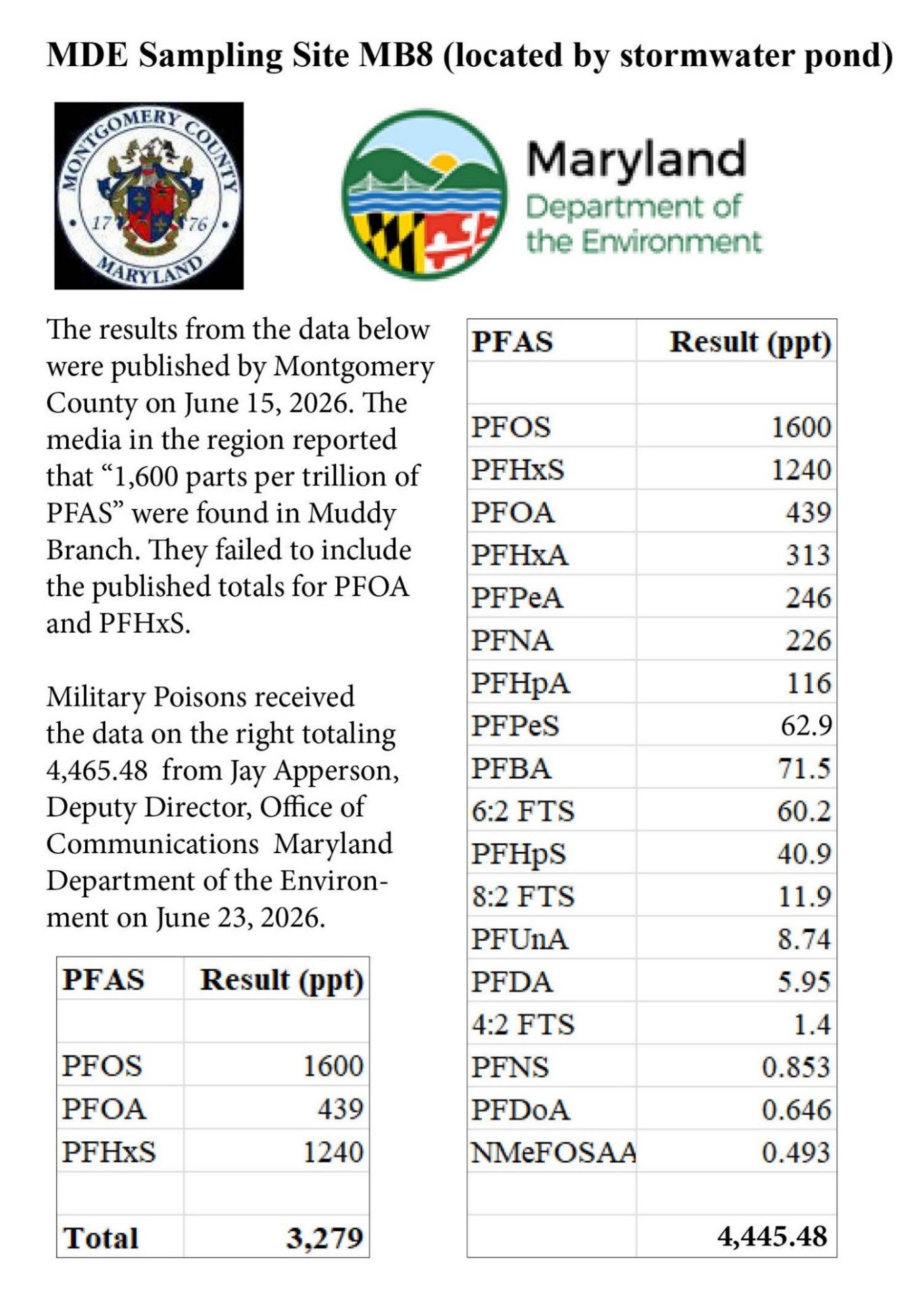
The Maryland Department of the Environment, (MDE) just released data for 18 separate PFAS compounds from Muddy Branch in Rockville, Maryland.
The newly released results from sampling location “Muddy Branch 8” near the stormwater pond show a total PFAS concentration of 4,465ppt. PFOS accounted for just over one-third of the PFAS detected at MB8, while the remaining 2,865 ppt consists of other PFAS compounds were not initially reported.
The findings suggest that a complex mixture of PFAS continues to migrate from the former training facility into surrounding surface waters.
The MDE did not detect 22 compounds and that is to be expected. They used an EPA method that returns results for 40 separate compounds. Prior results published by Montgomery County showed data for only three PFAS compounds.
The new data from MDE came in two separate PDFs. See Muddy Branch Sampling Results and Second Phase Muddy Branch Sampling Results.
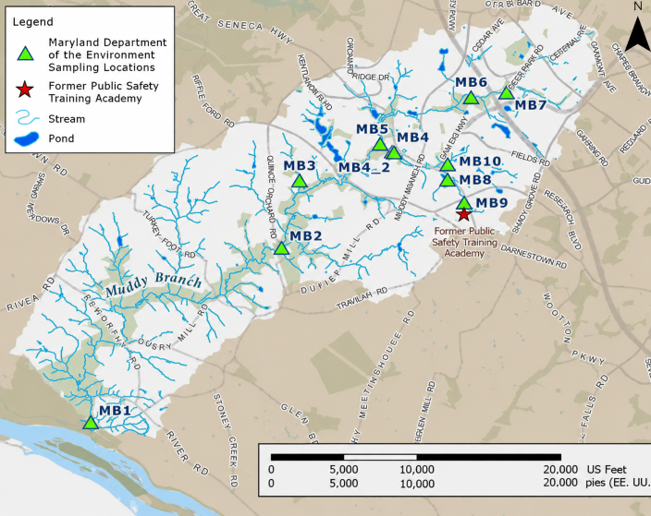
4,445 parts per trillion (ppt) total PFAS was reported at MB8, near the source of the contamination, with 61.1 total ppt draining into the Potomac River at MB 1.
PFAS contamination is highly complex because individual compounds behave differently in the environment. Some readily bind to vegetation, sediments, or organic matter, while others remain in water and migrate extremely long distances. Certain PFAS accumulate in aquatic invertebrates, while others are more readily transferred into fish and other wildlife. Some compounds concentrate near the bottom of streams and ponds, while others remain distributed throughout the water column. PFHxS, for example, is highly mobile and can travel considerable distances in groundwater and surface water, whereas other compounds exhibit a stronger tendency to sorb to soils and sediments. Understanding these differences is essential for predicting how contamination moves through ecosystems and ultimately reaches fish, wildlife, and people.
Scroll up to the map to make sense of this.
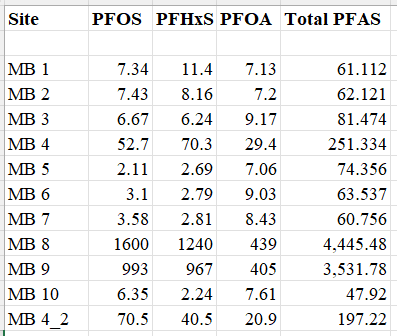
MB1 is located on Muddy Branch by the Potomac River. The concentrations are worrisome because the compounds bioaccumulate in fish. The EPA estimates that PFOS alone can bioaccumulate up to 4,000 in the filet of fish compared to the levels in the water. Smallmouth Bass have been detected with 574,000 ppt of PFOS where Antietam Creek empties into the river. The MDE has reported PFOS concentrations of 94,200 ppt in Largemouth Bass. At the same time, Maryland regulates PFOS in drinking water at 4 ppt.
Sites MB2, MB3, MB5, MB6, MB 7 are located on Muddy Branch. The contamination at these sites ranged from 62 ppt to 81 ppt.
Site MB4 is located on a small stream. Notice its heightened concentration of 251 ppt of PFAS compared to the other sites directly on the creek. This may be evidence of the “carcinogenic sponge” that perpetually squeezes out PFAS into surface water from groundwater plumes. Isn’t it interesting?
Site MB4_2 is also located on a small stream, and its concentration is elevated compared to nearby concentrations in the creek.
Site MB9, with its massive concentrations, is also located on a small stream.
Site MB8 is located by the stormwater pond, a kind of grand central station. During storms, rain infiltrates contaminated soils. PFAS dissolved in pore water are flushed into drainage channels and the pond.
MB10 is located on a small stream north of Great Seneca Highway and recorded the lowest PFAS concentrations among all samples. The location may lie outside the principal PFAS migration pathway from the former fire-training area. It’s a guessing game without substantially more testing. MB10 may be influenced by cleaner upstream flows and may receive less PFAS-laden pore water, stormwater runoff, and groundwater discharge from the source area.

The chemical fingerprint in Muddy Branch is strongly consistent with historical AFFF contamination. PFOS (1,600 ppt) and PFHxS (1,240 ppt) together account for approximately 64 percent of the total PFAS detected at Site MB8. The prominence of PFHxS is especially important because the compound is highly persistent, highly mobile in water, and often travels farther from contamination sources than PFOS. We can see this clearly in the Muddy Branch data. Although PFOS topped PFHxS at the source, PFHxS is the dominant compound at MB1 where the contaminants enter the Potomac.
The dominance of PFOS and PFHxS is also characteristic of legacy 3M firefighting foams manufactured using electrochemical fluorination technology, formulations that were widely used for firefighting training and emergency response throughout Maryland for decades. In addition to PFOS and PFHxS, the sample contained elevated concentrations of PFOA, PFNA, PFHxA, PFPeA, and other terminal PFAS that are unlikely to break down further in the environment. Taken together, the results indicate that Muddy Branch is receiving not a single contaminant, but a substantial and highly persistent mixture of PFAS compounds consistent with long-term use of 3M-style AFFF at the former training academy.
Equally noteworthy is what was not found. The laboratory did not detect GenX, ADONA, or other compounds typically associated with fluoropolymer manufacturing and modern industrial chemical production. Instead, the chemical profile is overwhelmingly consistent with contamination originating from historical aqueous film-forming foam (AFFF).
The newly released laboratory data provide one of the clearest indications yet of the extent and composition of PFAS contamination in Muddy Branch. Most importantly, the results demonstrate why comprehensive PFAS testing matters. Had public discussion remained focused solely on “PFAS at 1,600 ppt,” the majority of the contamination burden would have remained obscured. The difference between 1,600 ppt and 4,465 ppt is not a minor technical detail. It fundamentally changes the public's understanding of the magnitude, complexity, and persistence of PFAS contamination in the Muddy Branch watershed.