How one contaminated stream exposed Maryland's failure to investigate PFAS pollution from fire training facilities.
By Pat Elder
June 26, 2026
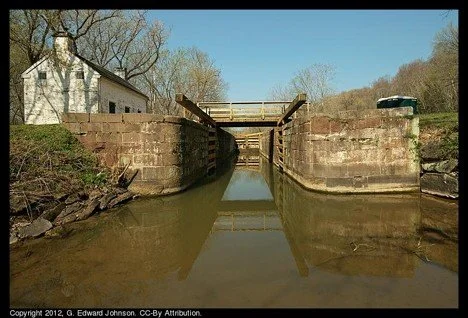
PFAS-contaminated water from the old Montgomery County Fire and Rescue Training Academy in Rockville flows nine miles downstream through Muddy Branch before entering the Potomac River immediately adjacent to Pennyfield Lock (Lock 22) on the C&O Canal, shown here.
Muddy Branch Exposed a Statewide Failure to Investigate PFAS Contamination from Fire Training Facilities across Maryland.
The “discovery” of severe PFAS contamination in Muddy Branch was entirely predictable. The former Montgomery County Public Safety Training Academy used carcinogenic firefighting foams for 40 years. The training academy had direct hydrologic connections to nearby streams and stormwater ponds.
Across Maryland, there are well over a hundred locations like Muddy Branch where firefighting foams containing PFAS were historically used. These sites include military bases, civilian airports, municipal fire stations, and firefighter training grounds. These locations are expected to have contaminated nearby surface waters, groundwater, sediment, fish, and wildlife in much the same way that we are witnessing the contamination unfold in Muddy Branch.
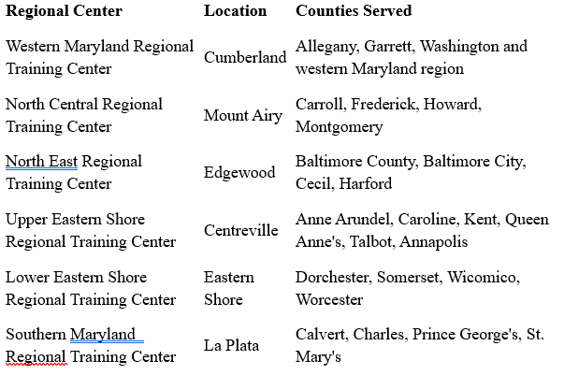
The Maryland Department of the Environment (MDE) has not publicly acknowledged the likely PFAS contamination associated with the Maryland Fire and Rescue Institute (MFRI) regional fire training centers across the state, despite the well-established history of aqueous film-forming foam (AFFF) use at fire training facilities across the staate and nationwide. ‘
The regional training centers are listed here.
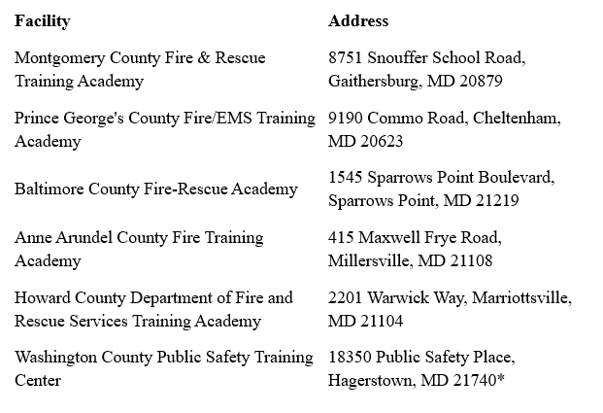
Similarly, the MDE has ignored the contamination flowing from the county-owned and operated fire training facilities statewide, at these locations.
The old Montgomery County Public Safety Training Academy was located at the intersection of Great Seneca Highway and Darnestown Road, immediately adjacent to the Muddy Branch watershed. It closed in 2016 when operations moved to the new academy at 8751 Snouffer School Road.
The Montgomery County Public Safety Training Academy at 8751 Snouffer School Road contains multiple live-fire training structures where Class B AFFF was likely used for flammable-liquid fire training before Maryland prohibited such training uses in 2021. Because the academy is situated immediately adjacent to the Cabin Branch watershed, PFAS released during historical training activities would be expected to migrate through stormwater runoff and shallow groundwater into nearby Cabin Branch. PFAS in the watershed may ultimately reach the Potomac River at Riley's Lock, about 16 miles away.
Maryland has not undertaken a systematic statewide investigation of either the Maryland Fire and Rescue Institute's regional training centers or county-operated fire training academies, despite decades of PFAS-containing firefighting foam use and the recognition of fire training areas as high-priority PFAS source areas nationwide.
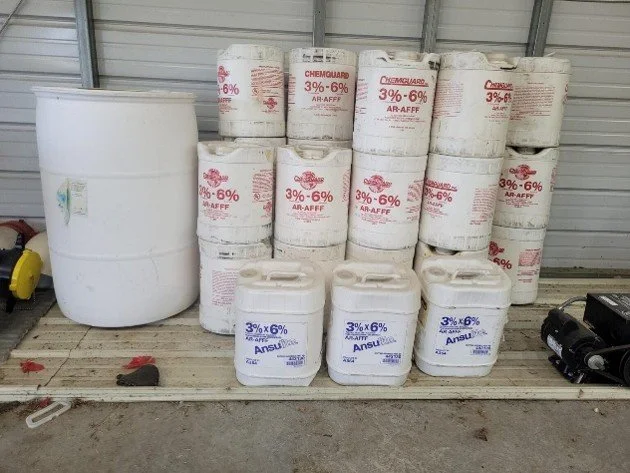
PFAS-containing firefighting foam sits in a storage area at the Mechanicsville Volunteer Fire Department in St. Mary’s County, MD. (Photo Courtesy of Joseph Guyther) Maryland Matters
Maryland also has hundreds of municipal and volunteer fire stations. Most are believed to have historically stored and used Class B aqueous film-forming foam (AFFF) for vehicle fires, fuel spills, aircraft incidents, and training. While most are not "training academies," they may represent a much larger number of potential PFAS source areas than the academies themselves.
Firetrucks were commonly equipped with AFFF storage tanks, proportioning systems, hoses, and foam nozzles that required routine operational testing. These activities often involved discharging foam onto designated testing pads, training grounds, gravel lots, or other outdoor areas. In addition to emergency responses and firefighter training exercises, decades of routine nozzle testing, system flushing, and accidental releases likely resulted in repeated PFAS discharges at fire stations throughout Maryland. These testing locations have never been investigated and may be heavily contaminated, particularly where runoff flowed into storm drains, ditches, streams, ponds, or groundwater recharge areas.
Airports and Military Bases
The MDE ought to be investigating all major airport and military firefighting training areas.
The Department of Defense has already identified numerous Maryland installations where AFFF was used during emergencies, testing, or routine training.
Here’s a list of military sites that the DOD has identified as having used AFFF during emergencies and routine practice.
Army
Aberdeen Proving Ground
Adelphi Laboratory Center
Fort Detrick
Fort Detrick - Forest Glen
Fort Meade – BRAC
Fort Meade – Active
Fort Meade – Phoenix
Phillips Army Airfield
Weide AASF
Navy
Annapolis Naval Academy
Annapolis Surface Weapons Center BRAC
NSWC Carderock – West Bethesda Campus
Bainbridge
Naval Research Laboratory Chesapeake Bay Detachment
Indian Head Naval Surface Weapons Center
Patuxent River Naval Air Station
Solomons Naval Recreation Center
Webster Field Annex – Patuxent River NAS
Walter Reed National Military Medical Center
White Oak- NSWC Dahlgren DIV
Air Force
Joint Base Andrews
National Guard Martin State
Maryland Airports
Aside from the clearly documented use of AFFF during fire training at Baltimore/Washington International Thurgood Marshall Airport in Baltimore over the years, Maryland’s regional Airports have likely trained with the toxic foams.
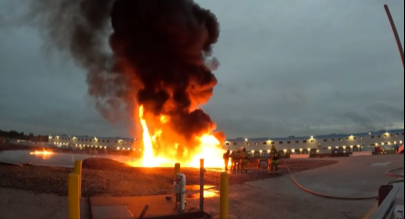
Baltimore Washington International Airport participates in annual Aircraft Rescue and Fire Fighting recertification training. The foams used to douse this recent blaze likely cccontained fluorine-free foams, but decades of practice likely involved the deadly foams. - IAFF Local 1742
Regional Airports that likely used the toxic foams
Martin State Airport
Wicomico Regional Airport
Hagerstown Regional Airport
Greater Cumberland Regional Airport
Frederick Municipal Airport
St. Mary's County Regional Airport
Easton Airport
Cambridge–Dorchester Regional Airport
Carroll County Regional Airport
Garrett County Airport
Montgomery County Airpark
Ocean City Municipal Airport
Bay Bridge Airport
Crisfield–Somerset County Airport
Tipton Airport
MDE’s botched “take-back” program
The MDE also dropped the ball in implementing the PFAS “take-back” program that the General Assembly had ordered and funded in 2022. Maryland banned PFAS-containing firefighting foam in 2022 and directed MDE to establish a program to collect and dispose of legacy AFFF.
The department received $500,000, a tiny amount in state funding, to carry out that mandate, yet by May 2026—roughly four years after passage of the law—fire departments across Maryland were still storing drums and containers of banned foam in closets, storage rooms, and apparatus bays while awaiting state action.
MDE's delay in implementing the state's AFFF take-back program created more than a bureaucratic problem. For years after Maryland banned PFAS-containing firefighting foam, thousands of gallons of the material remained stored at firehouses throughout the state. These stockpiles were often kept in plastic containers, storage rooms, apparatus bays, and outdoor locations vulnerable to weather, flooding, punctures, equipment failures, and accidental releases. The continued storage of large quantities of AFFF at hundreds of fire stations increases the likelihood of additional PFAS contamination events long after the state had recognized the hazards posed by the foam. Rather than promptly removing and securely disposing of the material, Maryland allowed it to remain scattered across local communities while the state struggled to establish the take-back program required by law.
The state’s unwillingness to dispose of legacy PFAS-containing firefighting foam raises questions not only about environmental risk but also about cost. Maine's Department of Environmental Protection recently estimated that approximately 50,000 gallons of aqueous film-forming foam (AFFF) remain available for collection across that state. Using a planning estimate of roughly $100 per gallon—derived from New Hampshire's statewide program, Maine projected that collection and disposal alone could cost at least $5 million. In the meantime, MDE recommends facilities “properly” store PFAS-containing Class-B foams, while regularly monitoring for storage system leaks and maintenance needs is necessary.
Maryland faces an even larger challenge. The state has a much larger population than Maine and contains hundreds of potential AFFF-use locations. If Maryland's legacy AFFF inventory is comparable to or greater than Maine's estimated 50,000 gallons, disposal costs could easily reach $5 million to $10 million or more.
The estimate does not include the costs of environmental investigation, “remediation”, or long-term monitoring at contaminated sites. These costs could reach several billion dollars at a hundred sites. “Cleanup” would require decades of groundwater extraction, multiple pump-and-treat systems, treatment plants using granular activated carbon or ion exchange, excavation and disposal of contaminated soils, installation of extensive monitoring well networks, repeated sampling of groundwater, surface water, fish and wildlife, replacement of contaminated drinking water supplies, engineering investigations, CERCLA oversight, and decades of long-term operation and maintenance.
Scientists cannot agree on what PFAS cleanup ultimately looks like. EPA acknowledges significant uncertainties surrounding the destruction of PFAS through high-temperature incineration, while landfilling merely transfers the chemicals to another location where contaminated leachate must be managed for decades. In many cases, "cleanup" means moving PFAS rather than eliminating it.
Who Bears the Burden?
This reality raises a difficult ethical question. When Maine shipped thousands of gallons of legacy firefighting foam to the hazardous waste facility in Emelle, Alabama, it reduced one state's environmental burden by transferring it to another community. Emelle is a predominantly Black community that has long hosted one of the nation's largest hazardous waste landfills. As states confront growing stockpiles of PFAS waste, policymakers must decide not only how to manage these chemicals, but also who will bear the environmental risks associated with their disposal.
WSSC prompted MDE to get to work
The testing process at Muddy Branch wasn’t initiated by MDE. Testing occurred only after the Washington Suburban Sanitary Commission (WSSC) requested additional PFAS investigation in the Muddy Branch watershed. Following WSSC's request, the MDE conducted more extensive sampling of streams and stormwater ponds in the area. MDE's investigation subsequently identified elevated concentrations of PFAS in surface waters near the former Montgomery County Public Safety Training Academy.
If there is a hero in this story, it is WSSC. Private citizens have tested tap water throughout Prince George’s and Montgomery Counties and found levels of PFAS well under federal guidelines. While WSSC limits drinking water to levels under 4 parts per trillion for PFOS and PFOA, the MDE allows Smallmouth Bass with 574,000 parts per trillion of PFOS to be consumed in the Potomac north on Montgomery County and Largemouth Bass south Montgomery County with 94,200 ppt of PFOS to be consumed by the unsuspecting public.
The Media Missed the Larger Story
Maryland's major news organizations have not treated PFAS contamination from fire training areas as the statewide story it plainly is. The Washington Post and The Baltimore Sun have failed to investigate the broader pattern of PFAS contamination from fire training academies, county training centers, municipal fire stations, airports, and military installations across Maryland.
Local television and radio outlets reported the initial Muddy Branch advisory, but the story stopped there. Initial reports focused public attention on the county's announcement that PFAS had been detected at about 1,600 parts per trillion near the former Montgomery County Public Safety Training Academy. But the fuller MDE data later showed a much broader chemical picture, including 4,465 ppt total PFAS at MB8 near the stormwater pond. That follow-up story—the one that changed the public's understanding of the scale and complexity of the contamination—was ignored.
Maryland's news media have reported on PFAS legislation, fish advisories, military cleanup efforts, and the state's delayed foam take-back program. What has been largely absent is sustained investigative reporting into the contamination of Maryland's fire training facilities themselves—the places where PFAS-containing firefighting foams were routinely discharged for decades.
The result is a distorted public record. Residents were told there was PFAS in Muddy Branch, but it was never explained that Muddy Branch is part of a much larger statewide pattern tied to decades of firefighting foam use. When major news organizations fail to explain that pattern, public agencies face less pressure, elected officials face fewer questions, and residents are left with the impression that this is an isolated event rather than a predictable consequence of Maryland's long failure to investigate fire training sites.
The failure of the press to follow the evidence allows public misunderstanding to flourish.
Still, Muddy Branch will ultimately prove to be the first clear demonstration of a much larger statewide problem.