How the U.S. Air Force Poisoned an English Watershed
By Pat Elder
May 29, 2026
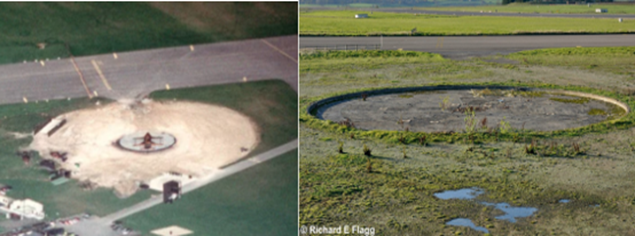
Left - The fire training area at US Air Force RAF Upper Heyford, England.
Right - The same training area today. Although the base closed in 1993, the contamination remains - and may forever.
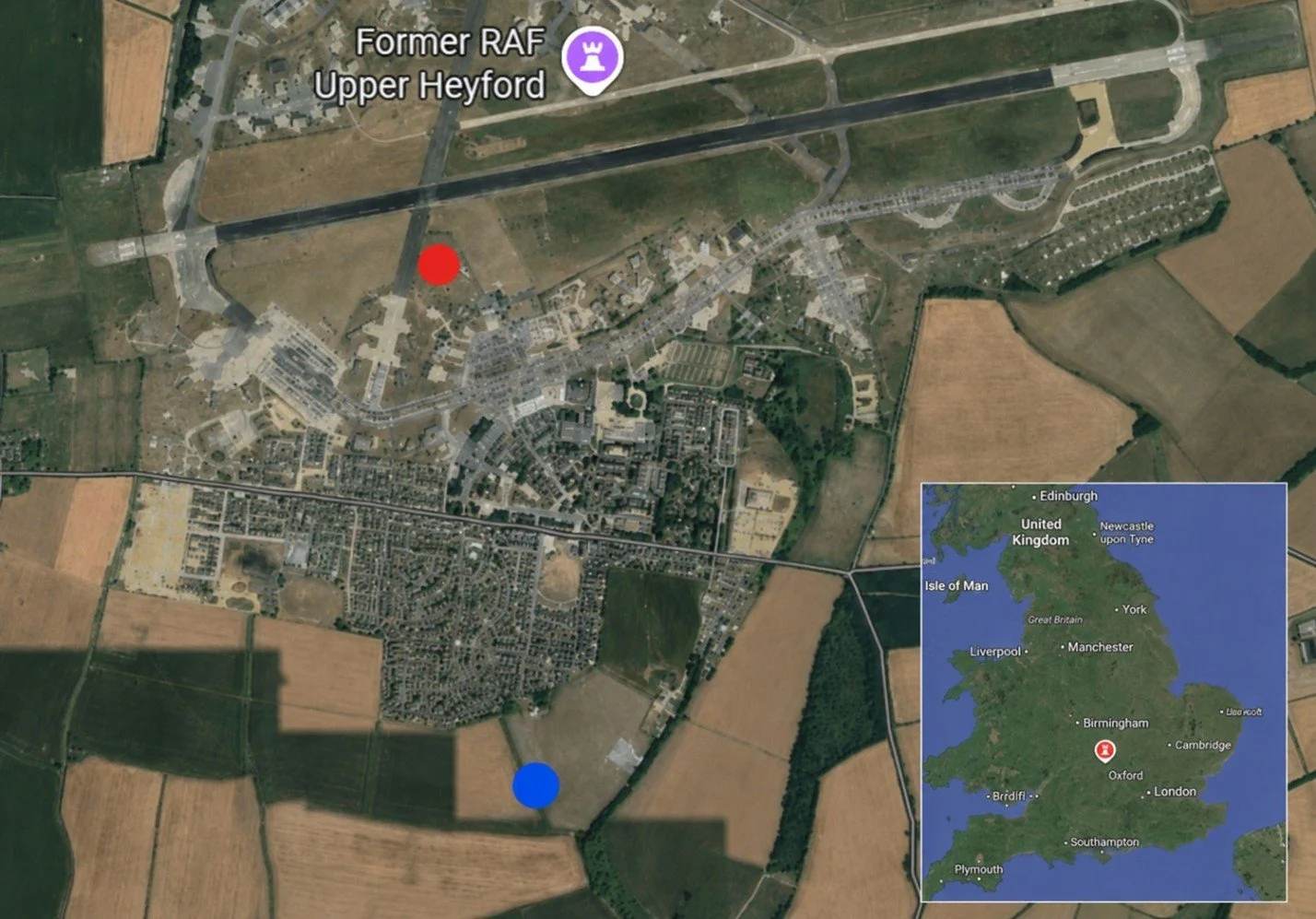
The red dot shows the location of the fire training area at RAF Upper Heyford. The blue dot is the location of the water sample taken from Gallos Brook, 1.5 km south.
A water sampling test commissioned by a group of Upper Heyford, England residents calling themselves “Gallos Brook” has revealed some of the highest concentrations of carcinogenic per-and poly fluoroalkyl substances, (PFAS), anywhere on earth. See the group’s website here: https://gallosbrook.wordpress.com/
Three decades after firefighting operations ceased at the U.S. Air Force base RAF Upper Heyford, laboratory testing detected PFOS, a lethal PFAS compound, at 27,823 parts per trillion (ppt), and total PFAS concentrations at 42,177 ppt.
The PFOS levels are 42,804 times higher than the European surface water safety threshold of .65 ppt. The contamination does not remain confined to streams. PFAS migrate into dust, fish, wildlife, food - and human flesh and blood.
The BBC reported, “The source of the stream, known as Gallos Brook, is an aquifer from within the old airbase, however, the source of the contamination is not known.” Actually, the contamination profile reads like a chemical fingerprint of military firefighting foam. The pollution is dominated by Per fluoro octane sulfonate (PFOS), and Per fluoro hexane sulfonate, (PFHxS). These are compounds historically associated with aqueous film-forming foam (AFFF) used extensively at military airfields.
The water sample also contained a complex mixture of precursor chemicals still degrading and transforming into new generations of terminal PFAS decades after the original releases occurred. Rather than behaving like an isolated spill from the distant past, the chemistry suggests a vast, aging reservoir of contamination that continues migrating through groundwater and seeping into the English watershed today.
While higher PFAS levels have been reported near fluorochemical manufacturing facilities in Decatur, Alabama and Zwijndrecht, Belgium, the concentrations documented near RAF Upper Heyford place the site among the most severely contaminated military-associated PFAS hotspots publicly identified anywhere in the world.
Most rivers and streams documented in Europe and North America measure PFOS in the tens to hundreds of parts per trillion for PFOS, with severe hotspots remaining below a few thousand parts per trillion. A major cross-European PFAS investigation coordinated by Le Monde and the Forever Pollution Project identified hundreds of heavily contaminated sites across Europe, yet publicly documented surface-water PFOS concentrations above 20,000 ppt remain rare outside major fluorochemical manufacturing zones. The Upper Heyford results therefore place the site in the category with the world’s most extreme PFAS contamination, despite the fact that firefighting operations at the base reportedly ceased more than thirty years ago.
National Study points to US RAF bases
as most toxic locations in England
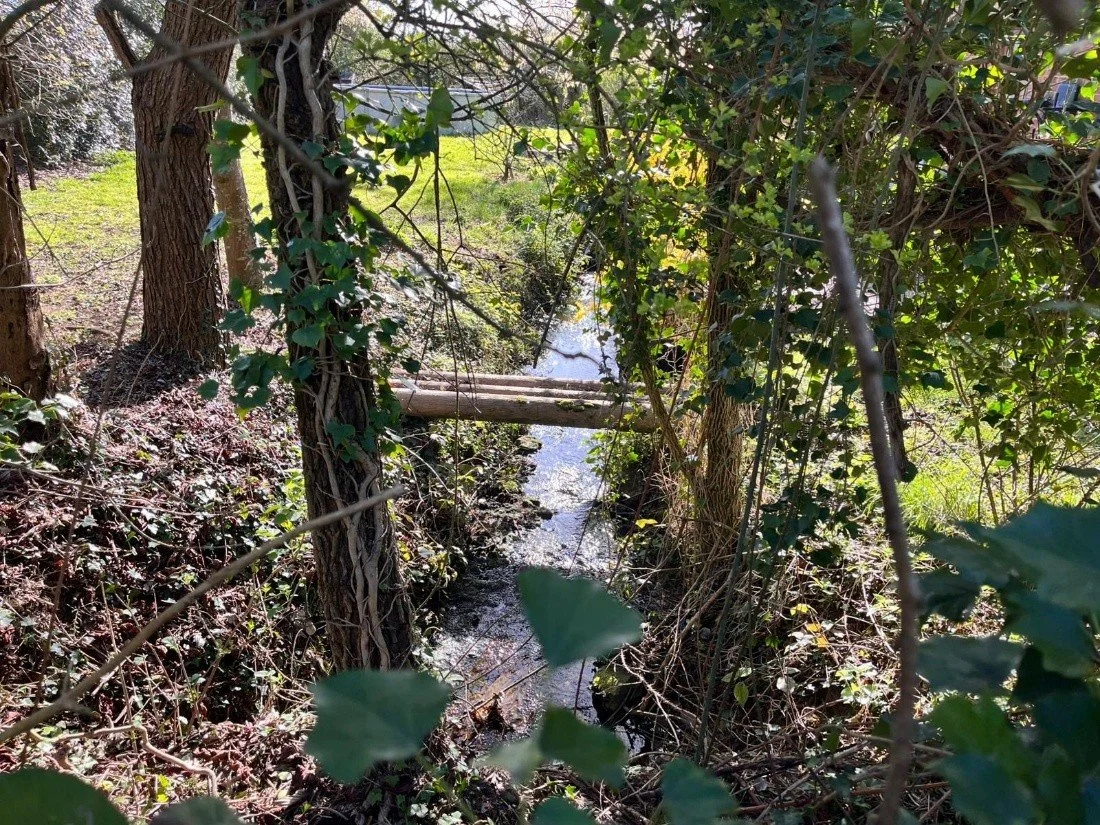
Gallos Brook
- Photo https://gallosbrook.wordpress.com/
A national study of per- and polyfluoroalkyl substances (PFAS) in aquatic environments of England provided the first comprehensive snapshot of PFAS contamination across England’s waters. The study, published in 2026, analyzed water from 850 locations in rivers, groundwater, and coastal waters. PFAS were detected at most sites, with levels climbing as high as 2,021 parts per trillion (ppt) in a section of Gallos Brook 3.5 km south of the Gallos Brook Community Group sample.
The top three most severely contaminated locations in England were former or active RAF bases and included RAF Fairford and former RAF Moreton-in-Marsh. Surface waters draining from civilian airports and wastewater treatment plants were also found to be contaminated across the country.
_______________________________________________________________________________


Calum Miller, the Liberal Democrat MP for Bicester and Woodstock
Sir Keir Starmer has said he will "make sure" that the "appropriate steps are taken" to tackle 'forever chemical' contamination at a former RAF base. The prime minister had been responding to Bicester and Woodstock MP Calum Miller, who raised concerns over the contamination at the former RAF Upper Heyford in parliament on Wednesday.
It comes after local residents paid for independent testing in a stream near the historic airbase, which found levels of 'forever chemicals' 43,000 times higher than environmental standards.
Calum Miller, Member of Parliament for Bicester and Woodstock (Oxfordshire), said the Environment Agency currently has "no plans for regular monitoring" at the site. "The Gallos Brook in my constituency has the highest concentration of forever chemicals in the country," he added.
Sir Keir responded, ‘I’ll make sure that the detail is looked at and that appropriate steps are taken.’
Upper Heyford demonstrates what happens when decades of military PFAS use intersect with modern redevelopment, incomplete environmental oversight, and the near scientific impossibility of recalling these chemicals once released. ______________________________________________________________________________
They didn’t give a damn and they still don’t

The U.S. Air Force has known about the devastating health risks associated with aqueous film-forming foam (AFFF) since the early 1970s, yet much of this information was withheld from public view by the military, the U.S. government, and manufacturer 3M. Investigative reporting by Sharon Lerner at the Intercept helped expose the extent to which internal warnings and toxicological concerns surrounding PFAS-containing firefighting foams were concealed for decades.
There is nothing novel here. PFAS are frequently described in the British press as “emerging contaminants,” although the chemicals themselves are decades old. The contamination is not emerging, recognition of the crisis in the UK is.
Secrets surrounding PFAS were closely guarded at U.S. military installations, particularly overseas, where environmental oversight, public disclosure laws, and independent monitoring were frequently weaker or virtually nonexistent.
The Environment Agency for England and Wales has known of the hazards associated with PFAS in the environment and the foam for almost 30 years.
One of the most troubling aspects of PFAS contamination is that governments and scientists still do not understand what ‘appropriate steps’ actually are once these chemicals have spread through groundwater, rivers, sediments, fish, wastewater systems, air, and the food chain. There is still no proven large-scale remediation strategy capable of removing PFAS from complex natural environments once contamination becomes widespread.
The first “appropriate steps” ought to include a robust government-sponsored testing regime together with the creation of a centralized, publicly accessible repository for PFAS sampling results. At present, the United Kingdom’s approach to PFAS monitoring and disclosure remains highly fragmented. Responsibility is scattered across local councils, water companies, the Environment Agency, the Ministry of Defence, the UK Health Security Agency, and private consultants, with no unified national database allowing the public to track contamination trends across groundwater, rivers, soils, sediments, fish tissue, sewage sludge, or military sites.
In many respects, the UK remains years behind the United States, and especially behind several U.S. states that have developed far more aggressive PFAS testing, disclosure, and regulatory systems. States such as Michigan, Minnesota, New Jersey, Maine, and Massachusetts have established statewide monitoring programs, enforceable drinking water standards, fish consumption advisories, interactive contamination maps, publicly searchable datasets, and mandatory reporting requirements for utilities and industrial facilities. The UK is about ten years behind some of these states.
The contrast is particularly stark around military contamination. In the United States, despite enormous shortcomings, the Comprehensive Environmental Response, Compensation, and Liability Act, (CERCLA) process has at least generated extensive public records, plume maps, and site inspection reports, at hundreds of military installations. Not so in the UK
The UK is dreadfully behind. If someone is able to talk to the Prime Minister, they may wish to explain that the current responses worldwide remain experimental, fragmented, and enormously expensive.
Pump-and-treat systems, which extract contaminated water from groundwater, can operate for decades while removing only a fraction of the contamination. Critics liken the method to sinking a few drinking water straws into a watermelon the size of an aircraft carrier. The pump and treat method extracts contaminated water from the groundwater, cleans it, and injects the cleansed water back into the ground. The process creates highly contaminated filters that scientists still do not know how to dispose of properly.
There is no evidence that PFAS-contaminated materials from RAF Upper Heyford were specifically transported to the nearby landfill or energy-from-waste facility. Relatively little large-scale excavation or remediation may have occurred at the site. However, it is well established that modern landfills and municipal incinerators routinely receive PFAS-laden materials from a wide range of industrial, military, commercial, and consumer waste streams. The broader concern is therefore not limited to Upper Heyford specifically, but to the growing challenge of managing PFAS-contaminated waste once these chemicals enter the disposal system.
Landfilling doesn’t work. It allows the chemicals to drain off.
Landfilling PFAS-contaminated waste at a site like the old Ardley Landfill near Bicester does not destroy the chemicals. Although the original Ardley landfill closed in 2015, the threat posed by buried PFAS waste does not end when a landfill stops accepting trash. The buried waste remains chemically active for centuries, and perhaps forever, continuously generating contaminated liquid leachate.
PFAS are extraordinarily mobile and highly water soluble. When contaminated soils, sediments, sewage sludge, spent granular activated carbon filters, or foam concentrates are buried, rainwater percolates through the waste mass and creates leachate, a chemically contaminated liquid formed as water dissolves and mobilizes compounds from decomposing refuse. Waste from residential communities also contains PFAS. Think of PFAS-treated clothing and furniture.
Unlike many conventional pollutants that bind tightly to soil or break down biologically over time, many PFAS compounds readily migrate with water. The landfill essentially becomes a long-term chemical reservoir that slowly releases contamination into surrounding hydrological systems.
The leachate itself forms continuously. Rainfall infiltrates the landfill cap and buried waste, dissolving soluble compounds along the way. PFAS are especially problematic because they resist both biodegradation and natural attenuation. Even modern landfills equipped with liners and leachate collection systems are not closed systems forever; liners age, seams fail, pipes crack, and groundwater gradients continue moving beneath and around disposal cells. The resulting leachate is often sent to wastewater treatment plants that are likewise incapable of fully removing PFAS, meaning the chemicals are frequently reintroduced into rivers through treated effluent or concentrated into sewage sludge.
In effect, landfill disposal does not eliminate PFAS contamination. It merely transfers the chemicals from one environmental compartment to another — from contaminated soil and filters into groundwater, streams, wastewater systems, air emissions, sludge, and downstream ecosystems.
A Department of Defense Report on critical PFAS uses published in 2023 reads like a catalogue of PFAS dependency across the military-industrial supply chain. Prepared in response to Congress and amid growing state restrictions on PFAS-containing products, the report identifies numerous PFAS uses the Pentagon considers “critical to national security,” including applications in weapons systems, aircraft, ships, electronics, batteries, seals, gaskets, lubricants, textiles, firefighting systems, and specialized coatings. The document is remarkable because it shows that PFAS are not limited to firefighting foam; they are embedded throughout military procurement and sustainment. Every one of these products eventually enters the waste stream, spreading PFAS through disposal, incineration, landfilling, wastewater, dust, and contaminated scrap.
Incineration cannot destroy the carcinogens
Municipal incinerators like the Viridor Ardley Energy-from-Waste facility near former RAF Upper Heyford typically operate at temperatures around 850°C (1,562°F), the standard required for ordinary municipal waste combustion in Europe. Those temperatures are insufficient to completely destroy PFAS. Research reviewed by the European Environment Agency suggests that full destruction of PFAS may require sustained temperatures up to 1,400°C.
Incomplete combustion can generate additional toxic fluorinated byproducts, ultrashort-chain PFAS, and hydrogen fluoride gas. Rather than eliminating the chemicals, incineration may simply redistribute them through stack emissions, fly ash, wastewater, and residual ash streams.
The issue becomes especially important if contaminated pump-and-treat filters, PFAS-laden sludge, or heavily contaminated soils and sediments from military sites were ultimately sent to municipal incinerators like Ardley. In that scenario, the contamination would not disappear. Instead, PFAS particles and gases would be dispersed through the atmosphere over large areas. Airborne PFAS can travel more than 150 kilometers from a single emission source, raising concerns that incineration may transform a concentrated contamination problem into a much broader regional air pollution pathway. This graphic illustrates the extent of the problem.
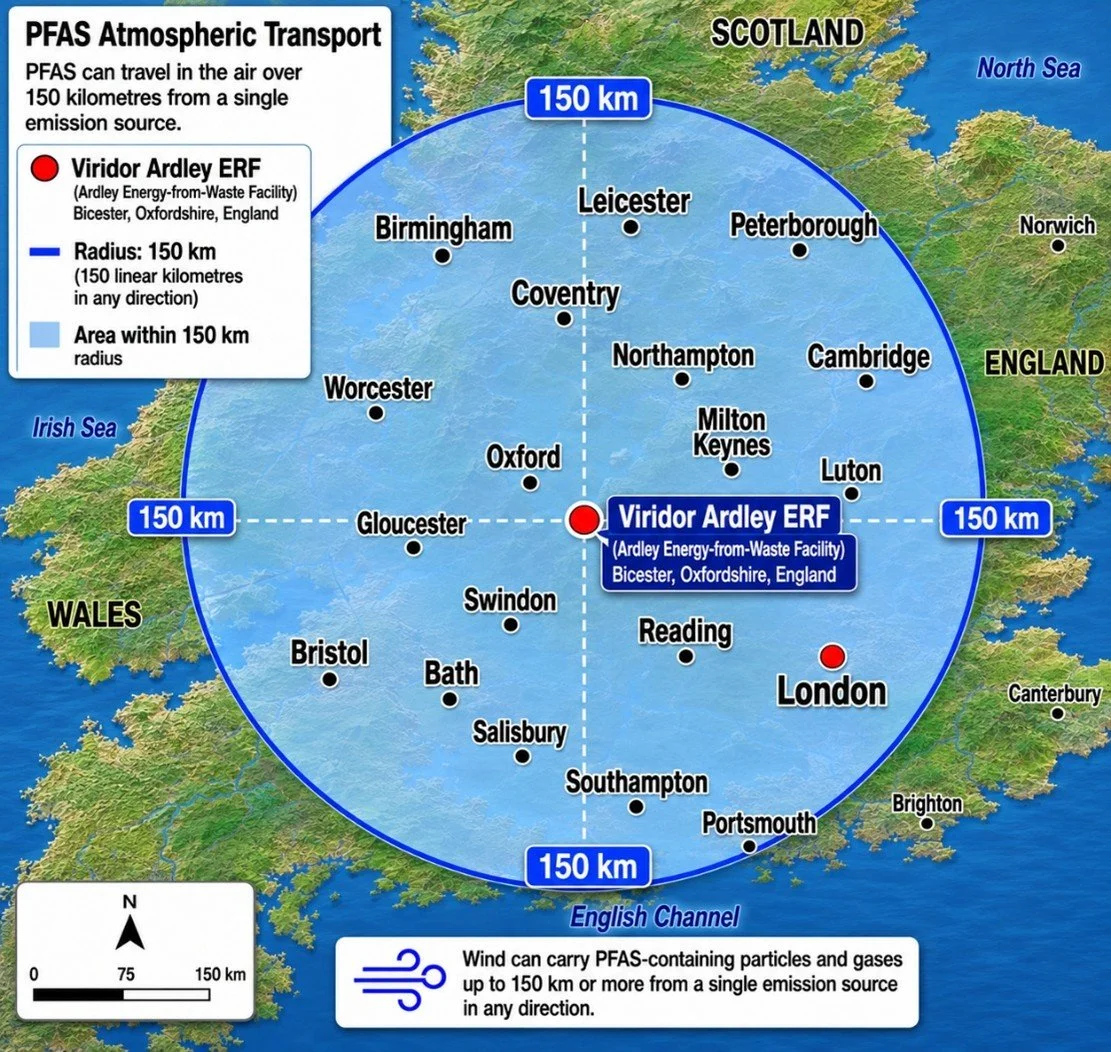
The uncomfortable reality is that modern industrial societies created tens of thousands of highly persistent fluorinated compounds before developing any coherent plan for how to remove them from the environment once released. That scientific and regulatory ambiguity sits at the center of the PFAS crisis. Britain still doesn’t get it. Prime Minister Starmer said he would make sure that appropriate steps are taken. We’d all love to see the plan.
Now, let’s examine what the Gallos Stream community group has reported.
PFOS at 27,823 ppt comprises 66% of the total amount of PFAS in the stream.

“Terminal” PFAS compounds such as PFOS, PFHxS, and PFOA are the highly persistent end-products that tend to accumulate in groundwater, surface water, sediments, fish tissue, and the food chain. Many of the precursor compounds detected at Upper Heyford gradually degrade over time into these terminal PFAS, meaning the contamination can continue generating PFOS, PFHxS, and PFOA type compounds long after the original releases occurred. The coexistence of both abundant precursors and high concentrations of terminal PFAS strongly suggests a large, aging AFFF-related contamination source that is still chemically evolving within the environment.
The ground is like a gigantic carcinogenic sponge soaked with PFAS. Firefighting foam was repeatedly discharged onto the same unlined training grounds for decades. The U.S. Air Force intended for the foams to seep into the ground, rather than to escape into surface waters.
When a stream cuts through or intersects a contaminated groundwater plume, the result can be astonishingly high PFAS concentrations in localized sections of the waterway. In many cases, the stream itself is not the original source. Rather, it acts as a discharge point where contaminated groundwater is emerging continuously from the banks, sediments, or shallow subsurface. This is why concentrations can suddenly spike in one section of a stream while being much lower elsewhere.
We don’t know a lot because of a lack of a comprehensive testing regime by authorities. Generally, high rainfall levels prior to testing will provide greater concentrations from the surface stream itself. Periods of drought may increase the proportion of contamination from groundwater seepage.
Accidental and intentional releases
of AFFF suppression system
During the period when RAF Upper Heyford was operational, the U.S. military relied on PFOS-based AFFF manufactured primarily by 3M under MIL-F-24385 specifications, and these foams were used across its global installations, including bases in the United Kingdom.
Although documentary confirmation for specific shelters at RAF Upper Heyford remains elusive, USAF records make clear that foam-based suppression systems were widely used throughout Air Force aircraft maintenance and shelter facilities during the Cold War era. At major tactical fighter bases such as Upper Heyford — where dozens of F-111 aircraft operated continuously under NATO alert conditions — repeated foam releases associated with fire suppression testing, maintenance operations, emergency response drills, and hot refueling activities likely represented an important long-term source of PFAS contamination.
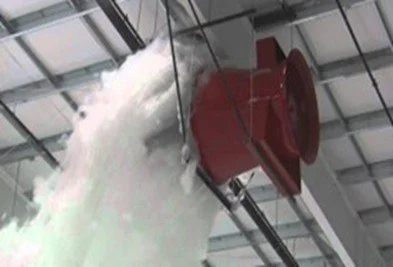
In the 1980s-era Air Force hangars, systems like the one shown used an aeration process to turn a small amount of concentrate into large volumes of firefighting foam.
3% AFFF liquid concentrate was mixed at 3 parts concentrate to 97 parts water. That water–foam solution was then pushed into a foam generator, whipping the liquid into a thick, expanded foam, something like shaving cream.
Imagine if you were getting ready to wash the car and you added detergent to a gallon of water. It would not create bubbles. But if you poured in a few ounces of detergent and you sprayed it with a high-pressure hose it would create overflowing bubbles. It’s the same principle.
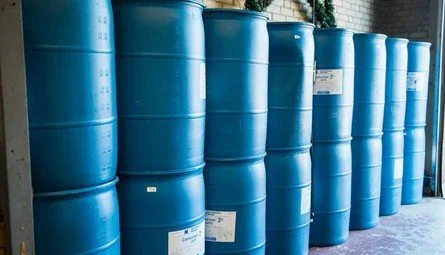
3% aqueous film-forming foam, (AFFF) in 55-gallon drums.
Public records show more than a hundred accidental AFFF releases at military installations in the US and just one in the UK. There may be more. Given fragmented reporting and decades of untracked incidents, the true number in the UK could reasonably extend into the mid hundreds. Unintended AFFF releases were most often caused by maintenance errors, electrical faults, false alarms from detection systems, mechanical failures, and improper testing.
Although there are very few UK press articles specifically documenting accidental AFFF or firefighting foam releases, one notable case occurred at RAF Fairford in July 2007, when approximately 50,000 gallons of firefighting foam and water were accidentally discharged from a hangar suppression system after a faulty diverter valve failed to contain the release. The foam entered nearby waterways and eventually the River Thames.
A 50,000-gallon firefighting foam discharge using a 3% AFFF mixture would contain approximately 1,500 gallons of AFFF concentrate and 48,500 gallons of water.
RAF installations historically operated fixed hangar suppression systems containing AFFF. Accidents resulted in hundreds or even thousands of gallons of AFFF foam concentrate to be emptied into the environment.
How much foam?
The 2018 Site Inspection at Joint Base Andrews near Washington demonstrates that accidental releases of firefighting foam were not isolated or extraordinary events, but rather a recurring feature of military aviation operations over many decades.
The report documents numerous accidental discharges, full-system failures, fire-training exercises, and uncontrolled releases from hangars, fire stations, fuel-cell maintenance areas, and former fire training areas. Several incidents involved massive quantities of foam at J.B. Andrews.

Joint Base Andrews just outside of Washington
is the home to Air Force One.
Building 3629 was the presidential hangar where the president’s plane was housed. Investigators identified five documented AFFF releases, including three complete system discharges of approximately 2,000 gallons of concentrate each. That’s in one building.
Intentional releases
In a 2013 routine test at Travis AFB, CA, 1,000 gallons of suppressant generated a six-foot-deep foam blanket across an 85,000-square-foot aircraft hangar (2 acres) within five minutes. See this video of a routine test. 2,000 gallons of concentrate could produce enough foam to fill a 2-acre hangar with 12 feet of foam.
Air Force preliminary assessments and site inspections frequently reference routine testing and training discharges from hangar suppression systems, but they omit the exact frequency. The systems themselves, however, were generally governed by NFPA 409 aircraft hangar fire protection standards which required full-system discharge testing. These were not rare events. At RAF Upper Heyford, where multiple hardened aircraft shelters and maintenance hangars handled JP-4 and JP-8 fuel systems, the cumulative releases from decades of testing, maintenance, false activations, training exercises, and emergency responses were likely enormous.
Fire Training Areas
Air Force Fire Training Areas (FTA’s) were used weekly, bi-weekly or monthly. The fire training areas were typically 100 feet in diameter and the one at Upper Heyford looks to be that size.
This description is taken from the AFFF Site Inspection at Joint Base Andrews:
“Former Fire Training Area 4 (FTA-4) was used for fire training activities from 1973 to 1990. Records indicate that approximately 300 gallons of a mix of JP-4, motor oil, and possibly solvents were released to the burn area through the fuel distribution system during weekly exercises. Standard practice for the exercises was to release the combustible liquids into the burn area, ignite them, then extinguish the fire with AFFF. The quantity of AFFF used during these exercises was not recorded.
Excess foamy liquid generated during the exercises flowed across the burn area into the oil/water separator (OWS). Oil was collected for off-site disposal. Residual foam and water passed through the OWS and flowed to a 44,700-gallon capacity leaching pond with gravel at the bottom. Liquids typically seeped through the gravel into the ground; also, the leaching pond often became plugged, causing the pond to overflow and discharge fluids to the ground surface. In some instances, the excess fluids were collected and transported to another OWS for discharge to the sanitary sewer system.”
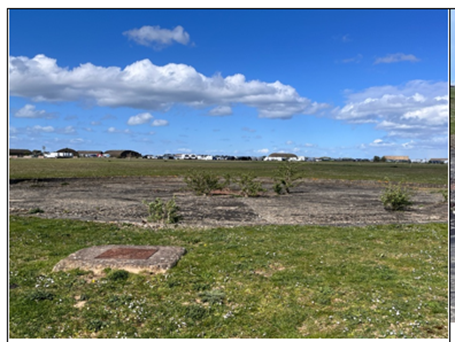
This appears to be a concrete runoff collection tank at Upper Heyford, located just downslope of the fire training area.
The collection tank likely functioned as a simple runoff collection and settling feature rather than an oil-water separator. Systems like this were designed to channel fuel- and foam-laden runoff away from burn pits, not to contain or treat dissolved contaminants. As a result, they served as direct conduits for PFAS migration into the ground.
The food chain is poisoned
Surface water contamination at these levels has produced staggering bioaccumulation elsewhere.
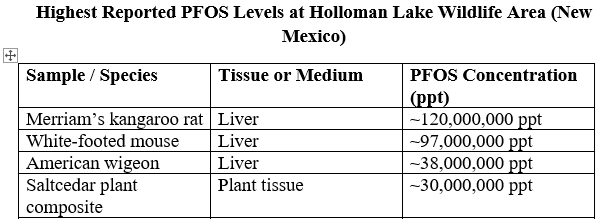
At Holloman AFB in New Mexico surface water was reported to contain 5,900 ppt of PFOS at nearby Holloman Lake. (compared to 27,823 ppt at Upper Heyford) Scientists reported the findings shown here in wildlife.
The Holloman Lake data show that PFOS contamination in surface water can translate into staggering concentrations in wildlife tissue, especially liver. If similar environmental pathways exist at Upper Heyford, the reported PFOS levels in Gallos Brook raise urgent questions not only about the stream itself, but about PFAS movement into plants, invertebrates, fish, birds, small mammals, livestock, and the broader human food chain.
PFAS are commonly found in human blood, and English residents in exposed communities can have very high levels. In Bentham, North Yorkshire, recent testing linked to PFAS firefighting-foam production found some residents and former workers with “alarming” blood levels; one former worker reportedly had 405 ng/mL, far above U.S. clinical risk thresholds.
For context, PFAS blood results are usually reported as ng/mL in serum, which is equivalent to parts per billion in blood serum. U.S. health agencies and the National Academies now treat combined PFAS serum levels above 2 ng/mL as a level where exposure-reduction and medical follow-up should be considered. Levels of PFAS above 20 ng/mL are considered to be dangerous.
What’s in your blood, Upper Heyford?
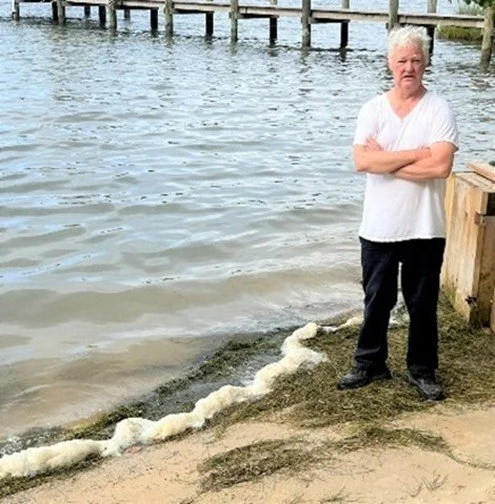
The foam gathers almost every day from the Webster Field Annex of the Patuxent River Naval Air Station. Maryland, directly across the creek.
My blood contains 42.16 ng/mL of PFAS, according to a study of Marylanders considered to be at risk, conducted by the Johns Hopkins School of Public Health. The Navy base used PFAS in firefighting foams since the 1980’s. I consumed contaminated oysters, crabs, and fish until I tested the food and found them to be poisonous. Neither the federal government nor the state recognizes the human health crisis, while the seafood remains cleared for consumption. Although I am not claiming direct causation, I have had two heart attacks, bypass surgery, and five arterial stents implanted. There is a strong correlation between PFAS in the blood and arterial disease.
The health impact of PFAS
The U.S. Environmental Protection Agency has emphasized that PFAS can bioaccumulate in fish at factors up to 4,000 times the concentration of PFOS in the water, meaning even relatively low PFAS concentrations in water can translate into extremely dangerous levels in fish tissue over time. Levels of PFOS exceeding 42,000 parts per trillion may translate to fish containing tens of millions parts per trillion in their fillet.
The U.K. has focused heavily on PFAS in drinking water, yet fish can bioaccumulate these chemicals to extraordinary levels. A flounder sampled from the River Thames at Woolwich reportedly contained about 52,100 ppt of PFOS in its tissue — hundreds of times higher than the concentrations regulators tolerate in drinking water.
Although the invertebrates and small fish in Gallos Stream are not directly consumed by humans, they may be consumed by larger fish further downstream. The entire food chain is poisoned. The other PFAS compounds found in Gallos Stream may also bioaccumulate in living creatures, although not at the same level of PFOS.
Health agencies associate PFAS exposure with increased cholesterol, reduced vaccine response, liver-enzyme changes, pregnancy-induced hypertension, lower birth weight, kidney and testicular cancer, and thyroid disease.

.
UK approach to PFAS is like playing whack a mole. There are more than 40,000 varieties of PFAS.
The UK Health Security Agency acknowledges links between certain PFAS exposures and cancers — particularly kidney and testicular cancers — yet stops short of describing PFAS as a carcinogenic chemical class. Instead, regulators continue to evaluate compounds individually, despite the reality that humans are exposed to complex mixtures of thousands of persistent fluorinated chemicals simultaneously. Critics argue this compound-by-compound approach understates the risks posed by widespread environmental contamination and resembles a regulatory game of whack-a-mole, where one compound is restricted only after years of study while countless related compounds remain in commerce and continue accumulating in the environment.
The contrast with California is striking. Under California’s Proposition 65 framework, both Perfluorooctanoic acid (PFOA) and Perfluorooctane sulfonate (PFOS) are formally listed as chemicals known to cause cancer.
Once firefighting foams enter the environment, they become embedded throughout the environment. Fish and livestock can bioaccumulate PFAS. Crops irrigated with contaminated water may absorb certain compounds. Dust generated from contaminated soils or dried sediments may carry PFAS particles into homes and our lungs.
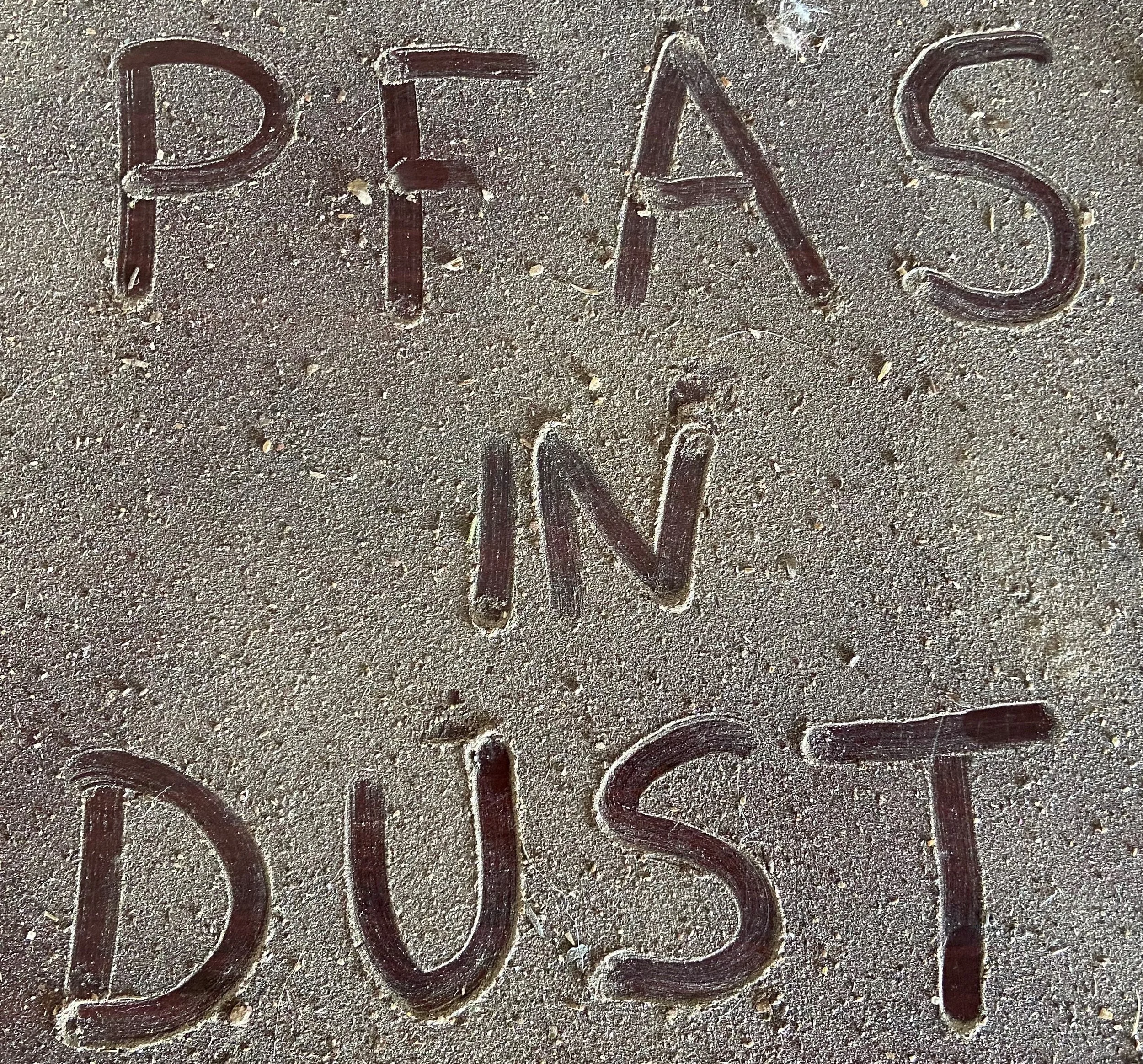
PFAS cling to sediments and coat the banks of streams and rivers. As water levels fall, the contaminated banks are exposed, dry out, and become a source of airborne dust that settles in our lungs and in our homes as dust.
In 2022, the U.S. Centers for Disease Control conducted a study of dust in homes adjacent to Shepherd Field Air National Guard Base, West Virginia, a base with many years of fire training an AFFF use.
One home had dust containing the following concentrations of PFAS:
PFHxS 16,400,000
PFOS 13,900,000
PFOA 3,430,000
Levels of blood were found to correlate with the levels in the dust. This is likely the number one pathway of PFAS ingestion for young children, especially in areas of prolonged use of the carcinogenic foams.
We must treat heavily impacted areas with caution. In such settings, minimizing dust is key: damp cleaning methods (like wet mopping) are preferable to dry sweeping, and vacuuming should ideally be done with sealed systems. Changing vacuum cleaner bags is an occupational hazard.
All of this is swirling around while the conversation in the UK remains fixated on the drinking water which seems to be within regulatory standards, according to municipal water providers. In the UK water companies must report and act if PFAS exceed 100 ppt total. London authorities report no exceedances in treated drinking water supplies at that level.
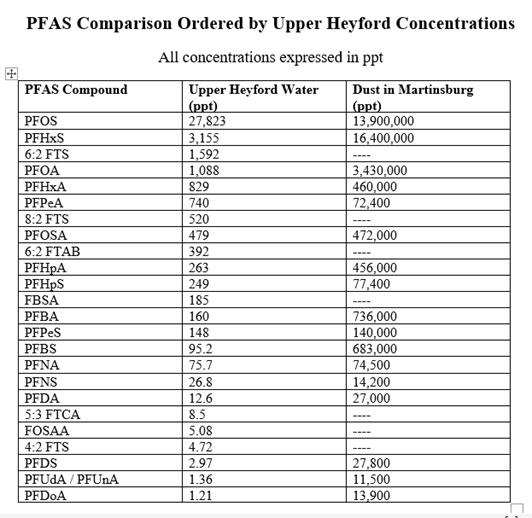
Now, see this chart that compares various PFAS compounds left behind by the US Air Force in surface water at Upper Heyford, compared to the PFAS compounds left behind in dust by the US Air Force in Martinsburg, West Virginia. Notice the 3M fingerprint characterized by high concentrations of PFOS and PFHxS. Because Shepherd Field is an active base, PFHxS levels exceed PFOS concentrations.
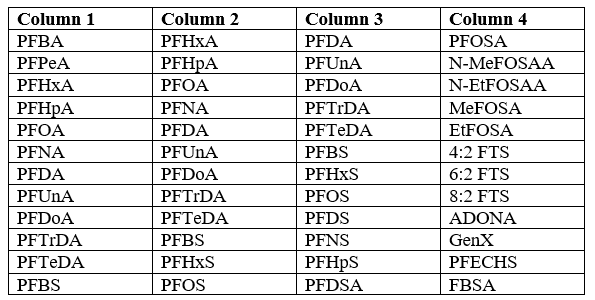
These 48 PFAS Compounds are Subjected to UK Water Company Monitoring Thresholds. Together, their total cannot exceed 100 ppt.
We don’t know the concentrations of PFAS in English fish, milk and eggs. Concentrations in the tens of thousands of parts per trillion have been documented around the world. Despite a vast global body of scientific evidence on PFAS persistence, toxicity, and bioaccumulation, the UK continues to prioritize casual monitoring and future evidence gathering over immediate regulatory controls.
Conclusion
Independent testing commissioned by the Gallos Brook community group near former RAF Upper Heyford in Oxfordshire revealed some of the highest publicly reported PFAS concentrations ever documented in surface water associated with a military site. The stream contained approximately 42,000 ppt total PFAS, including 27,823 ppt of PFOS alone, a contamination profile strongly associated with decades of U.S. Air Force aqueous film-forming foam (AFFF) use at the base’s fire training area.
The chemistry includes both terminal PFAS compounds and precursor compounds still degrading into new generations of persistent contaminants, suggesting not a static “legacy” spill, but a massive aging reservoir of PFAS continuing to migrate through groundwater and seep into Gallos Brook decades after firefighting operations ceased.
This report argues that RAF Upper Heyford reflects a broader international failure to confront the long-term consequences of military PFAS contamination. While British regulators focus on drinking water thresholds, the contamination has already moved through sediments, fish, dust, wastewater systems, air, and the food chain. The report criticizes both the fragmented U.K. regulatory system and the slow-moving U.S. military cleanup framework under CERCLA, arguing that governments still lack a credible large-scale strategy for removing PFAS once they disperse through complex ecosystems.
There is a steep learning curve inherent to PFAS contamination, but it must be mastered quickly if England hopes to protect vulnerable populations from chemicals that migrate through complex ecosystems and threaten public health.