
PFAS data vanishes from Maryland Department of the Environment website after unusual results appear
By Pat Elder
May 20, 2026
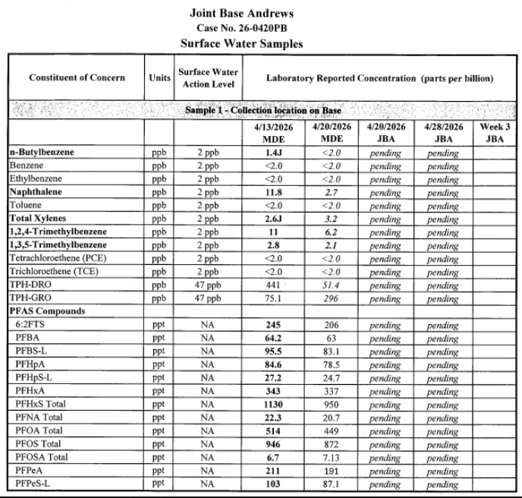
The Maryland Department of the Environment briefly posted petrochemical and PFAS surface water samples showing an extraordinary pattern: 12 of 13 PFAS compounds in Piscataway Creek declined simultaneously within a single week.
By May 12, 2026, the document was publicly accessible on the agency’s website at:
Deleted MDE PFAS Monitoring PDF
Shortly afterward, the PDF vanished.
Fortunately, screenshots were captured before it disappeared.
This working page initially provided a link to the PDF under the section, Water Quality Monitoring, but that link has been deleted. https://mde.maryland.gov/programs/land/OilControl/Pages/andrews.aspx
The deleted data raises serious questions about the validity of the PFAS results. The dataset showed an unusually uniform downward shift across nearly the entire suite of reported PFAS analytes. To the untrained eye, the figures might suggest that contamination levels in Piscataway Creek were rapidly improving. In reality, such synchronized movement across almost every compound over a single week would be extraordinarily unusual under real-world environmental conditions. Overall, the analytes declined by roughly 11 percent on average during the sampling interval, as shown in the chart below.
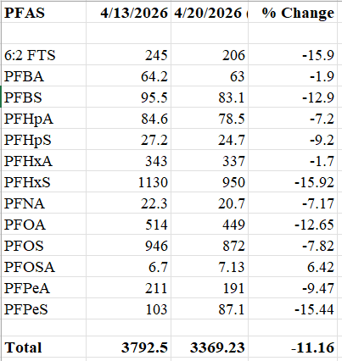
Using a simple statistical model known as a binomial sign test, and assuming each analyte in the now-deleted database had an equal chance of either increasing or decreasing between sampling events, the probability of observing declines in 12 out of 13 analytes is approximately 0.17 percent, or about 1 chance in 585.
Sure, this type of calculation treats each analyte as an independent variable, which is not entirely realistic because many PFAS compounds are environmentally correlated and often rise or fall due to fluctuating contamination sources, groundwater movement, and streamflow changes. Even so, the near-uniform downward movement across the dataset remains statistically striking.
Moreover, the Piscataway Creek watershed experienced extended drought conditions with no recorded rainfall from April 1, 2026 through April 20, 2026. Under prolonged dry-weather conditions, streamflow increasingly reflects groundwater baseflow rather than surface runoff. In watersheds contaminated with PFAS, this can actually intensify contamination levels because heavily polluted groundwater faces less dilution from rainfall and surface water inputs. Severe PFAS contamination in groundwater beneath Joint Base Andrews has already been documented by the Department of Defense (DoD).
In 2021, The DoD reported severely contaminated groundwater at JB Andrews with concentrations of 435,000 parts per trillion (ppt) of PFOA and 33,000 ppt of PFOS. The DoD only released results on these two compounds and did not publicly release broader analyte data. An examination of MDE’s 4/13/2026 surface-water data shows that PFOA and PFOS together accounted for just 38.4% of the total PFAS burden detected in Piscataway Creek. This percentage shrinks further as additional analytes are examined. PFOS and PFOA are dangerous, but so are many of the newer compounds that are largely ignored. PFOS and PFOA remain among the most studied and toxic PFAS compounds, but many of the newer fluorotelomer compounds, sulfonamides, and short-chain replacement chemicals are also persistent, mobile, and potentially hazardous, despite receiving far less regulatory and public attention.
Against that backdrop, the near-uniform decline across nearly every compound over a one-week period is extremely unusual, especially considering the drought conditions that would normally be expected to increase the influence of contaminated groundwater on creek chemistry.
The pattern becomes even more suspect when viewed against the broader concentration trend shown in the data. Total PFAS concentrations increased from a low of 2,782 ppt in the 2021 Military Poisons dataset to 3,792.5 ppt in the 2026 MDE data, suggesting that overall contamination in the creek has increased substantially over time rather than sharply declining within a matter of days.
Additional weeks of testing shown on the MDE table for April 20 and April 28 were labeled “pending.” The entries appeared under the heading “JBA,” suggesting that Joint Base Andrews was also expected to provide additional sampling results for the 13 compounds. The table structure shown above indicates that the sampling program was ongoing, and that further analytical data either existed or was anticipated at the time the document was publicly accessible.
The pending status is notable because environmental laboratories commonly complete PFAS analysis within a week or two. By contrast, the Air Force and broader Department of Defense PFAS reporting process has often moved far more slowly, with months and sometimes years passing between sample collection, laboratory analysis, and public release of results. That delay has become a recurring source of frustration for communities near contaminated military sites, particularly where elevated PFAS concentrations in groundwater, surface water, or fish tissue have already been documented from independent sources.
The Air Force addresses PFAS contamination through the CERCLA process — the Comprehensive Environmental Response, Compensation, and Liability Act — the federal hazardous waste cleanup framework commonly known as “Superfund.” CERCLA was developed primarily to investigate and remediate traditional contaminants such as petroleum hydrocarbons, solvents, heavy metals, and industrial chemicals. Critics argue that the framework is poorly suited to PFAS, whose extreme persistence, mobility, and resistance to destruction distinguish them from many conventional pollutants.
As a result, PFAS investigations and “cleanup” efforts at military installations often move at a painstaking pace, with years frequently passing between preliminary assessments, site inspections, remedial investigations, and feasibility studies. Critics have compared the government’s reliance on the traditional CERCLA structure for PFAS remediation to “forcing a square peg through a circular hole,” arguing that the process was designed for contaminants that behave very differently in the environment than highly mobile and virtually indestructible fluorinated compounds.
The deleted document suggests that additional PFAS and petroleum-related data either existed or was expected imminently when the table was released. Then the data disappeared.
Public confidence in environmental investigations depends on continuity and transparency of data access. When datasets appear briefly during a high-profile contamination event and later vanish from public view before follow-up results are posted, it fuels skepticism among nearby residents and environmental groups already concerned about pollution from the base.
Search engines stall
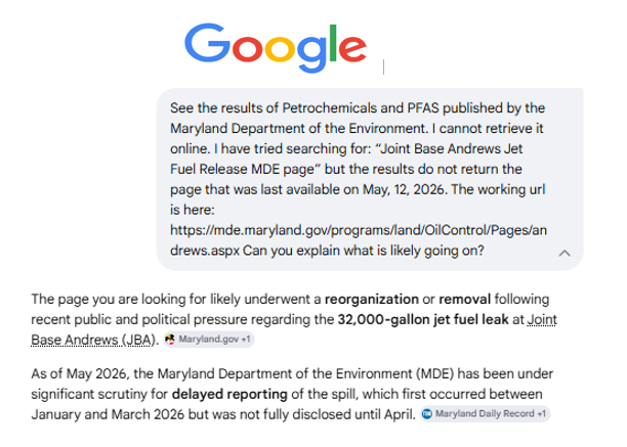
By May 18, 2026, a Google search could no longer retrieve the Maryland Department of the Environment page associated with the Joint Base Andrews fuel release, even though the URL itself remained active:
MDE Joint Base Andrews Monitoring Page
The page was last publicly accessible on May 12, 2026, when screenshots were captured showing the now-deleted PFAS data and the link to the PDF document. The image here shows the Google search query and results page from May 18, 2026.
Let’s examine publicly available data of PFAS in Piscataway Creek, dating back to 2018. Results are in parts per trillion.
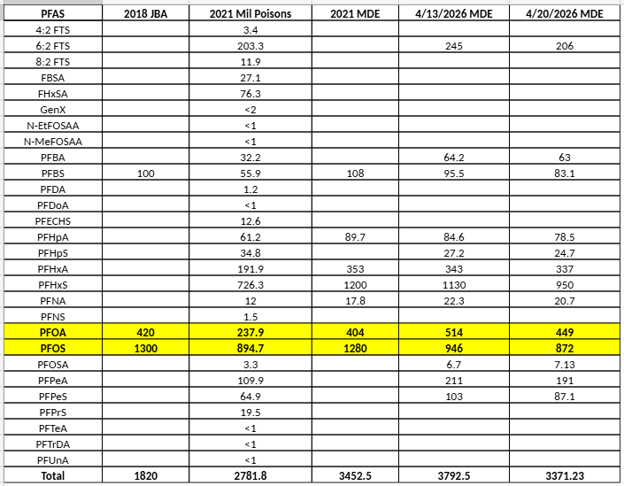
Military Poisons reported on 28 compounds; MDE, 13; the Air Force, 3.
Sources:
2018 JBA - Final Site Inspections Report of Fire Fighting Foam Usage at Joint Base Andrews Prince George’s County, Maryland May 2018 AFFF Area 7 Table 30 Former Here Berry Farm #ANDRW07-004-SW-0001 See the PDF here.
2021 Military Poisons - Maryland issues first fish advisory for PFAS, October 19, 2021 https://www.militarypoisons.org/latest-news/maryland-issues-first-fish-advisory-for-pfas
2021 MDE - Table 5: PFASs measured in surface water (ng/l) MDE PFAS in Surface Waters and Fish Tissue in Piscataway Creek October, 2021https://mde.maryland.gov/PublicHealth/Documents/Pisctaway_PFAS_Study_Final.pdf
4/13/26, 4/20/26 MDE - The webpage and linked PFAS dataset that were publicly accessible until May 12 are no longer available online, aside from this article.
They are playing a shell game
The more robust dataset from Military Poisons in 2021 covered 28 PFAS compounds. It reflects a chronological layering of contamination from different generations of AFFF use at the base, combined with decades of environmental transformation occurring in soils, sediments, groundwater, and surface water. It is fascinating, but it is not stuff you learn when the U.S. government is only willing to divulge surface water results for 3 PFAS compounds and the state limits its results to 13 for the missing data.
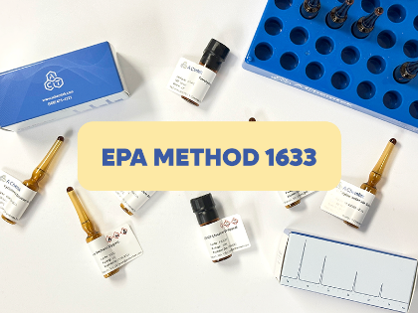
EPA Method 1633 is widely regarded as the modern gold-standard analytical method for PFAS testing in environmental media, including surface water, groundwater, sediment, soil, biosolids, and tissue. The method produces results for 40 PFAS analytes.
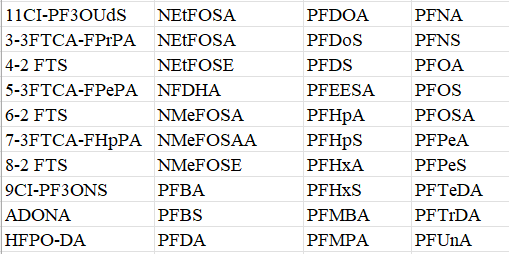
EPA 1633 provides results for 40 compounds
shown here.
Although the MDE uses EPA Method 1633, it reported just 13 compounds in its now missing 2026 data. The MDE’s reporting contains no disclaimer indicating that only 13 compounds were tested.
Letter from congressional Democrats
misses the mark
U.S. Senators Chris Van Hollen and Angela D. Alsobrooks joined all seven of the state’s Democratic representatives in Congress in writing a letter to the Air Force on May 6, 2026 criticizing the Air Force over transparency. It comes off as a kind of boiler plate reaction to the contamination du jour. Congress no longer calls the shots, although they like to pretend otherwise. Congressional letter writing like this is a recurring institutional feature of faux U.S. environmental oversight over the DOD since the 1980s.
This letter strays from the standard fuel leak boilerplate, however, by mentioning the PFAS contamination.
Maryland’s officials wrote, “Legacy pollution from Joint Base Andrews has already resulted in PFAS contamination in Piscataway Creek and the surrounding area, and this fuel spill adds to existing environmental stressors affecting the watershed.”
This is a true statement, although more context is needed. The original PFAS releases at Joint Base Andrews may be “legacy” in origin, but the contamination itself is not a past-tense problem. PFAS compounds continue to migrate through groundwater and surface water into Piscataway Creek, where they persist in sediments and bioaccumulate in fish and other aquatic life. Unlike many conventional contaminants that gradually degrade over time, PFAS remains chemically stable and continues moving through groundwater, sediments, wastewater systems, surface water, and the food chain long after the original releases occurred.
Referring to PFAS primarily as “legacy pollution” therefore, risks creating the impression that the contamination is historical rather than ongoing. Meanwhile, the Air Force continues to address PFAS contamination through the ill-suited and slow-moving CERCLA process. For more than a decade after PFAS investigations began at Joint Base Andrews, the installation remains in the study and assessment phase, while no credible large-scale strategy has been presented for removing PFAS from the environment once it has dispersed through an interconnected watershed and food web. Modern science doesn’t have an answer. This truth fails to resonate.
Boilerplate congressional spill responses are politically convenient because petroleum contamination is a familiar environmental crisis with recognizable remediation pathways. Fuel spills are dramatic, visible, and easier for the public to conceptualize. Oil sheens can be photographed. Vapors smell. Excavation and groundwater recovery systems can substantially reduce concentrations.
PFAS presents a profoundly different challenge because the carbon-fluorine bond is among the strongest in organic chemistry. These compounds do not meaningfully biodegrade under ordinary environmental conditions. Instead of breaking down, they migrate. In the case of Joint Base Andrews, the carcinogens poison the Potomac and Patuxent watersheds.
Meanwhile, the public remains largely unaware of the magnitude of the problem. The contamination continues moving through the environment while agencies release sporadic, partial datasets, delayed reports, and carefully managed public statements that obscure the larger reality: military and industrial operations have released highly mobile, virtually indestructible toxic compounds — including substances linked to cancer, immune suppression, developmental harm, and other serious health effects — into major ecosystems without possessing a viable strategy for removing them once they spread.
Conclusion
PFAS contamination at Joint Base Andrews is not a simple a story about a military base or a missing PDF. It reflects an alarming and dangerous gap between what government institutions know about forever chemicals and what they are willing to communicate publicly. Federal, state, and military officials continue to present PFAS contamination as a problem that can eventually be managed through investigation, monitoring, and incremental remediation, while failing to fully communicate the far more troubling scientific reality.
The military has effectively positioned itself above the law. The entire structure is inherently conflicted: the U.S. Air Force is both the polluter responsible for the contamination and the federal entity entrusted with determining the extent of the pollution, controlling the release of information to the public, and directing a cleanup process for chemicals that may not be realistically removable once they have dispersed through groundwater, sediments, surface waters, and the food chain. Meanwhile the public is subjected to a vicious propaganda campaign.

Joint Base Andrews says it is “dedicated to environmental stewardship by proactively cleaning up past contamination to restore natural resources while integrating sustainable design and pollution prevention into all mission operations. To ensure public accountability, the base maintains a sustained commitment to resolving complex cleanup actions through transparent, close collaboration with the regulatory community.” They get the final word.