By Pat Elder
August 23, 2026
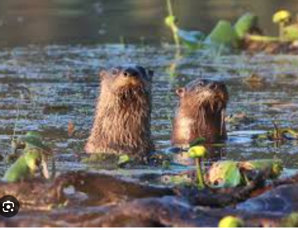
Otters, among the most contaminated animals in the UK, reveal the consequences of decades of unchecked PFAS pollution.
The UK has a PFAS problem that is becoming increasingly difficult to hide. At Gallos Brook, a stream draining the former US air base at Upper Heyford, recent testing found 27,823 parts per trillion of PFOS and more than 42,000 ppt of total measured PFAS—extraordinary concentrations from a military base that closed 33 years ago. Across the UK, PFAS are turning up in rivers, groundwater, sewage sludge, fish and wildlife, while additional quantities continue to enter the economy through industrial uses and imported products. Yet the government still cannot say with confidence how much PFAS enters the country, where it is used or where it ultimately ends up.
I have seen this pattern elsewhere. In California, I have written extensively about contamination at the former Fort Ord, where a university now occupies much of the former military installation, My colleagues and I have documented reports of cancer among eight former students or their spouses. Whether those illnesses are connected to environmental exposures has not been established, but the contamination and the absence of comprehensive investigation demand scrutiny.
The problem is that governments accumulate evidence of contamination without responding with anything approaching the scale of the problem.
The UK has now unveiled its PFAS Plan: building a safer future together.The title suggests urgency and action. The document itself reveals something very different. It acknowledges widespread contamination and promises to “protect our environment, safeguard public health, and build a cleaner, safer future,” even as PFAS continue to be manufactured, used and imported and enormous quantities already circulate through the UK water, soils, wastes and food chains.
That contradiction is at the heart of this story. The UK does not suffer from a shortage of PFAS evidence. It suffers from a shortage of political response to that evidence.
PFAS have been measured in the liver of an otter, the body of a porpoise, the egg of a gannet and the flesh of fish across the UK. These animals are doing something government policy documents cannot: they are showing us what decades of persistent chemical contamination actually look like after the chemicals leave a military airfield, factory, wastewater plant or farm field and begin moving through an ecosystem.
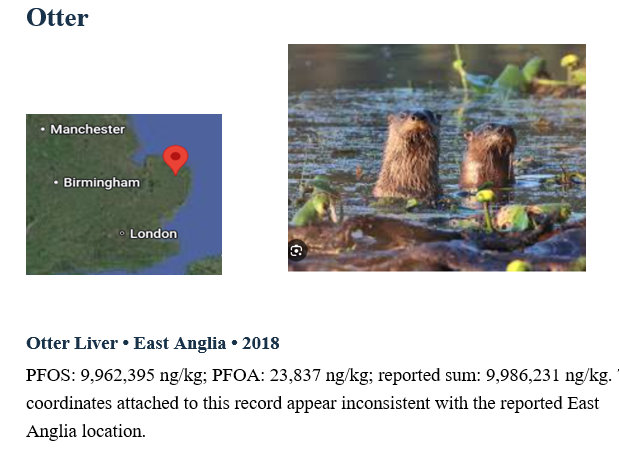
One record is particularly difficult to dismiss. An otter from East Anglia carried nearly 10 million parts per trillion of PFOS in its liver.
That otter provides a useful place to begin asking a larger question: if the UK already knows that PFAS contamination is widespread in its waters, wastes, and wildlife, why does its new national plan still read more like a promise to study the problem than a plan to stop it?
PFAS continue to be manufactured, imported and used throughout the UK while enormous additional quantities enter the country embedded in imported products—from electronics and industrial equipment to textiles, coatings, cosmetics, food packaging and countless other goods. The true volume is unknown because the UK’s chemical-registration system does not comprehensively track PFAS contained in imported finished products or substances entering the market below reporting thresholds. Consequently, the government cannot say with confidence how much PFAS is entering the UK. Let’s look at the government’s newly unveiled PFAS Plan.

The government promises to “protect our environment, safeguard public health, and build a cleaner, safer future.”
Widespread irreversible harm has already occurred. The question now is whether the UK will prevent further damage or continue allowing contamination to accumulate. The government itself reports PFAS in roughly 80% of surface-water samples, 50% of groundwater samples and all fish samples tested. And how does the UK build a cleaner future while PFAS continues to be manufactured and continues to enter the country through imported products and industrial supply chains?
Parliament should know how much PFAS enters the country each year, where it is used, where it ends up and who will pay for its disposal and “cleanup.” (Actually, the world does not know how the “clean up” these chemicals, and the UK is way behind this learning curve.)
The British plan offers no major national investment comparable to renewable energy research and no serious program to accelerate PFAS-free alternatives. The plan fails to require the basics: immediate disclosure of known contamination, mandatory testing around former military and firefighting sites, enforceable cleanup orders, private-well protections, fish and livestock advisories, medical monitoring or a painful polluter-pays mechanism.
Sewage sludge presents another enormous gap. The government acknowledges that about 94% of water-company sewage sludge is recycled to land yet proposes more study and possible future reforms rather than national PFAS limits for sludge applied to farmland! The issue is still novel in the British mind, so few can comprehend this terrestrial apocalypse.
A credible plan would immediately require testing at former military airfields, fire-training areas, landfills, wastewater works and affected catchments; public disclosure of results; protections for contaminated streams, fish, livestock water and private wells; enforceable standards; and a polluter-pays cleanup program.
Government documents describe contamination in percentages, monitoring programs and future consultations. Wildlife expresses the same problem in flesh and blood. Perhaps it will be harder to ignore when PFAS is measured in the liver of an otter, the egg of a gannet, the body of a porpoise or the flesh of a fish.

Otters are the cutest critters!
Perhaps it will be harder to ignore when PFAS is measured in the liver of an otter, the egg of a gannet, the body of a porpoise or the flesh of a fish

A startling record from a complicated database
The PFAS Data Hub, developed from the Forever Pollution Project, brings together millions of monitoring results from government agencies and scientific programs across Europe. It is a noble, almost herculean achievement. Yet the existence of so much data has not produced the sustained, detailed public reporting its scale would seem to warrant. Extraordinary findings remain buried in datasets that require considerable technical work to interpret. The records used here include work associated with the Centre for Environment, Fisheries and Aquaculture Science, Natural Resources Wales, the UK Centre for Ecology & Hydrology and related wildlife-monitoring programs.
Concentrations are reported in nanograms per kilogram of fresh weight; that is, per kilogram of tissue as collected, including its natural moisture.
1 ng/kg = 1 part per trillion, (ppt).
For that otter, the available record reports two compounds: PFOS at 9,962,395 ng/kg and PFOA at 23,837 ng/kg. Their combined concentration is approximately 9.99 million ng/kg. Because the record does not include a complete panel of PFAS compounds, this figure should be understood as the sum of the two reported substances, not the animal’s total PFAS burden. It could be much worse.
Independent studies confirm the scale
A Scandinavian study of 140 otters found PFOS was dominant, accounting for approximately 80% of the PFAS measured. The highest PFOS concentration was 16 micrograms per gram wet weight: 16,000,000 ng/kg, or 16 million ppt. This compares to the 9.9 million ppt found in the Otter from East Anglia. The authors described those liver concentrations as a matter of great concern for otter populations.
The primary concerns are impaired immunity, reproductive and developmental problems, liver damage, and disruption of thyroid hormones. While researchers cannot diagnose a particular otter’s condition from a liver sample alone, several studies provide important context. For instance, a study of 80 adult female southern sea otters in California found significantly higher PFOS and PFOA concentrations in animals that died from infectious diseases than in those that died from noninfectious causes.
PFOS may threaten otters at the cellular level as well. Laboratory studies have linked exposure to oxidative stress, DNA damage, chromosome abnormalities, and changes in the chemical signals that regulate genes.
_______________________________________________________________________________________________________
The fear is not simply that pollution might kill otters or cause their populations to decline. It is that generations of exposure to PFAS, pesticides, industrial chemicals, and heavy metals are altering the biological inheritance of the animals that survive. The question is not only whether these animals will survive, but what many generations of contamination may compel them to become.
_____________________________________________________________________________________________________
Why predators carry so much PFAS
PFOS does not simply remain freely dispersed in the water column. It has a strong tendency to associate with proteins and biological material, accumulating in biologically rich sediments, microorganisms, invertebrates, and other organisms at the base of the food web. Fish eat those organisms. Otters, porpoises, dolphins, gannets and other predators repeatedly consume contaminated prey. Finally, PFOS does not remain evenly distributed through an animal. It binds to proteins in blood and organs and commonly reaches much higher concentrations in liver than in muscle.
An otter liver is therefore not an isolated curiosity. It is a biological sampling device, integrating contamination from an entire watershed and food web.
The wildlife record
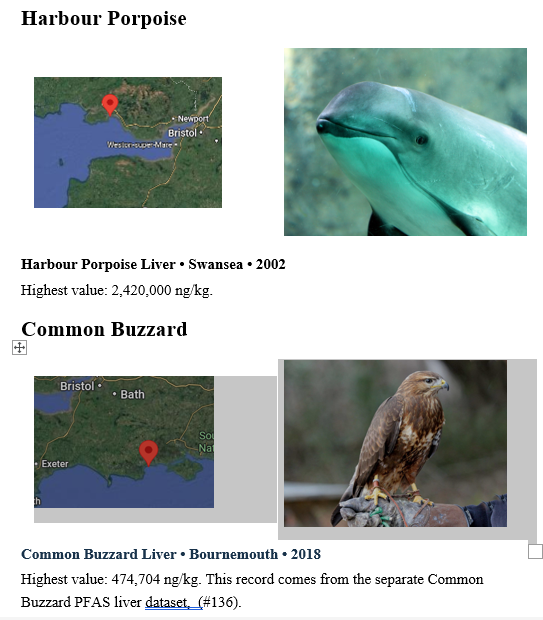
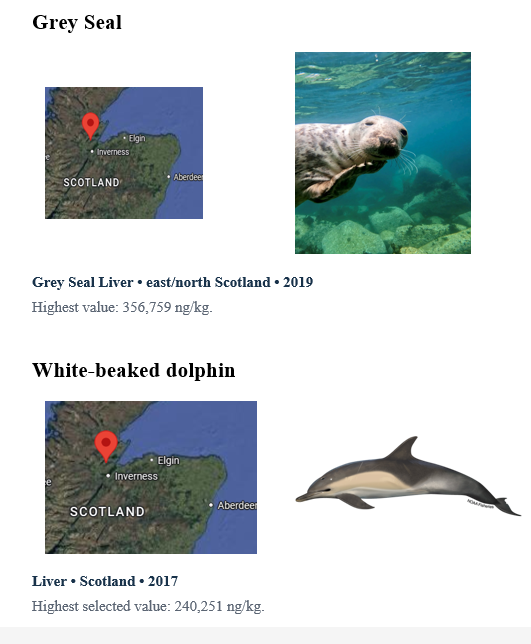
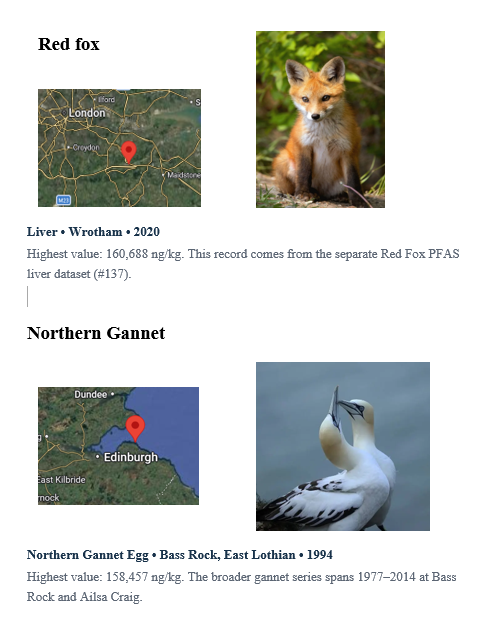
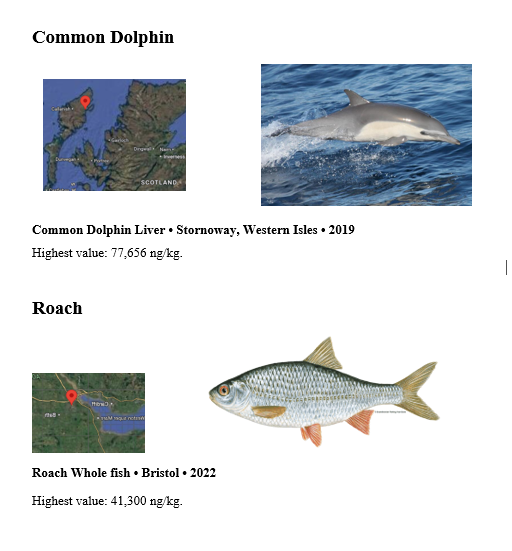
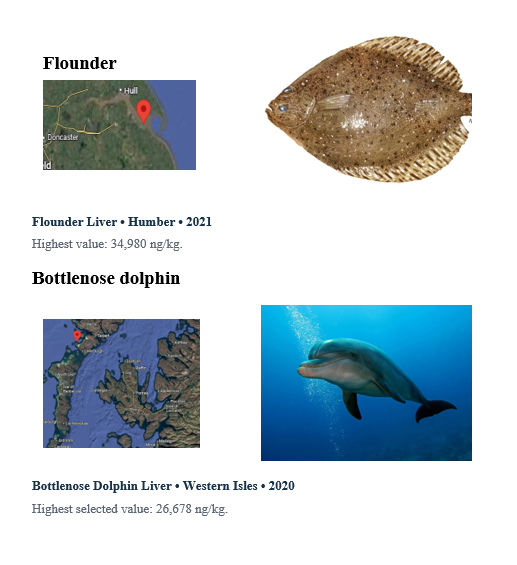
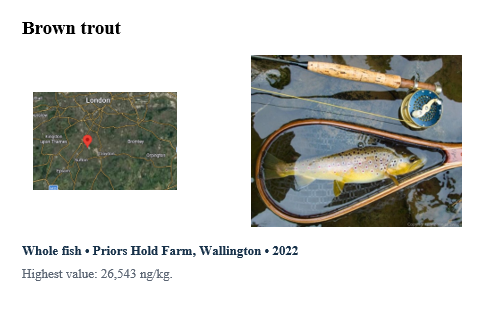
The following profiles show the highest records selected from the working datasets. The maps provide geographic context; they should not all be read as precise carcass-recovery coordinates. The photographs illustrate the species and are not photographs of the sampled animals.
How to read the profiles: Values are ng/kg fresh weight (equivalent to ppt) and show the combined value of PFOS and PFOA for each species. Tissues, years and analytical panels differ, so the records are not directly equivalent.
What the animals are telling us
PFAS released by human activity do not disappear. They circulate through biological matter in watersheds, and they enter prey and accumulate in living bodies. The highest burdens appear where biology and chemistry would lead us to expect them—in protein-rich tissues and in animals that feed high in the food web.
The otter is especially powerful as a sentinel. It lives at the meeting point of river, land and food web. Its liver can reflect wastewater discharges, sludge spread on fields, and military and industrial emissions. When millions of parts per trillion of PFOS are measured in that liver, the proper response is a change of regulatory policy.
The UK needs sustained, transparent PFAS monitoring in water, sediment, fish, birds and mammals; consistent analytical panels that allow comparison over time; accurate public geolocation; and investigation of the sources associated with the highest burdens. Monitoring alone is not enough. The objective must be to stop continuing releases and prevent the next generation of replacement PFAS from repeating the history of PFOS and PFOA.
We treat chemical persistence as an abstract regulatory calculation, but the otter makes it a physical reality. The pollution exiting a military base or a factory today does not disappear—it travels through our watersheds until it becomes embedded in our ecosystems. To save our wildlife, the UK's strategy must evolve from documenting this ecological inheritance to aggressively stopping it.
Sources and data notes
PFAS Data Hub datasets. Harmonized European PFAS monitoring data; working dataset UK_fauna and separate sources #136 and #137.
Military Poisons: UK Biota totals spreadsheet Comprehensive database supporting this articl
Forever Pollution Project: Dataset and Maps. Background on the collaborative dataset and later CNRS improvements.
O'Rourke et al. (2022). Anthropogenic Drivers of Variation in Concentrations of Perfluoroalkyl Substances in Otters from England and Wales.
Roos et al. (2013). Increasing concentrations of perfluoroalkyl acids in Scandinavian otters between 1972 and 2011.
Kannan, Perrotta and Thomas (2006). Association between perfluorinated compounds and pathological conditions in southern sea otters.
O'Rourke et al. (2024). Persistence of PFOA pollution near a PTFE production site and occurrence of replacement PFAS in English otters.
Pereira et al. gannet egg dataset. PFAS in northern gannet eggs from Ailsa Craig and Bass Rock, 1977–2014.
Military Poisons: The Gallos Brook Disaster. Background on the Upper Heyford surface-water testing discussed in the opening.
Military Poisons: Eight former CSUMB students or spouses report cancer diagnoses. Background on the Fort Ord reporting discussed in the opening.
We have raised $3,000 to perform environmental testing at Fort Ord which we will carry out in the fall. Thank you.