Residents suffer from pancreatic cancer, gall bladder cancer, and diseases of the lungs, colon, uterus, kidneys, thyroid, and large intestines
By Pat Elder
March 1, 2026
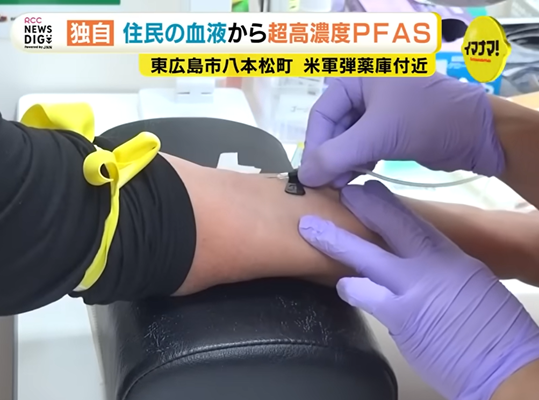
RCC Broadcasting Company / Japan News Network, February 12, 2026
In Hachihonmatsu-cho, a small community in Higashihiroshima City, Japan, residents living near the U.S. Army’s Kawakami Ammunition Depot recently learned that their blood contains extraordinarily high concentrations of per- and polyfluoroalkyl substances (PFAS). Laboratory testing of thirteen residents revealed serum concentrations reaching 2,350.8 ng/mL (nanograms per milliliter, or parts per billion) for seven PFAS compounds identified in clinical guidance issued by the U.S. National Academies of Sciences, Engineering, and Medicine.
The U.S. scientific organization recommends enhanced medical monitoring beginning at 2 ng/mL. The measured concentrations in Hachihonmatsu-cho exceed that threshold by a factor of 1,175.
No comprehensive peer-reviewed study to date documents higher non-occupational community exposure blood PFAS concentrations anywhere in the world.
These concentrations were analyzed from the serum of an elderly couple who have lived their entire lives in the shadow of the U.S. military installation. They are suffering from pancreatic cancer, gallbladder cancer, thyroid disorders, lung disease, colon disease, kidney disease, uterine disease, and other chronic illnesses that peer-reviewed literature has repeatedly associated with elevated PFAS exposure.
People in the village were suffering, and they knew the U.S. Army was poisoning their water. The folks from Hachihonmatsu-cho realized they were in trouble and that help was not on the way, so they came together and organized themselves. They requested government-funded blood testing, but government officials refused. Government officials told community members that high blood results would “only stir up anxiety.” It was clear they were on their own. Thirteen residents ultimately pooled their own money to hire a private laboratory.
Not much help from the media
Japanese media refer to PFAS as emerging contaminants, like this is something new. Newspapers and TV stations still say PFAS “may be associated with health effects.” Meanwhile, internationally, the scientific debate has largely shifted from whether PFAS can cause harm to how much exposure results in what kinds and levels of risk. The state of California classifies PFOS and PFOA as human carcinogens. The International Agency for Research on Cancer classifies PFOA as carcinogenic to humans. Slowly, things are changing.
===========
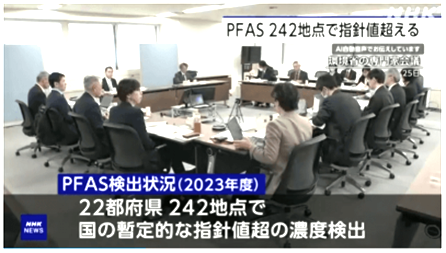
The Government Survey of well water PFAS exceeds guideline value at 242 locations. – NHK News
In April, 2025 the Government of Japan released the first nationwide overview of PFAS contamination in rivers, lakes, and groundwater, documenting 242 exceedances of the provisional 50 ng/L combined PFOS + PFOA target. This was a modest, yet important move to address the risks from these chemicals. (ng/L is nanograms per liter, or parts per trillion.)
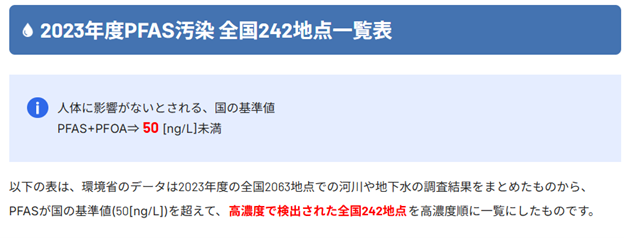
Translation from Japanese Government Advisory -
FY2023 PFAS List of 242 contaminated sites Nationwide.
The national standard values for PFAS + PFOA , that are considered to have no effect on the human body, is less than 50 [ng/L].
The table below lists the 242 locations nationwide where PFAS were detected at high concentrations, exceedingthe national standard (50 ng/L ), in descending order of concentration, based on Ministry of Environment data compiled from surveyresults of rivers and groundwater at 2,063 locationsnationwide in 2023.
We have reformatted this data into a user-friendly spreadsheet.
Japan’s Ministry of the Environment states that the national standard value for PFOS + PFOA “considered to have no effect on the human body” is less than 50 ng/L (50 parts per trillion). This stands in stark contrast to the trajectory of U.S. Environmental Protection Agency (EPA) science.
In June 2022, EPA issued interim updated health advisories for drinking water that were dramatically lower:
PFOA: 0.004 ng/L (4 parts per quadrillion)
PFOS: 0.02 ng/L (20 parts per quadrillion)
Those advisories were not enforceable limits, but they reflected EPA’s determination that adverse health effects may occur at extremely low concentrations — near or below the limits of laboratory detection.
In April 2024, the EPA finalized its first enforceable Maximum Contaminant Levels (MCLs) under the Safe Drinking Water Act:
PFOA: 4 ng/L
PFOS: 4 ng/L
Even these enforceable limits are more than 10 times stricter than Japan’s 50 ng/L benchmark for combined PFOS + PFOA.
The disparity becomes even more alarming when considering bioaccumulation. EPA has long recognized that PFOS bioaccumulates strongly in aquatic organisms. Under EPA ecological risk frameworks, PFOS in surface water can bioaccumulate in fish at factors commonly cited in the range of approximately 4,000-fold or greater.
That means a river concentration of 50 ng/L PFOS could theoretically result in fish tissue concentrations approaching 200,000 ng/kg (200,000 ppt, or 200 ppb). In fact, Japanese scientists with the National Institute of Advanced Industrial Science and Technology (AIST), have catalogued fish containing more than a million parts per trillion of PFOS in the fillet.
Fish consumption then becomes a major exposure pathway, especially for subsistence fishers and communities relying on local waterways. Drinking water standards alone do not capture this risk.
From a comparative regulatory standpoint, Japan’s 50 ng/L standard for PFOS + PFOA in water is scientifically outdated and likely insufficient to protect public health — particularly when fish consumption and cumulative exposure are considered.
In June, 2025, the Japanese Ministry of the Environment revised the Water Supply Act standards to make PFOS and PFOA legally enforceable at the same level. Under the amended statute, beginning on April 1, 2026, all water utilities will be required to conduct regular PFAS testing and ensure compliance with this legal standard.
The June 2025 revision does not introduce legal requirements for PFOS/PFOA in surface waters such as rivers, and lakes. It does not regulate private drinking water wells.
It is good the see Japan moving in the right direction, regulating these two compounds, although PFOS was banned in Japan in 2010 while PFOA was banned in 2021. The data shows, however, that these compounds are still prevalent in the environment. The revised Water Supply Act standards do not regulate any of the 16,000 other PFAS compounds known to exist.
The highest concentration in the country — 26,000 ng/L — was detected in groundwater in Settsu City, Osaka Prefecture, near the Daikin Industries Yodogawa Plant. The second highest concentration — 15,000 ng/L — was detected in groundwater in Higashihiroshima City. The Higashihiroshima result was not publicly reported by the government of Japan until almost two years after sampling occurred.
Residents who had been drinking the contaminated well water were unaware of the magnitude of exposure while the data sat unpublished for nearly two years. Cyclopure, the firm we use to test surface water in Japan and other locations worldwide, routinely returns PFAS water testing results in 2-3 weeks.
The Kawakami Ammunition Depot occupies a large, forested tract within the Seno (Senogawa) River watershed. A tributary of the Seno River crosses the facility footprint before flowing downstream toward residential areas.
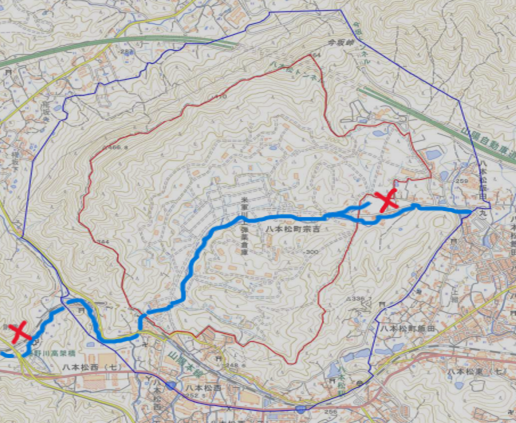
The red boundary shows the perimeter of the U.S. Army Kawakami Ammunition Depot. A tributary of the Seno River cuts across the facility, flowing from the northeast to the southwest. The X on the left shows where we took a water sample from the Seno River while the X on the right shows the location of Hachihonmatsu-cho, where the infamous well sample was collected.
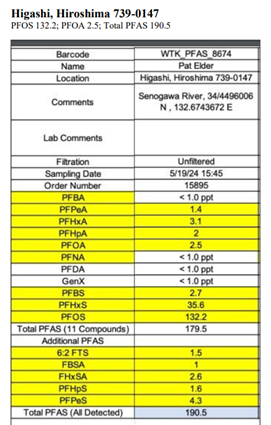
In May 2024, Military Poisons sampled the Senogawa River downstream from the depot. The water measured 190.5 parts per trillion (ppt) of total PFAS, including 132.2 ppt PFOS and 2.5 ppt PFOA.
The dominance of PFOS (132.2 ppt) and PFHxS (35.6 ppt) is very typical of 3M-era AFFF formulations, used at Army installations worldwide. These readings in the river significantly exceed Japan’s ridiculously inflated provisional 50 ng/L (ppt) combined benchmark for PFOS and PFOA.
The U.S. EPA says fish can bioaccumulate PFOS in their fillet at levels that are up to 4,000 times the levels in the river, while there are 132.2 ppt of PFOS in the Senogawa River. Sure, many of these fish are tiny, but they are filled with PFAS, and they are consumed by larger fish.
Concentrations this high, especially for PFOS, are potentially disastrous forever. The entire food chain is likely impacted in the region, starting with the sediment, then, the invertebrates, then, all aquatic life in the watershed for many miles. Finally, land creatures, including humans, are impacted. We spoke these truths to many in the region. The PFAS coats the riverbanks and when the waters recede, the carcinogens are lifted into the air and settle in our lungs, and in our homes as dust.
What’s in your dust, Higashihiroshima City?
What’s in your fish, beef, and chicken, Japan? What’s in your blood? A study by a team of Japanese scientists reported that chicken livers were found to contain 67,000 ppt. Pig livers had 54,000 ppt and cattle had 34,000 ppt.
Dogs were found to have total PFAS at 35 ng/ml in blood serum compared to the 2,350.8 ng/mL in humans at Hachihonmatsu-cho.
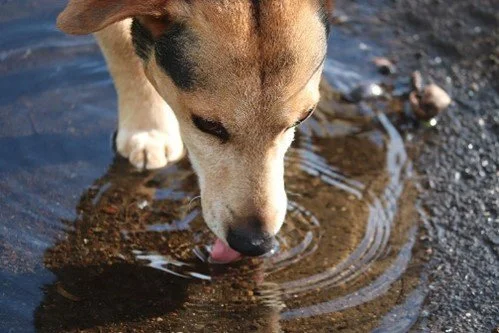
We shouldn’t allow dogs to drink from puddles and we shouldn’t allow humans to ingest any PFAS at all.
We thought these were terribly high levels until reviewing the government’s data for the Senogawa River which show 3,500 ng/L of PFOS and 87 ng/L of PFOA. The PFOS levels are 26 times higher than what we found with our single test. The government data says this concentration was found at “Point 17” on the river. We don’t know where this is and we were not provided with GPS data.
Our efforts since 2023 have helped to raise awareness with the publication of data showing dangerous levels of PFAS in rivers throughout Japan, including the Senogawa River downstream of the Kawakami Ammunition Depot.
See:
Surface water test results from Okinawa, 2023
Surface water test results from mainland Japan, 2023
Surface water test results from Japan, 2024
============
The Veterans for Peace Speaking Tour, organized for many years by Rachel Clark, a Japanese-American woman from New York, focused on U.S. military-caused contamination during whirlwind tours of Japan in 2023 and 2024. The tours visited Okinawa (including 2 remote islands) - Yokosuka - Kitakyushu - Nagasaki - Sasebo - Hiroshima - Iwakuni - Tokushima - Nishinomiya (Kobe) - Kyoto - Kyotango - Komatsu - Kaga - Nakano, Tokyo, among other locations.
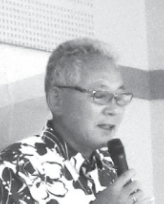
Hideki Nitta, Peace Link Hiroshima
On August 20th, 2024 Hideki Nitta, Peace Link Hiroshima, Kure, Iwakuni Coordinator hosted an event titled "Veterans Speak for Peace in Iwakuni" at the Iwakuni Civic Cultural Hall. It was co-sponsored by the Hiroshima Residents' Association Opposing the Expansion and Reinforcement of Iwakuni Base and the Residents' Network to Protect the Quiet Environment of the Seto Inland Sea.
I was honored to give a presentation, translated by Rachel Clark, that reported on the threat to environmental and health posed by U.S. ammunition depot. The presentation addressed the importance of further surface water testing, as well as well water testing. I encouraged residents to have their blood tested and I explained the 2 ng/ml warning from the U.S. National Academies of Sciences. I stressed the carcinogenicity of the substances, and I specifically addressed many of the diseases now known to afflict residents living in close proximity of the ammunition depot. See Hideki Nitta’s report here.
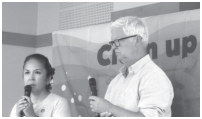
Pat Elder and Rachel Clark in August, 2024.
The poisoned well is 200 meters from the fence
The couple in their eighties had relied on the same private well for decades. Their home sits approximately 200 meters from the perimeter of the Kawakami Ammunition Depot. The water was trusted and it was used daily for drinking and cooking for most of their lives.
As we have read, the water had 15,000 nanograms per liter (ng/L) of total PFAS in their well. For perspective, the U.S. Environmental Protection Agency has finalized a Maximum Contaminant Level (MCL) of 4 ng/L for PFOS and 4 ng/L for PFOA in drinking water, although the Trump Administration has delayed actual enforcement.
The Army isn’t talking
Official U.S. Army communications regarding PFAS at its installations in Japan emphasize drinking water safety. The messaging focuses primarily on ensuring that on-base drinking water provided to service members and their families meets applicable regulatory thresholds. They’ve been honest about providing drinking water mostly free of PFAS at its installations worldwide. They take care of their own.
The Army focuses on drinking water, a relatively inexpensive, controllable endpoint that can be treated with filtration technologies. They don’t address the surface water because they understand there is great potential liability once the Japanese nation wakes up to the threat.
The Army can account for every gallon of aqueous film-forming foam, (AFFF) it has used. They just aren’t going to share it with us because they are worried about the potential liability. The Army admits it used the carcinogenic foams in routine exercises from 1991 to 2009 at the Kawakami Ammunition Depot for training exercises and fire engine inspections. It is likely that the Army used the PFAS-laced foams beginning in the early 1970’s, like it did almost everywhere else.
Aqueous Film Forming Foam (AFFF) is a well-documented source of PFAS contamination at military installations worldwide. PFAS migrate readily through soil into groundwater and surface water. Once present, they are extraordinarily difficult, if not impossible to remove.
There is no public record showing that the U.S. Army has acknowledged PFAS contamination in groundwater or surface water off base at Kawakami Ammunition Depot. Local government requests for environmental surveys to be conducted inside the depot property have been unanswered.
This impasse is attributed to the Japan-U.S. Status of Forces Agreement (SOFA), which places installation access firmly under U.S. military control.
Munitions Disposal
According to the Defense Visual Information Distribution Service, the Kawakami Ammunition Depot uses a specialized deactivation furnace to dispose of outdated munitions. The process utilizes a rotary kiln that reaches temperatures up to 1,200 degrees Fahrenheit to deactivate obsolete or decommissioned materials, including live rounds and "duds" with explosive residue.”
Rotary kiln deactivation furnaces often operate at temperatures insufficient to break strong carbon-fluorine bonds, causing PFAS to aerosolize and contaminate surrounding soil and water. These systems can also release heavy metals, particulates, and toxic byproducts, acting as an unmonitored source of long-term chemical pollution.
Finally, the furnace may also incinerate items that contain PFAS. Fluoropolymer seals, gaskets, and O-rings, along with wire insulation and fluoropolymer coatings on electronic systems may be fed into the furnace only to result in recycling these carcinogens into the environment.
Just one more respectful, but forceful jab at the media over its PFAS coverage.
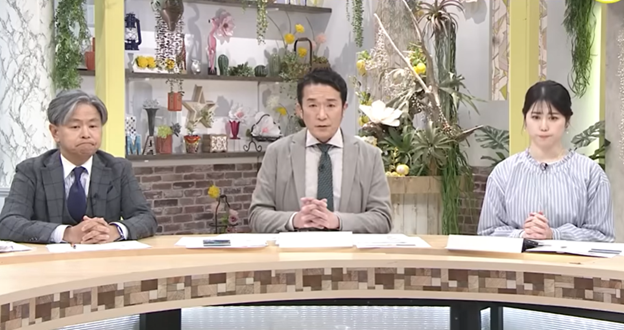
Japan News Network reported on the Hachihonmatsu-cho blood tests. It’s not good news. Japan News Network, 2/12/26
According to the news program, “Tokyo and other cities around the country are collecting blood concentration tests like this – and in reality more data are needed to establish significance in academic surveys to identify the cause. The reason why Higashihiroshima city is not conducting a final concentration test is likely because the country’s policy has not been decided.”
More data is always welcome, but identifying the cause of contamination at Kawakami Ammunition Depot is a fait accompli, as it is in places like Yokota Air Base and U.S. Naval Base Yokosuka.
Regarding the country’s policy, the government took an important step last year when it released national PFAS data, so there is hope they will continue to do the right thing.
Still, the new enforceable 50 ng/L combined PFOS + PFOA drinking-water standard applies only to regulated water utilities. It does not impose limits on privately owned wells, so residents in places like Hachihonmatsu-cho may continue to drink well water poisoned by the U.S. military and powerful Japanese corporations without government interference.
And, finally..
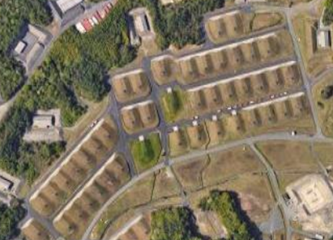
This Google image captures some of the 50 by 100-foot bunkers at the Kawakami Ammunition Depot.
A standard military ammunition storage bunker with a 50-foot by 100-foot footprint typically features an internal ceiling height between 12 and 15 feet, which provides a total gross volume of approximately 75,000 cubic feet. These magazines are specifically designed to accommodate forklifts and palletized stacking, generally resulting in a maximum Net Explosive Weight (NEW) capacity of around 500,000 pounds of explosive material. Regulation 6055.09 – p.95
Net Explosive Weight (NEW) is the actual weight of the propellant and high explosive filler. It does not include the total weight of the metal casings, etc.
If we can count 100 bunkers this might create a capacity of 50 million pounds of conventional ammunition, exceeding the explosive power of the Hiroshima bomb at 30 million pounds. If China and Japan go to war a Chinese strike on the Kawakami Ammunition Depot may be contemplated. It’s not ludicrous to contemplate the risk.

It is striking and deeply troubling that our work appears to be gaining more traction in Japan than in the United States. A lot of positive change has occurred in Japan in a short period of time, although more work needs to be done. Communities there are demanding answers, but not so much at home.
Hawaiʻi may be the lone partial exception, though even there, the state’s governor and congressional representatives have been hesitant to confront the Department of Defense or compel meaningful accountability for widespread contamination.
Meanwhile, nearly 2,000 people who lived at Fort Ord, California, have died or are suffering from cancer and serious disease. For decades, the Army used and disposed of Agent Orange, PFAS, trichloroethylene (TCE), and a toxic mixture of volatile organic compounds with reckless disregard. The human toll is no longer abstract — it is written in obituaries and oncology wards.
This spring, we hope to return to Marina and Seaside to conduct independent PFAS testing of surface waters. Communities deserve data. Families deserve clarity.
Can you help us make this happen? Please see the bottom of this page: https://www.fortordcontamination.org/ https://www.fortordcontamination.org/