PFAS in Hilo, Hawaii
A stream adjacent to Chiefess Kapi’olani Elementary School is contaminated with the carcinogens.
By Pat Elder
February 27, 2026
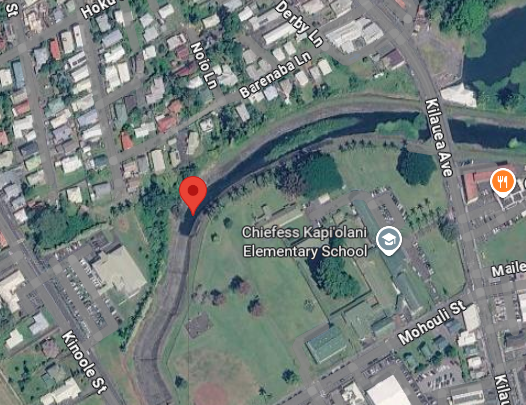
We collected a water sample from a stream running directly behind Chiefess Kapiʻolani Elementary School in Hilo that contained carcinogenic per-and poly fluoroalkyl substances, PFAS. The school playground sits only a few blocks from the runway of Hilo International Airport. Immediately adjacent to the airport property is the Hilo Army Aviation Support Facility #2 (AASF #2), a Hawaiʻi Army National Guard aviation installation.
The stream flows into Waiākea Pond, a low-elevation coastal waterbody that discharges into Hilo Bay less than a mile away. Because the system lies at or near sea level and is directly connected to the bay, tidal backwater effects likely influence water levels and flow direction within portions of the stream corridor.
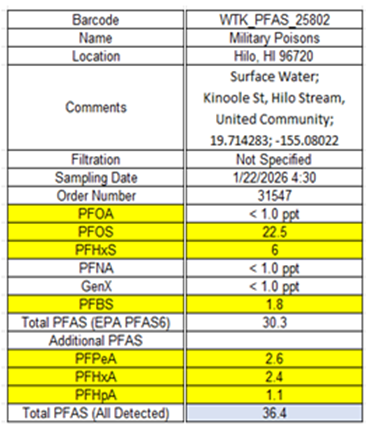
Laboratory analysis detected 36.4 parts per trillion (ppt) of total PFAS, including 22.5 ppt of PFOS, along with PFHxS, PFBS, PFPeA, PFHxA, and PFHpA.
This is not a pressing health crisis. The sample was taken from surface water, not drinking water. No child is in immediate danger. But the presence of multiple PFAS compounds in a stream immediately adjacent to an elementary school warrants scientific attention — particularly given the chemical profile.
PFOS and PFHxS dominate the sample. These sulfonates are strongly associated with legacy aqueous film-forming foam (AFFF), the firefighting agent used for decades at military and civilian airports nationwide. These compounds can come from other sources, but their prominence near an active aviation facility raises reasonable questions.
The Army is the least transparent of the military branches in these matters. They rarely admit to using the substances and they never acknowledge environment or health impacts. Here, the likely environmental liability is shared with the state.
From the Army’s PFAS investigation, “Historically, documentation of PFAS use was not required because PFAS were considered benign. Therefore, records were not typically kept by the facility or available during the Preliminary Assessment on the use of PFAS in training, firefighting, or other non-traditional activities, or on its disposition.”
The Army report says personnel available for interviews had knowledge dating back only to 1989. The use and storage of AFFF between 1969 and 1989 are described as unknown. The report concludes, “No known or documented releases of PFAS to the environment were identified.”
The Army National Guard report acknowledges that eight major aviation incidents have occurred at Hilo International Airport over the years.
During one early 1990s event, Hilo Army Aviation Support Facility #2 personnel reported assisting with water and Halon extinguishers. For the remaining incidents, however, the response actions, locations, and extinguishing agents used are described as “generally unknown.”
That admission is significant. The airport is owned and operated by the State of Hawaii, specifically through the Hawaii Department of Transportation (HDOT) – Airports Division.
For decades, U.S. Federal Aviation Administration regulations under 14 CFR Part 139 required airports to maintain Aircraft Rescue and Fire Fighting (ARFF) services equipped with aqueous film-forming foam (AFFF) that met accepted performance standards, because water alone is ineffective against high-intensity hydrocarbon fuel fires and AFFF was the only agent that consistently met FAA-approved extinguishing performance.
Given the longstanding regulatory requirements governing ARFF operations, the claim that the extinguishing agents used in seven of eight major aviation incidents are “generally unknown” is difficult to reconcile with standard aviation fire-response protocols.
This is how the Army operates. The absence of documentation is used to support a broader conclusion: because no use, storage, or disposal of PFAS-containing materials could be documented from 1989 forward, no “Areas of Interest” were identified and the investigation was closed. They failed to take a single environmental sample.
We can gain valuable insight from Kalaeloa Airport (John Rodgers Field) Oʻahu, where the Kalaeloa Army Aviation Support Facility #1-JRF is located.
In the Preliminary Assessment and Site Inspection, the Hawaiʻi Army National Guard does not identify any AFFF releases attributable to its own operations at AASF #1–JRF. Instead, documented historical foam discharge activities are associated with the Hawaiʻi Department of Transportation – Airports Division (DOT-A), which has operated the airfield following the Navy’s departure in 1999.
Because releases were identified, unlike at Hilo, the base advanced to the Site Inspection stage of a deeply flawed CERCLA process. That step produced limited but revealing data. Soil samples collected from 0–2 feet below ground surface contained 1,500 µg/kg (1.5 million ppt) of PFOS. Groundwater 34 feet below the surface was contaminated with a shocking 6,900 ppt of PFOS.
At Kalaeloa, documented foam use produced measurable contamination and a formal Site Inspection. At Hilo, the same aviation realities are described as unknowable and the investigation was closed.

Warriors who care for the land.
Finally, the Army National Guard did not sample surface water at Kalaeloa. Surface water in the area flows generally from the mountains toward the ocean in a southerly direction, while the property contains approximately 80 underground injection control wells designed to capture stormwater runoff. The Hawaiʻi Department of Health requested drainage maps showing how surface water flows toward these wells. The Guard declined to provide the maps, citing security concerns.
The Navy’s November 29, 2022 release at Red Hill involved approximately 1,300 gallons of AFFF concentrate. By comparison, if Kalaeloa’s reported practice of discharging 25 gallons of concentrate per month continued for just a little more than four years, the cumulative volume released would exceed the total amount spilled at Red Hill.
In other words, routine foam releases at a state-run airports are well documented elsewhere in Hawaiʻi.
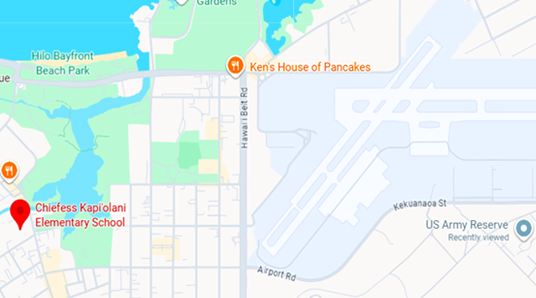
Chiefess Kapi’olani Elementary School is just a few blocks from the runway and the Hilo Army Aviation Support Facility #2, Hawai‘i, where the use of aqueous film-forming foam has been documented.
The surface water data behind Chiefess Kapiʻolani Elementary does not prove causation. It does not establish liability, and it does not demonstrate an acute health emergency, but it deserves scrutiny.
A rigorous investigation is called for that includes further testing of the stream and Waiākea Pond. Sediment at several locations and groundwater must be analyzed between the contamination site and the school. Fish should be tested. This is what more prudent nations on earth do.
Some science
The six compounds detected are classified as terminal perfluoroalkyl acids—the stable end-products that laboratories measure under EPA analytical methods. These terminal PFAS tend to last forever in the environment and are often formed through the breakdown of precursor compounds, meaning their presence can reflect both direct releases and the transformation of other PFAS over time.
Many PFAS enter the environment not as terminal acids but as precursor compounds. These precursors (original compounds) can transform overtime through environmental processes into PFOS and other terminal kinds of PFAS. Standard laboratory testing generally measures only the terminal acids and does not capture most precursor compounds.
The detected 36.4 ppt reflects only the PFAS already converted into terminal forms. It does not represent the full PFAS burden in the stream.
Dr. Roger Brewer, a retired environmental chemist formerly with the Hawaiʻi State Department of Health, has emphasized that reliance solely on terminal PFAS testing can underestimate the true extent of contamination. Brewer shows us that many PFAS present in the environment are not terminal acids but parent compounds that may escape detection under conventional analytical methods. Over time, environmental processes such as oxidation and biodegradation can transform these parent compounds into regulated terminal acids, including PFOS, thereby increasing measured concentrations long after the original release.
By ignoring precursor compounds, regulators risk overlooking a chemical time bomb, a hidden reservoir of PFAS that can convert into persistent, regulated acids many years after discharge.
Here is an example of a precursor like N-etFOSA, which is found in many legacy AFFF formulation, transforming into deadly, terminal PFOS over time
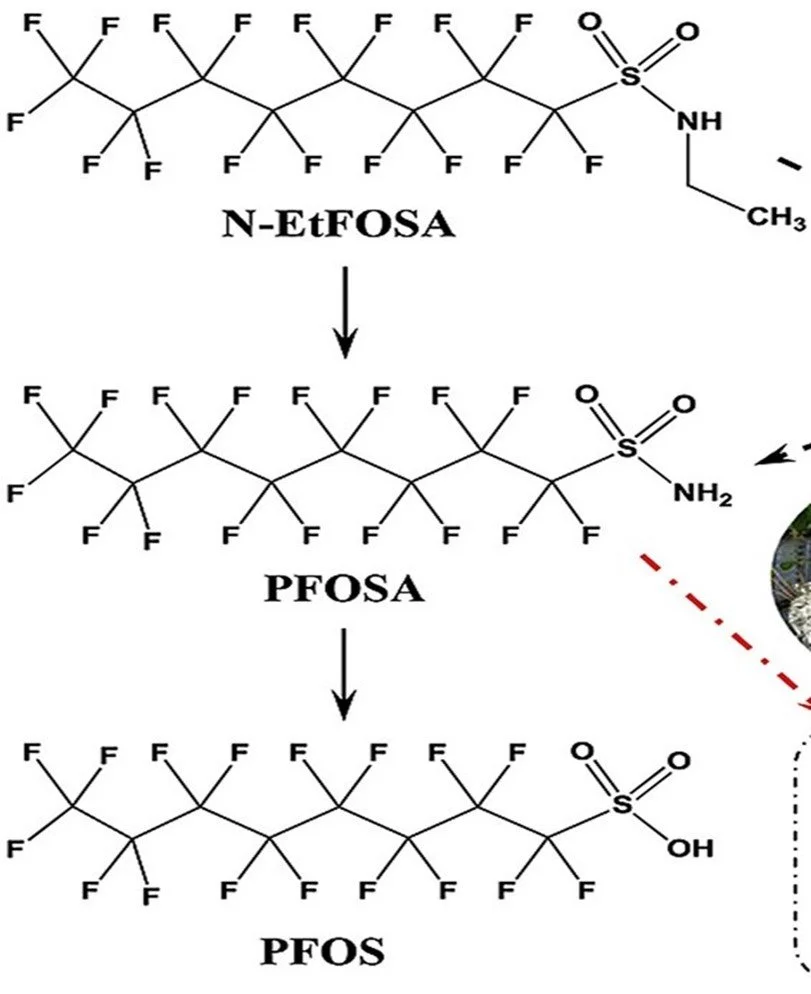
We may only be seeing the tip of the toxic iceberg from this one lonely sample in Hilo.
PFOS has a strong affinity for organic matter and fine sediments. As a result, even moderate concentrations in surface water can lead to higher concentrations in streambed sediments. Because the stream drains into Waiākea Pond, PFOS may settle and accumulate in sediments where fine particles deposit. Over time, aquatic invertebrates and fish can accumulate PFOS at concentrations significantly higher than those found in the surrounding water. Sediments can also act as long-term reservoirs that release PFOS back into the water column during storms or disturbance events.
According to the EPA, “PFOS has been shown to accumulate to levels of concern in fish. The estimated bioconcentration factor in fish ranges from 1,000 to 4,000.” Using the upper end of that EPA range as an illustration, a water concentration of 22.5 ppt could theoretically correspond to fish tissue concentrations in the tens of thousands of parts per trillion.
At the former Wurtsmith Air Force Base in Michigan, PFOS in fish filets reached 9,580 ppb—equivalent to 9.58 million ppt—demonstrating that fish near AFFF-impacted military sites can carry PFOS in the million-ppt range.
PFOS is well known to bind to organic matter and accumulate in sediments and aquatic invertebrates. Small forage fish that feed in contaminated sediments can accumulate PFOS, and larger predatory fish can then accumulate higher levels. For this reason, even moderate PFOS concentrations in surface water can translate into significantly higher concentrations in sediment and aquatic organisms, creating a potential pathway of human exposure through fish consumption.
To keep these figures in perspective, the Biden Administration’s EPA finalized a 4 parts per trillion (ppt) Maximum Contaminant Level (MCL) for PFOS in drinking water in April 2024, originally requiring compliance by 2029; however, Trump’s EPA has announced plans to extend the compliance deadline to 2031 while retaining the 4 ppt standard.
Although the EPA has established a 4 ppt national drinking water standard for PFOS, it has not acted to regulate the chemicals in surface water. Hawaiʻi has not adopted independent state-level PFAS standards for drinking water or surface waters. As a result, regulatory protection in the state remains largely dependent on federal action and federal enforcement timelines. If federal implementation continues to be delayed and deprioritized, Hawaiʻi will continue to lack a separate state statutory framework to ensure protections.
PFOS in the air and dust at the elementary school
PFOS is not volatile and does not evaporate into air under environmental conditions. However, PFOS binds strongly to soils and organic matter. If stream banks contain PFOS-bearing sediments, children could be exposed through the dust and air in the building.
When contaminated sediments dry and are lifted by wind, mowing, or foot traffic, PFOS can attach to airborne dust particles.
PFOS exposure during pregnancy and early childhood has been associated with developmental effects, including reduced birth weight, immune system suppression (such as decreased vaccine response), and potential impacts on growth and neurodevelopment.
The available data confirm the presence of multiple PFAS compounds in a school-adjacent stream, with PFOS as the dominant contaminant. The results support further scientific investigation.
===============================
This article is part 8 of a multi-part series on PFAS in Hawaii.
Part 1 – The Army is leaving contaminated O’ahu sites to focus on Pohakuloa
A look at the Army’s strategy for retaining lands in Hawai’i while public pressure is mounting to not renew Army-leased lands 38 pages. January 12, 2026.
Part 2 – PFAS contamination at Pohakuloa
PFAS is much worse at Pohakuloa than anyone knew. 27 pages. January 14, 2026.
Part 3 – PFAS contamination at three leased bases on O’ahu
The Army says there is no PFAS contamination at Kahuku Training Area, Makua Military Reservation, and Kawailoa-Poamoho Training Area but an analysis shows otherwise. 27 pages. January 26, 2026
Part 4 – PFAS contamination at Wheeler Army Airfield
Plenty of evidence showing how the Army flagrantly violates federal law. It reports 174.7 parts per trillion of PFAS from one groundwater test while the Navy reports 2.88 million parts per trillion in groundwater nearby. 33 pages. February 1, 2026.
Part 5 - PFAS contamination at the Fort Shafter Child Development Center
The daycare facility is located 300 feet from a contaminated former Army firefighting foam training area. A stream believed to be carrying the carcinogens passes just 60 feet from where children play outside. 10 pages. February 7, 2026
Part 6 - PFAS contamination at Tripler Army Medical Center
The Army hides PFAS contamination from dozens of sources, refusing to divulge levels of the toxins in the environment. 7 pages. February 8, 2026
Part 7 - The Army shows no progress on cleaning up PFAS in Hawai’i.
CERCLA Has Become a Procedural Stumbling Block 11 pages February 17, 2026
==============================

This project is supported by financial assistance from the Sierra Club of Hawaii.
The Sierra Club of Hawaiʻi is the state chapter of the national Sierra Club and operates as a grassroots environmental advocacy organization focused on climate, land, water, justice, and outdoor access issues in Hawaiʻi. Can you take a moment to support this work? Please donate.