By Pat Elder
March 10, 2026
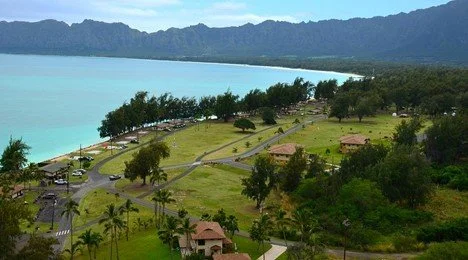
Aerial view of the Bellows Air Force Station coastal recreation area along Waimānalo Bay on Oʻahu.
Bellows Air Force Station in Hawai’i presents a disturbing case study in how the military’s PFAS investigations are structured to narrow public understanding while limiting the scope and cost of cleanup. Most of the old Air Force base was transferred to the Marine Corps in 1999, creating an opportunity for the Pentagon to bury the environmental record. The Air Force limited its review to the coastal recreation parcel it retained. This is an area unlikely to contain contamination sources. Meanwhile, the Marine Corps focused on a single aircraft crash site under its tenure, ignoring the historical record of PFAS contamination.
No fire training areas, fire stations, hangars, or emergency response areas were identified within the boundary of the current Bellows Air Force Station parcel, consisting of 422 acres, according to an Air Force final report on PFAS. The PFAS Preliminary Assessment / Site Inspection for Bellows Air Force Station notes that the Bellows runways were closed in 1958, ending their role as an active airfield. Based on this closure, the report concluded that significant AFFF releases were unlikely to have occurred at Bellows AFS after 1970.
They’re not telling the whole story of PFAS contamination by the Air Force since the late 1960’s. The Marine Corps acquired 1,049 acres of Bellows Air Force Station from the Air Force in 1999. The Marine Corps Training Area Bellows is now part of Marine Corps Base Hawaii, headquartered in Kaneohe Bay.
According to internal Air Force correspondence from 2017, “The Marine Corps Training Area Bellows is not part of this scope of the project, and regardless of the operator of the facility in the past, the Marines now control this installation and own the environmental program there. The Air Force has neither permission to conduct investigations on, nor the authority to spend AF funding on, this USMC installation.” (PA/SI).
So, it’s up to the Marines to report on the reckless behavior of the Air Force through 1999.
The Air Force apparently didn’t tell the Marine Corps much about its PFAS past while the Marines are apparently happy to look the other way.
In 2000, one year after the handover to the Marines, the Air Force Environmental Restoration Program released a report on various kinds of contamination at Bellows Air Force Station. During the investigation of “Site 22” inspectors reported finding discarded drums that were rusted and empty. Several of the drums were labeled “Jet Fuel,” and notably, one steel drum with a plastic inner liner was labeled “AFFF – Fire Fighting Agent.” A second drum with a similar plastic liner was located within two feet of the AFFF drum. Even though the containers were empty when discovered, their presence indicates that firefighting foam was stored or handled at this location.
Throughout the world, the Air Force routinely created massive, unlined craters, filled them with jet fuel, ignited an inferno, and then instructed airmen to douse the flames using the carcinogenic foams. The description of an AFFF-labeled drum at a waste site in this Air Force document should have been treated as an obvious indication of PFAS contamination. Both the Air Force and the Marines ignored it, while state regulators remained on the sidelines.
The Air Force report does not identify the exact locations of the drums, and the reports do not include photographs of the drums or surface debris.
The DOD is playing a kind of PFAS shell game with us.

The red X shows the location of the MV-22 crash.
The dismissive Air Force report briefly references a 2015 MV-22 aircraft crash that occurred at the runway intersection on May 17, 2015. It was a terrible accident that claimed the lives of two Marines and injured 20 others on board.
More than 100 gallons of AFFF were used to suppress the fire. The environmental response was conducted by the Navy.
The November, 2023 PFAS Site Inspection for Marine Corps Base Hawaii contained brief reporting on the Bellows installation, focusing exclusively on the MV-22 crash. Although there are likely several dozen PFAS locations at Bellows, this site was the only “Area of Interest” identified in the Preliminary Assessment. The Marine Corps closed PFAS investigations on the remainder of the facility. They collected 16 soil samples and just three groundwater samples at the crash site.
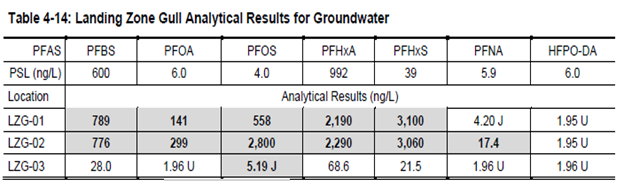
The chart shows that the results of various PFAS compounds exceed the project screening levels. These are the levels that trigger a requirement for more testing, possibly leading to clean-up,
The results from the Marine Corps study showed dangerously high levels of groundwater contamination. This is one important area where the Army and the Navy diverge. The Army rarely reports groundwater levels above three digits. For instance, the highest levels of PFAS at Wheeler Army Airfield were reported at 174 parts per trillion for total PFAS.
Sample “Landing Zone-02” contained a total of 9,242.4 ng/L (ppt) of PFAS in groundwater. The 2,800 ng/l is 700 times over the EPA standard. It is a minor concentration compared to the 2.8 million ppt reported by the Navy at Pearl Harbor.
The Marines argue it’s not a big deal because nobody drinks this water, but it means the entire food chain is poisoned forever.
The Marine Corps Site Inspection reported soil at the same location at 12.4 ug/kg (ppb) for PFOS. The Project Screening Level (PSL) for PFOS is 12.6 µg/kg. This means the detected concentration is just below the screening threshold. It’s a shell game, while they can tell us pretty much anything they want. There are no checks and balances. There is no transparency.
It is the chronic use of AFFF and PFAS in a host of products that contributes a far greater share of the PFAS in the environment than a single accident. It is the overhead foam suppression systems, the fire training areas, the machine shops that produce contaminated waste streams that create most of the contamination.
The Marine report failed to test surface water at Bellows.
Make it stand out
Whatever it is, the way you tell your story online can make all the difference.
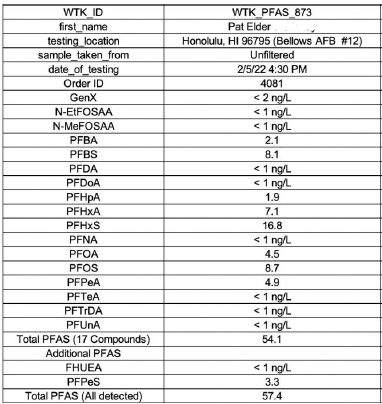
Military Poisons collected a single surface water sample from Waimanalo Stream near Bellows Air Force Station on February 5, 2022.
We detected nine PFAS compounds totalling 57.4 ppt. It pales in comparison to the groundwater reported at the runway, but it is nonetheless threatening because it shows contamination in the stream, undersoring the necessity of the institution of a robust fish testing regime.
The state has tested fish throughout O’ahu but it has been several years and they have still not released the results.
The Air Force Environmental Restoration Program report from 2000 identified four highly contaminated sites at Bellows. They were more concerned with traditional contaminants such as petroleum hydrocarbons, solvents, and metals than PFAS. However, like many legacy waste-management areas on military installations, these locations remain predictable pathways for PFAS contamination.
They identified the landfill, two disposal pits, and a storm drainage system that carried runoff from maintenance yards, fuel handling areas, and other operational surfaces toward lower areas of the installation and eventually toward coastal discharge points. None of these were addressed by the Marine Corps in its PFAS assessment.
Public descriptions of exercises at Bellows indicate that training has included mortar firing, anti-armor weapons, and maneuver exercises involving rocket launchers and other infantry support weapons. Because Bellows lies close to residential areas, much of this training today involves simulated or controlled live-fire scenarios.
An examination of the Air Force Civil Engineer Center Administrative Record shows a host of sites that ought to be examined for PFAS exposure.
Former Large Bombing Rainge
Former AOC-18 Dump
Multiple Dump Sites
Pier Dump Site
Cesspool/Injection Well
Wash Racks
Bomb Dispersal Area
Multiple underground storage tanks
Urban Warfare Training Facility
WP-07 Grease Pit.
Other documented sites/tests:
AFFF drum burial site
Waimānalo Stream - Surface-Water, Sediment, and stream bank
Various surface water bodies
Deep Water Monitoring Wells
Pump and Treat Systems
Fish Testing
Field training exercises.
Helicopter landing zones and aviation support areas
Maintenance, wash-water, and wastewater
PFAS Volatility, Dust Testing
The military’s investigation of PFAS contamination at Bellows is a despicable campaign to curtail what the public is allowed to see while limiting the financial liability of testing and cleanup. The Air Force restricted its study to the narrow coastal recreation parcel, an area not expected to contain the major sources of contamination, while the Marine Corps limited its review to a single aircraft crash site and declared the rest of the installation outside the scope of concern. In doing so, both services have effectively obscured the historical record of firefighting foam use, fuel handling, maintenance operations, and training activities that are widely recognized sources of PFAS contamination.
====================================================================================================================

Julie Akey’s story has become one of the most powerful human accounts tied to military contamination. Julie lived at Fort Ord for roughly a year and a half in the late 1990s while studying Arabic. Nearly two decades later, in 2017, she was diagnosed with Multiple Myeloma, a rare and incurable cancer of the blood that typically affects much older adults.
After her diagnosis, Julie began hearing from other former service members and families who had lived at Fort Ord and developed similar cancers. She helped start a Facebook group and built a registry of former residents. She identified 138 people who lived in her extended neighborhood were diagnosed with the blood cancer. Many are deceased. Today she has a database of close to 2,000 who lived at Fort Ord and are suffering with a host of diseases and cancers.
PFAS, Benzene, and Trichlorothylene have been linked to Multiple Myeloma. These killers are found in the groundwater at Fort Ord and they may have caused widespread sickness. We would like to test surface water bodies for PFAS in and around the former Army base. It’s something we can do. Can you help us make this happen? Please see the bottom of this page to contribute: https://www.fortordcontamination.org/