Guest commentary: Fort Ord’s unanswered health questions

Opinion > Commentary Online here.

By Julie Akey
PUBLISHED: July 13, 2026 at 9:11 AM PDT
“For thousands of former Fort Ord residents and veterans, this report is not the end of the story. It is a reminder of how much we still do not know—and why the investigation must continue.”
Sean Tubo's July 10 Monterey Herald article, "New study says Fort Ord water posed no public health hazard," accurately reports the conclusions of the Agency for Toxic Substances and Disease Registry’s (ATSDR) updated Health Consultation. However, the ATSDR answers only a narrow question: whether a limited number of contaminants found in drinking water between 1985 and 1994 were likely to pose unacceptable health risks. The ATSDR report does not answer the broader question that thousands of former soldiers, military families, civilian employees, and Monterey County residents have been asking for decades: Did contamination at Fort Ord sicken and kill many?
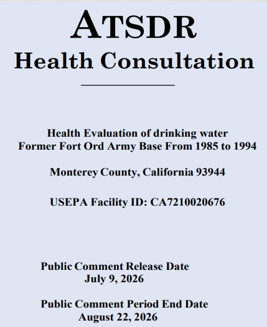
The agency limited its evaluation to 1985 through 1994 largely to remain consistent with an assessment it conducted in 1996. That may satisfy an administrative objective, but it is not a scientific one. Fort Ord remained occupied after 1994, and thousands of people continued to live, work, attend school, and recreate there for years after the Army closed the base.
I know because I was one of them.
I lived at Fort Ord in 1996 and 1997. Twenty years later I was diagnosed with Multiple Myeloma. Since then, I have identified 138 people who lived or served at Fort Ord and later developed the same blood cancer. Altogether, I have compiled a database of nearly 2,000 former residents and military personnel suffering from cancers and other serious illnesses associated with chemicals known to have contaminated the installation. Most of these diseases are associated with military activities.
The report also acknowledges another major limitation: there are virtually no drinking-water records before 1985. Without those records, ATSDR cannot evaluate exposures during much of Fort Ord's operational history. That absence of data should never be interpreted as evidence that harmful exposures did not occur. It simply means we do not know.
Nor does the report examine every contaminant that may have been present. It evaluates only nine chemicals identified in available drinking-water records. As a result, its conclusions apply only to those contaminants, during that limited period, under the specific exposure assumptions used by the agency.
Perhaps the most significant unanswered question involves vapor intrusion.
ATSDR openly acknowledges that indoor-air and sub-slab sampling are needed to determine whether toxic vapors migrated from contaminated groundwater and soil gas into occupied buildings. Because those data do not exist for the period studied, the agency states it cannot determine whether people were exposed through this pathway.
This is an extraordinary admission.
Today, large portions of the former Fort Ord have been redeveloped into neighborhoods, apartment complexes, schools, university facilities, athletic fields, offices, and retail centers. Many sit above documented groundwater plumes containing trichloroethylene (TCE), tetrachloroethylene (PCE), carbon tetrachloride, and other volatile chemicals.
At The Dunes on Monterey Bay, soil-gas investigations continue to detect elevated concentrations of TCE and PCE beneath a busy commercial development. Yet comparable investigations have not been conducted beneath many residential neighborhoods or student housing at California State University, Monterey Bay, located above documented groundwater contamination.
The reported outdoor concentrations of PCE (tetrachloroethylene) and TCE (trichloroethylene) are exceptionally severe for an open-air pedestrian environment. Employees and regular shoppers may be at risk.
Vapor intrusion is not simply a historical concern. It represents a current exposure pathway affecting people who live, work, shop, and study on the former base today.
PFAS contamination presents another major gap. Because these "forever chemicals" were not monitored in drinking water during the 1985-1994 period, ATSDR correctly concludes that it cannot evaluate potential health risks from PFAS exposure. But that should not be misunderstood as evidence that PFAS were absent.
The report does not evaluate every contaminant, every exposure pathway, or every period of Fort Ord's history. It does not assess pre-1985 drinking-water exposures, post-1994 redevelopment, vapor intrusion into occupied buildings, PFAS contamination, contaminated soils, or other potential routes of exposure.
ATSDR should evaluate post-1994 exposure scenarios, including neighborhoods, schools, university facilities, athletic complexes, and commercial developments built on the former installation. It should recommend comprehensive indoor-air testing where groundwater plumes remain beneath occupied buildings. It should continue searching for pre-1985 environmental records and support investigations into PFAS and other contaminants that could not be evaluated because historical monitoring data are missing.
For thousands of former Fort Ord residents and veterans, this report is not the end of the story. It is a reminder of how much we still do not know—and why the investigation must continue.
- Julie Akey
==========================================
Please help us with a contribution
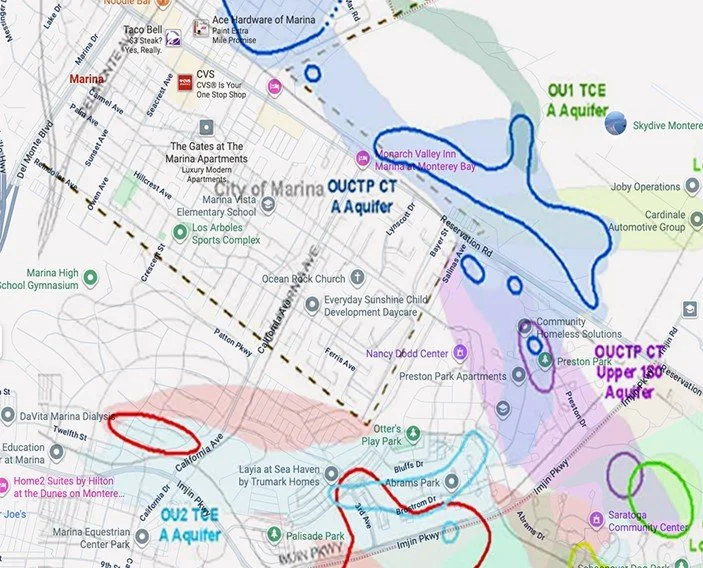
The Army, ATSDR, EPA, and the state of California neglected to test for volatile organic compounds on the former Fort Ord.
- Plume map, Fort Ord Cleanup
Thousands of civilians and college students now live, work, study, and sleep above documented groundwater plumes containing trichloroethylene (TCE), carbon tetrachloride (CT), and tetrachloroethylene (PCE) at the former Fort Ord. While groundwater contamination has been extensively mapped, no testing has been conducted to determine whether these volatile chemicals are migrating into occupied buildings through vapor intrusion.
We seek funding to conduct independent indoor-air monitoring in residences, retail buildings, and student housing, while simultaneously sampling PFAS in surface water and drinking water throughout the former installation. The resulting data will be shared publicly and with regulatory agencies to help determine whether additional health protections are warranted.
Can you help us do this? Go here, to the bottom of the page, to contribute. https://www.fortordcontamination.org/