
The Geometry of War
By Pat Elder
July 22, 2026
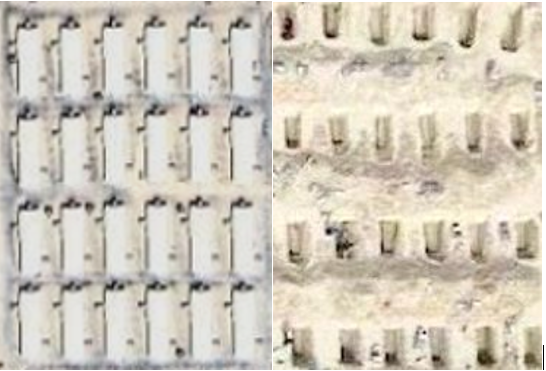
On the left, a satellite image of the U.S. Army’s Ammunition Supply Point at Camp Buehring, Kuwait.
On the right, freshly dug graves in the new cemetery beside the Shajareh Tayyebeh Girl’s School in Minab, Iran.
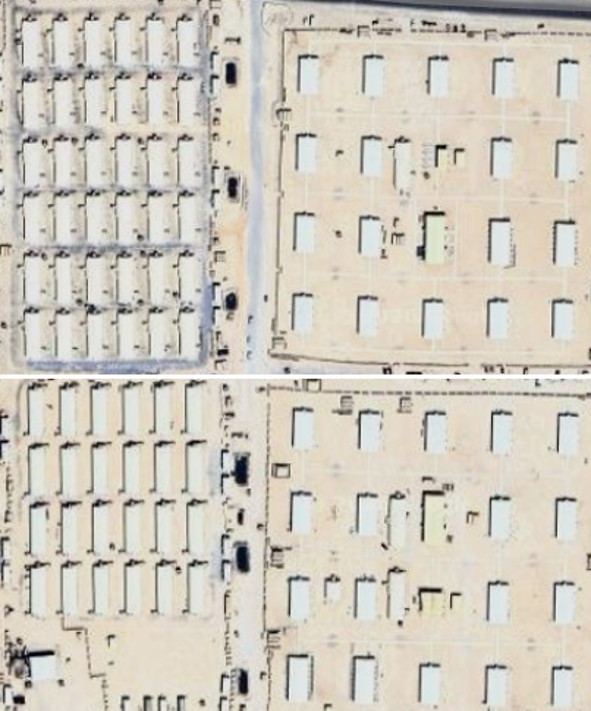
Camp Buehring reveals rows of nearly identical ammunition magazines arranged with mathematical precision, each structure separated by the same measured distance and aligned in an orderly grid designed for the efficient storage and movement of weapons.
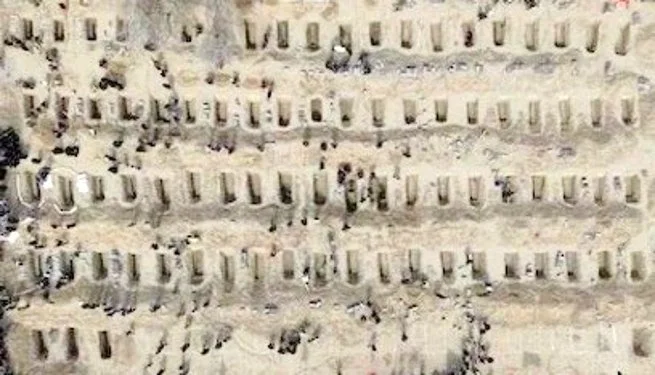
Aerial imagery of the Minab cemetery shows fresh graves excavated in equally disciplined rows after the U.S. strike on Shajareh Tayyebeh Girls' School. The photo shows row upon row of newly dug burial plots.
The two landscapes serve entirely different purposes, yet they are linked by a haunting visual symmetry. One is an architecture of logistics, where standardized spacing reflects the orderly management of destructive force. The other is an architecture of mourning, where standardized spacing reflects the hurried necessity of burying the dead. (Peace be upon them.)
This is not meant to suggest that Army weapons were used at Minab. Navy Tomahawks likely killed the children. It is the geometry that is striking.
The imagery from above both landscapes resolve into the same repetitive language of rectangles and parallel rows, a reminder that modern warfare leaves its own unmistakable patterns not only in military infrastructure but also in the places where its human consequences are ultimately laid to rest.
For months I carried the image in my head of the freshly dug graves in Minab. Then it struck me when I recently viewed Google images of the U.S. Army’s Ammunition Supply Point at Camp Buehring Kuwait, before it was largely destroyed by the Iranians.
The precise ammunition depot grid was constructed to store the machinery of war, from small-arms ammunition and artillery shells to guided rockets, missiles, and precision-guided aircraft munitions.
The graves were dug to receive its punishment.
Reuters documented the Minab attack and photographed the freshly prepared graves—rows upon rows of identical rectangular excavations cut into the earth, waiting for the bodies of children and their teachers. There is order and repetition, imposed by imperial barbarism.
Seen from above, the two landscapes echo one another with unsettling precision: rows of rectangles, evenly spaced, stretching across the ground. One represents irreversible loss and engenders future generations of malice. The other demonstrates the mechanics of the Zionist American merger fueled by corporate ascendency, institutionalized war preparation, and imperial fantasies.
History has often been written through such images. From the regimented trenches of the First World War to the endless rows of gravestones at National Cemetery. Geometry is one of war's recurring visual languages. We see the geometry in today’s rectangular runways, circular fire training areas, and the arc of ballistic missiles. They represent the geometry of war.