Is It Safe to Live Here?
Building Homes on the Footprint of RAF Upper Heyford
By Pat Elder
April 30, 2026
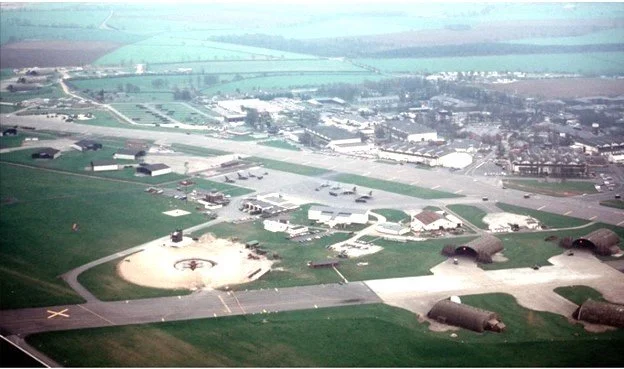
A 1989 aerial view of RAF Upper Heyford shows the circular fire training area.

Plans call for up to 9,000 homes at former RAF Upper Heyford, England. What could go wrong? - BBC
I have responded to questions I received from people living in the Upper Heyford region.
Is it safe to live here?
It may or may not be safe to live near RAF Upper Heyford, and the answer depends on specific conditions at each property. Decades of airfield operations, including firefighting foam use, fuel handling, and industrial maintenance left behind PFAS in soil, groundwater, surface water, sediments, and the air. These chemicals are highly persistent and mobile, meaning they can remain in the environment for centuries (and likely longer) and move through water systems.
While municipal drinking water in the UK is regulated and often tested, it is still advisable to test your tap water. I like Cyclopure for testing water. The firm is in Chicago, and a single kit is $85. https://cyclopure.com/product/wtk/ It’s great because the water runs through the bottom of the cup through a filter. The dry cup is mailed back to Cyclopure.
For blood testing, I recommend Empower DX for $279. https://empowerdxlab.com/products/product/pfas-16-test-legacy-compounds.
I had my blood tested. The sample measured 42.2 nanograms per milliliter (ng/mL), equivalent to 42.2 micrograms per liter (µg/L), or 42.2 parts per billion (ppb). See the results here. I live 1,800 feet across the creek from a Navy base that had a fire training area in use for more than 20 years. The foams accumulate daily on my beach and the PFAS has poisoned the fish, crabs, and oysters in the Chesapeake region. I feasted off of the seafood from my beach.
The 100 parts per trillion of total PFAS allowed in your tap water is not fully protective of human life. Women who are pregnant or may become pregnant should not be consuming any level of PFAS in drinking water and neither should anyone else. Contamination in private wells may be a serious threat. Groundwater beneath the fire training area is reported to move mainly southeast. The most reliable way to determine safety is through targeted, site-specific testing of water, soil, and indoor dust. It can be tricky to test groundwater due to the impact of gravity and the slow, but steady downward seepage. For instance, testing at 50 feet and at 500 feet below the surface may find low levels while concentrations may be in the tens of thousands of parts per trillion somewhere in between. Authorities can play a shell game with groundwater sampling.
What are the dangers to me, my children, and pets?
The primary concern is long-term exposure to PFAS through multiple pathways rather than any single, acute risk. These chemicals are associated in the scientific literature with increased risks of certain cancers, immune system effects, and developmental impacts in children. Exposure can occur through drinking water, contact with contaminated soil or sediments, ingestion of household dust (particularly for young children), and consumption of contaminated fish or produce. Pets may face similar risks, especially if they drink from puddles, streams, or drainage areas where contaminants can accumulate. Sediments along local waterways, such as brooks downstream of former base operations, can act as reservoirs for PFAS; when they dry, fine particles can become airborne and contribute to indoor dust. The key issue is cumulative exposure over time rather than immediate toxicity.
How do I keep safe?
Precautionary steps can significantly reduce potential exposure while more comprehensive data is gathered. Testing is the first priority: households should consider testing tap water, and communities may wish to organize broader sampling of local streams, soils, and sediments. At home, exposure to dust can be reduced by wet mopping and damp cloth cleaning rather than dry sweeping or vacuuming that can redistribute fine particles.
Hardwood, tile, and other smooth flooring surfaces are typically easier to keep free of PFAS-contaminated dust because they do not trap particles the way carpets do. Carpets act as reservoirs, accumulating dust and making complete removal more difficult even with regular vacuuming.
Home air filters ought to be regularly changed. Removing shoes indoors and frequent handwashing, particularly for children, also helps limit ingestion of contaminated dust. At the community level, identifying where wastewater is treated, where effluent is discharged, and whether sewage sludge has been applied to land can help clarify additional exposure pathways. Has sludge been incinerated? If so, many of the compounds may not be destroyed because municipal incinerators don’t typically get hot enough.
What damage might the USAF have left in the land?
The contamination profile at RAF Upper Heyford is not unique. It reflects decades of standard U.S. Air Force operations. These bases routinely used firefighting foams containing PFAS, industrial solvents such as trichloroethylene (TCE) and perchloroethylene (PCE), carbon tetrachloride (CT), and large volumes of jet fuel containing benzene and other deadly toxins. Over time, these chemicals can migrate into groundwater, where they break down into even more dangerous compounds such as vinyl chloride. Additional contaminants, including petroleum hydrocarbons, lead, and de-icing chemicals—are commonly associated with airfield operations and can persist in soils and sediments for decades after a base closes.
Although there is no clear, publicly documented evidence that RAF Upper Heyford used or stored Agent Orange in the way it was used at more than a hundred military bases in the U.S., dioxin testing may shed light on this. Airbases like Upper Heyford required constant vegetation control along runways and taxiways, and perimeter fencing. Many of herbicides used by the U.S. Air Force have since been banned, although their deadly nature may persist.
Historical operations at bases like RAF Upper Heyford often involved repeated use of firefighting foams, fuels, solvents, and other industrial materials. Fire training areas and emergency response sites are of particular concern, as they were commonly used for live-fire exercises involving fuel and foam applications over many years. These activities can leave PFAS in surface soils and allow them to migrate downward into deeper soils and groundwater. Over time, contaminants can move off-site via groundwater flow or surface runoff, accumulating in low-lying areas, streambeds, and sediments. Even decades after closure, these legacy contaminants can persist, which is why modern investigations frequently uncover elevated levels long after operations have ceased.
Closing note
The uncertainty outlined here should be taken seriously. A coordinated, community-driven approach to testing and information sharing is the most effective way to replace speculation with evidence. Often, communites around the world face this task without government support. Framing the issue around measured risk, practical precautions, and the need for transparent data keeps the focus where it belongs—on protecting health without overstating what is not yet fully known.