The Air Force contaminates Piscataway Creek
By Pat Elder
April 18, 2026
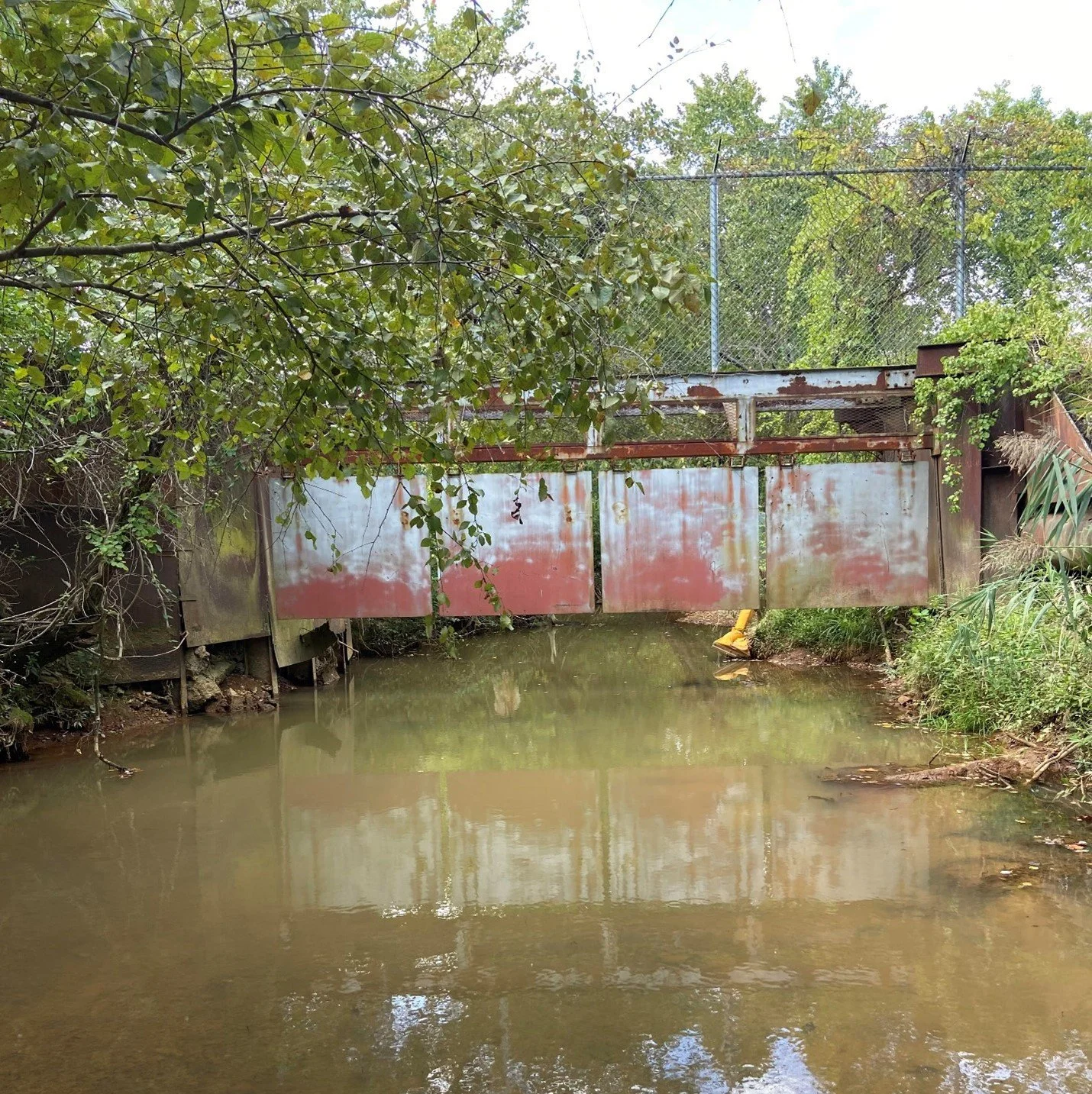
Sept. 22, 2021 - View looking north to the spot where Piscataway Creek flows out of Joint Base Andrews in Maryland. Notice the yellow oil containment boom inside the base. Piscataway Creek has been the military’s toxic sewer since World War II. We found deadly levels of PFAS here, among the highest in the world.
From January to March, 2026, Joint Base Andrews released 32,000 gallons of jet fuel from a faulty refueling system. It hid the leaks from the public until the odor and the oily sheen on the water demanded attention.
Much of the fuel flowed into Piscataway Creek, well-known for its toxic levels of PFAS from fire training areas originating from the home of Air Force One. Joint Base Andrews is located 8 miles south of Washington in Prince George’s County, Maryland.
The Air Force said the leaks contained a total of 22,000 gallons. They told the state they recovered 10,000 gallons of fuel before it reached the creek.
Maryland Secretary of the Environment Serena McIlwain released a farcical statement, “While Maryland values its deep ties to federal defense installations across the state, contaminating Maryland’s land and water is unacceptable.”
The track record of the Maryland Department of the Environment shows that criminal environmental behavior by the military is entirely acceptable. Let’s examine lessons we’ve learned before analyzing the spill du jour.
(Ed. note - Substantively, your critique is grounded. Instead of engaging your evidence, critics can dismiss you as advocacy-driven or biased.
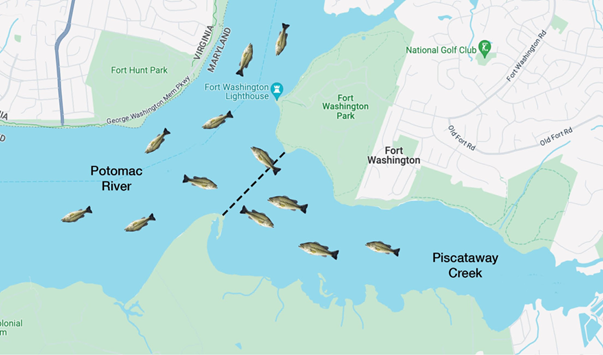
The Maryland Department of the Environment warns against consuming Largemouth Bass from Piscataway Creek but says they are OK to eat from the Potomac River.
A snapshot of Maryland’s lax regulation of the military’s destructive behavior
After citizen pressure, the Maryland Department of the Environment documented deadly levels of PFAS in Piscataway Creek flowing from Joint Base Andrews, along with hundreds of thousands of parts per trillion of PFOS in several species of fish, the state did not compel the U.S. Air Force to undertake cleanup measures or impose fines.
Maryland cannot take such punitive action. Instead, the state pretends to be tough.
Maryland established weak fish consumption advisories in 2021 warning the public to limit or avoid eating the poisonous fish, but it did not extend the advisory into the Potomac River, where there would be real financial pain. Even today, the public is fishing and consuming carcinogenic fish from Piscataway Creek. There’s not a single sign to be found along the creek warning the public not to eat the fish
The National Park Service still says Piscataway Creek is one of the Washington area's premier bass fishing spots. The Interstate Commission on the Potomac River Basin boasts, “The mouth of Piscataway Bay is yielding largemouth bass, and the nearby channel at Fort Washington is a blue catfish paradise.” Apparently, neither entity has received the memo on the poisoned fish.
In 2020 the MDE fundamentally misled the public about PFAS contamination in oysters from St. Inigoes Creek and the St. Mary’s River by using flawed testing methods and inappropriate interpretations. MDE used a lab method with a detection limit of 1 µg/kg (1,000 ppt) for each PFAS compound.

MDE is the fox in the hen house.
The state concluded that the oysters in the creek did not contain PFAS when our testing by Eurofins showed more than 2,000 parts per trillion of PFAS in an oyster. See Maryland Report Misleads the Public on PFAS Contamination in Oysters. The oysters are poisoned by the Webster Field Annex of the Webster Field Annex of the Patuxent River NAS. Crabs were found with 6,650 parts per trillion of PFAS in their backfin and rock fish has 23,100 parts per trillion of the carcinogens. See: Test Results – St. Mary’s (Eurofins PFAS data)
(Ed. Note -Your St. Inigoes and Piscataway examples are powerful, but critics will challenge sampling comparability, representativeness of localized fish data, and causation (military vs. other sources).
The MDE says their testing revealed no PFAS levels of concern or need to recommend meal limits for blue crabs or oysters.
In 2020 I sent my PFAS test results from St. Inigoes Creek to more than a hundred media outlets, everyone in the General Assembly, and the administration at St. Mary’s College of Maryland. The Bay Journal covered the story about the PFAS in St. Inigoes Creek. They interviewed Ira May, who oversees federal site cleanups for the MDE, “May suggested that contamination in the creek, if it exists, could have another source. The chemicals are often found in landfills, he noted, as well as in biosolids and at sites where civilian fire departments sprayed foam.”
The St. Andrews Landfill is 11 miles away and the closest fire station in Valley Lee is 5 miles away. The firehouse where the Navy used AFFF since the 1970’s is 1,800 feet across the water from me. I knew at this point that the state was covering for the Navy. In 2021,when I discovered that the Army at Fort George G. Meade had contaminated the Little Patuxent River with 2,306.2 ppt of PFAS, the MDE was silent and no media picked up the story. The Navy, Air Force, and the Army are contaminating Maryland’s rivers with these powerful chemicals while the MDE looks the other way.
There are a dozen more stories like this in Maryland, but this is an article about the Air Force spill du jour.
Contamination at military installations is governed under the federal Comprehensive Environmental Response, Compensation, and Liability Act of 1980 (CERCLA) framework, which places authority for investigation and cleanup with the Department of Defense and relegates the state to a weak advisory role.

The Air Force - See no contamination. Hear no complaints. Acknowledge nothing.
CERCLA was designed by Congress to hold polluters accountable. At military installations, it often does the opposite—handing the polluter the pen to write its own liability story, on its own schedule, using its own data. When this is the ultimate result it is more expedient for the state to simply look the other way. The state and the DOD like to call each other “partners.”
(Ed. Note - Agreed—but they’ll attack the absolutism.)
The Air Force response on paper is always impressive. It cranks out thousands of pages of preliminary studies and site inspections and final studies and a host of related investigations that involve testing and evaluations under incredibly complex federal processes. The response moves at a glacial pace while groundwater, sediment, surface water, and aquatic, and human life remain severely impacted, with no comprehensive remediation or compensation in sight.
This is the norm nationwide.
There are many well-documented Air Force fuel spill cases across the country. The most striking example is Kirtland Air Force Base in New Mexico, where between 5 million and 24 million gallons of jet fuel leaked into the subsurface.
There is no evidence that the U.S. Air Force has paid compensation to the State of New Mexico for the Kirtland jet fuel spills. The state has gone so far as to file legal actions seeking to recover past and future cleanup costs and damages. Nothing.
When states get feisty, the Air Force simply claims “sovereign immunity” in U.S. District Court Cases. Well-documented examples include Cannon AFB (NM), Maxwell AFB (AL), and McClellan AFB (CA), and Wurtsmith AFB, (MI). Sovereign Immunity means the Air Force claims it is above the law, that it has the right to poison people and the planet in the name of the great god of national security.
At many other bases the Air Force has claimed it is immune from state prosecution over severe contamination. Without specifically stating “sovereign immunity” it claims states don’t have the right to demand cleanup or recover damages. Examples include Holloman Air Force Base, (NM), Peterson Air Force Base, (CO), and Luke Air Force Base, (AZ).
We have created a monster.
(Ed. Note - You characterize sovereign immunity as the Air Force claiming, “the right to poison people.” That’s morally compelling—but legally, they’ll say sovereign immunity is a jurisdictional doctrine, not a license to pollute. They’ll say the Air Force is complying with federal law.)
The Maryland Department of the Environment presents itself as a vigilant watchdog. They responded to the leak at Joint Base Andrews by stating, “The base failed to promptly disclose leaks as required by its state oil permit and did not report the full extent of the discharge until April 8, 2026. Its leak detection system failed multiple times between January and March, yet MDE was not notified until odors, and a fuel sheen were observed near the headwaters of Piscataway Creek on March 23. The contamination prevention system also failed twice in early April, when a containment dam collapsed during heavy rain.”
Boy, they sure sound tough.
The Potomac Riverkeeper Network called for the state to investigate potential criminal activity, saying it appears Andrews officials worked to conceal the problem from the state. “This needs to be a criminal investigation,” Potomac Riverkeeper Dean Naujoks told The Baltimore Sun. “They withheld information and they did not report the leaks when they were required to do so.”
Right now, the claim that the leak detection system failed comes from MDE’s investigation, not the Air Force. The identity of who first observed the sheen and odors remains unclear. The spill was not reported until it became visibly obvious. We don’t know if this proves to be a true technical failure or a failure to act on available information, but it doesn’t matter because the whole thing will disappear from public sight, and the Air Force will not be compelled to do much of anything.
What's past is prologue.
The Air Force holds all the cards! Multi-million-dollar remediation programs are out of the question. Instead, the state is asking the Air Force to conduct a soil investigation to find exactly where the fuel is traveling. The state is asking the Air Force to install monitoring wells and remediate impacted soils, and to provide daily updates on all cleanup progress.
The MDE press release on the jet fuel spill advises the public to “avoid swimming, wading, or recreating in areas of Piscataway Creek where a petroleum sheen or odor is present, or near containment booms.” This is an outrageous statement considering that the creek should have been shut down for these uses five years ago.
For residents in Accokeek and nearby communities, the most immediate concern is thought to be the drinking water, although the MDE made it clear in their initial press release that there is no threat to drinking water (in tap water) as intake pipes are upstream. Our own testing of WSSC-supplied tap water, has found contaminant levels within regulatory standards.
Private well water is not regarded as a primary risk pathway. Most modern wells in the area draw from deep confined aquifers, typically between 150 and 400 feet below ground, which are protected by layers of clay and silt that significantly limit the downward migration of contaminants. These aquifers have long been considered reliable and relatively protected sources of drinking water.
(Ed. Note - Critics will point to this and say even the author admits drinking water risk is low. This doesn’t defeat your argument, but it gives them a talking point.)
Older wells, shallow wells, or wells with construction deficiencies may provide pathways for contamination, and over long periods certain chemicals can migrate downward under the right conditions. These cases are the exception rather than the rule, but they can still poison people.
The environmental impact of releasing tens of thousands of gallons of jet fuel into a tidal creek is substantial. Surface sheens reduce oxygen exchange and can expose fish and aquatic organisms to toxic conditions. Fuel can bind to the muddy sediments typical of Southern Maryland waterways, creating long-term reservoirs of contamination that slowly release hydrocarbons back into the water column. Shoreline marshes are particularly vulnerable, as petroleum can damage vegetation, and poison the habitat for birds and aquatic life.
Cleanup technologies are limited. Booms and skimmers can capture floating fuel, but they do little to address contamination that has already infiltrated sediments or soils. Once fuel is embedded in these environments, it becomes nearly impossible to remove.
The spill and its aftermath are predictable
This incident follows a well-established pattern in how environmental crises unfold publicly. Initial discovery produces a surge of concern, followed by reassuring statements from officials that emphasize limited risk, particularly to drinking water. As more technical details emerge, the issue becomes harder for the public to interpret, and media attention begins to decline. Eventually, the event fades from broad public awareness, leaving only directly affected individuals and engaged observers to continue tracking developments. This trajectory is closely aligned with Situational Crisis Communication Theory, developed by Timothy Coombs, which describes how organizations respond to crises by attempting to reduce perceived severity and rebuild trust. In this case, emphasizing that drinking water is not affected, disputing the total volume of the spill, and highlighting containment efforts all function to narrow public concern and stabilize the narrative.
Let’s examine Timothy Coombs’ Situational Crisis Communication Theory, (SCCT). He says there are seven predictable phases after a crisis like the Piscataway Jet fuel spill.
1. Pre-crisis
2. Crisis trigger
3. Crisis response
4. Narrative entrenchment
5. Plateau phase
6. Decline phase
7. Post-crisis phase
We have witnessed this scenario involving military environmental catastrophes, state bystanders, and lackluster press reporting so many times across the country it has become almost entirely predictable.
The pre-crisis stage - In the Andrews case, this phase appears to have stretched across months, from January through March, 2026, as fuel leaked from a faulty system. Detection mechanisms reportedly failed, and required notifications were not made. Coombs calls this a period of “signal detection,” when risks are present but not yet visible to the public.
The crisis trigger - At Andrews, the trigger was the observation of odors and a visible sheen near the headwaters of Piscataway Creek, followed by involvement from the Maryland Department of the Environment. Once the spill entered public view, a small handful of press outlets covered the event. Predictably, the early reporting was fragmented and incomplete, with no historical analysis. Coombs emphasizes that perceptions of responsibility form quickly in this phase and are difficult to reverse.
The crisis response phase - We haven’t reached this phase; however, we can expect the Air Force to issue general statements that they are seriously pursuing the matter, and they are proud of their record of environmental stewardship. The theory suggests that MDE will likely double down on its rhetoric. It makes them look good. If responses are perceived by the dwindling numbers of those still paying attention as evasive or incomplete, media attention may deepen and public anger may intensify, but this is unlikely, especially when actors like the Air Force and the MDE are well versed in public propaganda.
Narrative entrenchment - Here, the story evolves. Under SCCT, reputational damage at this stage depends less on the original event than on how the organization communicates after it. This is where trust is typically rebuilt.
Plateau Phase - The major facts are known but they become tired and worn, hardly newsworthy, while more horrendous stories grab attention. Media coverage putters out and loses urgency. This phase creates an opportunity for federal and state actors to wait out the attention cycle.
Decline Phase - Here, public attention fizzles out. News outlets turn to newer stories, and coverage becomes intermittent, often tied to mundane events like regulatory updates or legal filings. Public concern drops sharply, though it does not disappear entirely. It just becomes concentrated among those most directly affected.
Post-crisis phase - This includes scattered monitoring, potential litigation but NGOs, and soft regulatory actions, but official efforts are concentrated on reputational repair. For the public at large, the issue has been forgotten.
In the case of Joint Base Andrews, the most intense scrutiny has already occurred.
The central lesson of Coombs’ theory is that crises are not defined by what happened, but by how they are presented to the public, interpreted, and remembered. The cumulative effect of a hundred stories like this creates a numbed and dumbed citizenry ready to absorb any blow.
(Ed. Note - Your use of Coombs is sharp, but parts of it are predictive rather than evidentiary. Critics will say you’re fitting the facts into a theory rather than proving the pattern in this specific case.)
Thank you for suffering through this article. I receive criticism for being “biased” and “‘advocacy driven” so I wanted to respond by making it clear that I know how I come off. There must be a place for this level of candor. Special thanks to an anonymous, retired EPA regulator for her editorial comments.