Letter to activists concerned about contamination at Naval Base Kitsap
By Pat Elder
April 1, 2026
The U.S. Navy presents its Restoration Advisory Boards (RABs) as vehicles for transparency and community engagement, but at Naval Base Kitsap the reality tells a very different story. Critical documents—like the January 15, 2026 meeting minutes and the accompanying Keyport report—are withheld from public view and quietly distributed to a select few, limiting meaningful public scrutiny and participation. This controlled flow of information is not accidental; it reflects a broader pattern in which complex jargon, restricted access, and carefully managed narratives obscure the full scope of contamination and delay accountability. At stake is not just bureaucratic process, but the health of communities living with the long-term consequences of toxic exposure.
Until now, there has been no publicly available webpage for the Naval Base Kitsap Restoration Advisory Board Meeting Minutes from the January 15, 2026 meeting. The Navy has also neglected to put the 37-page PDF, “Naval Base Kitsap Restoration Advisory Board Meeting Keyport” online.
This is not an administrative oversight. It’s how the Navy handles their Dog and Pony Shows, known as Restoration Advisory Boards, or RABs.
The Navy is attempting to placate a small number of you by sending these files as attachments to emails rather than posting this damnable material online. They figure it makes you feel like an insider. They are masters of propaganda, and they don’t want to risk these files getting out to a larger audience.
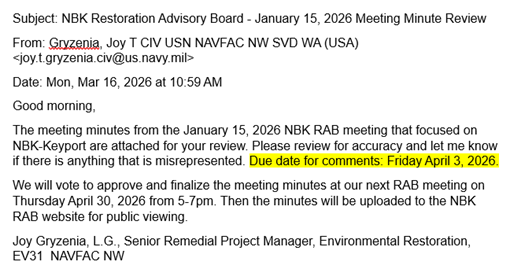
Email dated March 16, 2026 from RAB Co-chair, Gryzenia, Joy T CIV USN NAVFAC NW SVD WA (USA) to a handful of recipients
There is no publicly posted date for the next Naval Base Kitsap RAB meeting, apparently set for April 30, 2026. There are no official Navy pages or announcements. Only a small handful of folks know about this upcoming meeting.
RAB Co-chair, Gryzenia, Joy T CIV USN NAVFAC NW SVD WA (USA) (Joy), is a highly sophisticated DOD-trained propagandist. The Navy is preying on your community this way.
The Naval Base Kitsap Restoration Advisory Board Meeting Minutes of January 15, 2026 acknowledge the indigenous peoples and their land. This is something the Navy has been doing because it paints them, you know, as thoughtful and caring individuals who live in the same community. What is needed is for beautiful, indigenous souls to stand up and vehemently shout down Joy if she reads this placating pablum. They must explain that they have lived on this land for thousands of years and left it in pristine condition, while the Navy, in two generations, has knowingly and recklessly contaminated the air, soil, groundwater and surface water with a host of contaminants, while throwing indigenous tribes a kind of bone from a desecrated gravesite.
You must become combative! You won’t win any other way, despite your carefully researched facts and talking points.
CERCLA?
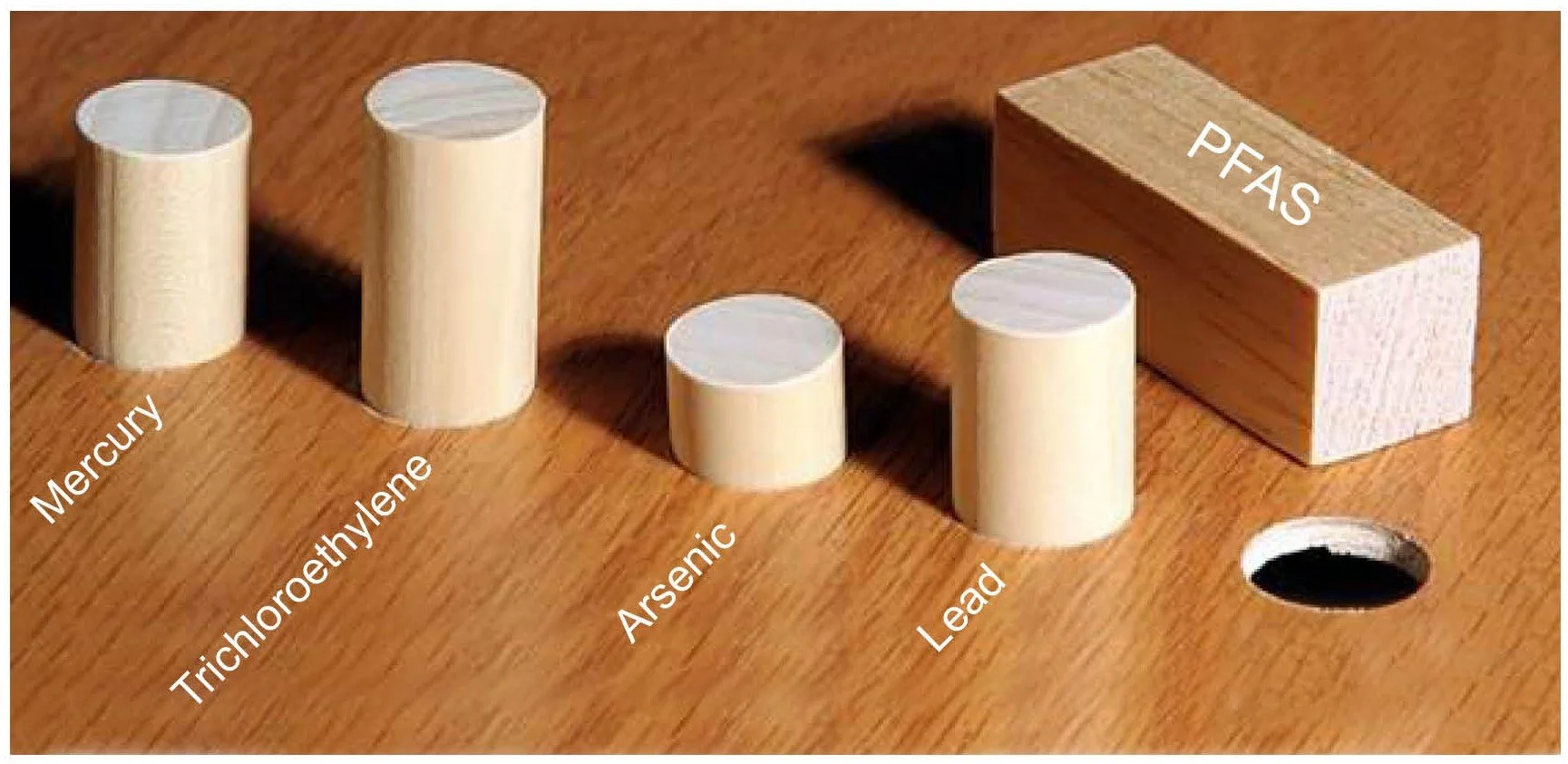
The Navy relies heavily on the CERCLA process. CERCLA is the Comprehensive Environmental Response, Compensation, and Liability Act of 1980. The act is ill-equipped to deal with persistent toxins like PFAS. They haven’t “cleaned up” anything at Kitsap! They are still in the study phase. The Navy has known AFFF was poisonous and could not be “cleaned up” in 1973!
Kroop, R. (1973).Biodegradation of Fluorocarbon Surfacants (U.S.Navy / 3M–related internal research)
Your thyroid be damned! PFAS puts out fires better than anything.
Please understand too, that the CERCLA process was designed for a host of contaminants that can be remediated! You must ask the Navy, how do they plan to attack the PFAS contamination. Pump and Treat? Mass excavation of soils and shipment to RCRA facilities? How do they intend to “clean up” sub soils or miles and miles of poisoned sediment? What’s the plan for the poisoned invertebrates and larger food chain? If you want to shake them up, plan it out, create a script, raise your voices and nonviolently get in their faces.
Tell them to cool it on the acronyms and the abbreviations!
Explain that you are intelligent citizens, just not versed in the purposely confusing military propagandistic gibberish laced throughout the January minutes and accompanying presentation. They’ll introduce these terms once, and expect you to immediately memorize them. It is a propagandistic ploy.
You must memorize these before your next privately-held RAB meeting:
AFFF – Aqueous Film-Forming Foam
AOPI – Area of Potential Interest
BGS – Below Ground Surface
BRAC – Base Realignment and Closure
COC – Contaminant of Concern
COPC – Contaminant of Potential Concern
CSM – Conceptual Site Model
DERP – Defense Environmental Restoration Program
DW – Drinking Water
ERA – Ecological Risk Assessment
FFA – Federal Facility Agreement
FFF – Fluorine-Free Foam
FS – Feasibility Study
FYR’s - Five-Year Reviews
GW – Groundwater
HAL – Health Advisory Level
HHRA – Human Health Risk Assessment
HI – Hazard Index
HQ – Hazard Quotient
IRP – Installation Restoration Program
LTM - Long-term monitoring
LUC’s – Land Use Controls
MCL – Maximum Contaminant Level
MDL – Method Detection Limit
MMRP – Military Munitions Response Program
MNA - Monitored natural attenuation
MW – Monitoring Well
NBK – Naval Base Kitsap
NFA – No Further Action
NPYFI – Navy playing you for idiots
OSD – Office of the Secretary of Defense
OU – Operating Unit
PA – Preliminary Assessment
PAOs - Public Affair Officers
PCB’s - Polychlorinated Biphenyls
PP - Proposed Plan
PQL – Practical Quantitation Limit
RA – Remedial Action
RAB – Restoration Advisory Board
RD – Remedial Design
RG’s - Remediation Goals (RGs)
RI/FS – Remedial Investigation / Feasibility Study
ROD – Record of Decision
ROD-A – Record of Decision Amendment
RSL – Regional Screening Level
SI – Site Inspection
SRI – Supplemental Remedial Investigation
SW – Surface Water
TAPP – Technical Assistance for Public Participation
TCRA - Time Critical Removal Action
UST’s - Underground Storage Tanks
VOC’s - Volatile Organic Compounds
Now you’ll be equipped to understand and push back on this from Page 6 of the minutes:
“The 1994 OU 2 ROD identified VOCs as COCs. The selected remedy includes LUCs and LTM/MNA, which are reviewed in the recurring FYRs.”
This is important, especially the notification process concerning the LUC’s. You can learn about land use controls (LUCs) from the frustrated residents around Naval Air Station Brunswick, Maine. They say that PFAS contamination from aqueous film-forming foam (AFFF) has not been removed, and that Land Use Controls are like a band-aid measure. LUCs pretend to manage exposure on paper while leaving the carcinogens in place.
LUCs, they argue, depend on centuries of enforcement, record-keeping, and public awareness—systems that can fail as houses, townhomes and condominium units change hands, exposing future residents who may not know the risks. The Mainers in Brunswick see land use controls as shifting the burden from cleanup to supposed containment, raising concerns about property values, public health, and whether redevelopment is occurring on land that remains dangerously contaminated.
Joy can explain it to you. Demand that she explains what this means: “The 1994 OU 2 ROD identified VOCs as COCs. The selected remedy includes LUCs and LTM/MNA, which are reviewed in the recurring FYRs.” Ask her if the use of PFAS has changed this equation. We know that AFFF use was standard across naval air stations and firefighting training areas since 1970. Ask Joy how this reality alters the assumptions embedded in the statement above.
(If Joy and her family lived next door, I’m sure we’d enjoy barbecues together, go to the same church, and our kids would play on the same teams. This is not a personal thing. Joy is GI – General Issue.)
Hitler’s Reich Minister of Public Enlightenment and Propaganda, Joseph Goebbels built influence by stripping ideas down to blunt, emotional slogans and repeating them until they felt unquestionably true. He said, “It would not be impossible to prove with sufficient repetition and a psychological understanding of the people concerned that a square is in fact a circle.”
Institutions like the U.S. Navy often do the opposite, by burying meaning under layers of acronyms, technical terms, and bureaucratic phrasing that make it hard for ordinary people to follow. One approach overwhelms you with simplicity, the other with complexity, but both can limit real understanding: one by replacing thinking with repetition, the other by making clear thinking harder in the first place. The result, in both cases, isn’t informed public judgment but a kind of fog, either because everything sounds too obvious to question or too confusing to untangle.
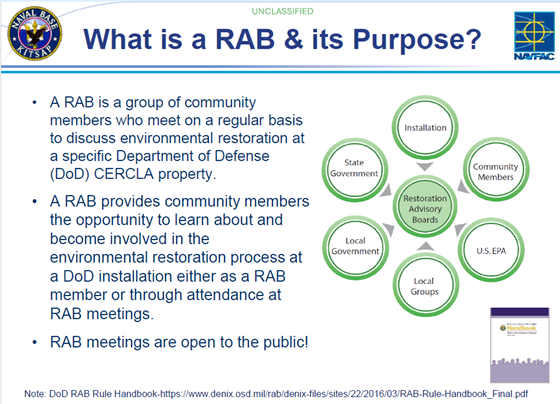
A Restoration Advisory Board (RAB) is promoted as a way to give the community a voice, but in practice the process is tightly controlled by the Navy. They set the agenda, frame the discussion, and ultimately shape what information is presented and how it is interpreted. Calling this a “community discussion” of environmental restoration is misleading when one side controls both the narrative and the flow of information.
Ask the community in Hawaiʻi who were shut out of meaningful dialogue with the Navy after the catastrophic Red Hill leak contaminated the drinking water of some 93,000 residents with jet fuel. Ask them what “public participation” really meant in practice. The Navy retained tight control over the response process while the community was shut out of meaningful participation, viewing public meetings and engagement as superficial while key decisions were made internally.
Wayne Tanaka, Director of the Sierra Club of Hawaiʻi, voiced that frustration, saying, “Enough is enough—we’ve lost all faith in the local Navy command,” and warning that “too many leaks, too many lies” had eroded public trust. For the community, the crisis became not just about contamination, but about a profound imbalance of power in which those affected had little real say in how the problem was handled. You are dealing with the same Navy.
The Navy doesn’t have a plan for how to deal with the PFAS! If they really do, we’d all like to see it!
If the RAB provides community members the opportunity to learn about PFAS and the Navy is our instructor, this is untenable. They have no credibility! The Navy began lying to the American public about the deadly consequence of the use of PFAS compounds in 1973 and they are still lying to us today.
PFAS impacts fetal development. Why should we hide our outrage? Kitsap, you gotta get in their faces, with harsh, disciplined restraint. Show up, speak plainly, and hold power to account without losing composure. Study how Martin Luther King and Rosa Parks handled themselves. There’s a great discipline involved in this.
The Epicenter of Contamination
Certainly, the Navy has recklessly used and discarded hundreds of products and applications containing PFAS at Naval Base Kitsap–Bangor, but we will briefly focus on Building 1300, Fire Station 61, a facility historically used for firefighting operations, including the storage and use of AFFF firefighting foam. This is the epicenter of the tragic carcinogenic injection into the bosom of the earth at Kitsap. Routine activities at this building, like fire training, nozzle testing, and equipment washing over decades have poisoned soil and groundwater in the region forever. Let’s understand Table 4-24 together. It is from the PFAS Site Inspection.
There is a PFAS Site Inspection for Naval Base Kitsap–Bangor, and it is available online, but it’s buried in Navy administrative record systems. You won’t find the relatively brief 1,474-page report by simply googling it. Also, it couldn’t be uploaded on this Squarespace platform because the file is too large. It’s how the Navy prefers to do things. You can search for it here.
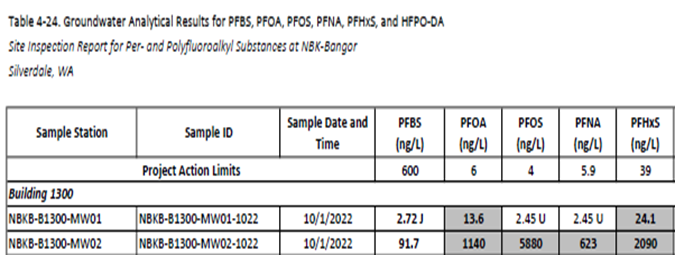
This table shows PFAS contamination in groundwater 26-36 feet below the ground near the fire station. They are playing a shell game with us. What are the concentrations at 50, 100, 200 feet down?
The top row lists the Navy’s own “action levels,” basically the point where they say contamination becomes a concern. These concentrations do not protect our health!
Breaking News - Human beings should not be drinking any level of these carcinogens. Less than one part per trillion of PFOA in drinking water is associated with increased rates of pancreatic cancer.
When you look at the second well (MW02), the numbers are not just over the superficially high limits, they are wildly higher: for example, PFOS is 5,880 ng/L (parts per trillion) and PFOA is 1,140 ng/L.
The Biden Administration set a 4 ppt limit for PFOS and PFOA in drinking water while admitting no safe level exists. They promised enforcement by 2029. The Trump administration has deferred enforcement to 2031.
Let’s look at it again.
PFAS Parts per trillion
PFBS 91.7
PFOA 1140
PFOS 5880
PFNA 623
PFHxS 2090
Total 9,824.7
We must become familiar with these compounds, their presence in our environment and our bodies, and their impact on our progeny. We should know the levels of these carcinogens in the water we drink and the food we eat. What’s in your fish, chicken, milk, and eggs, Kitsap?
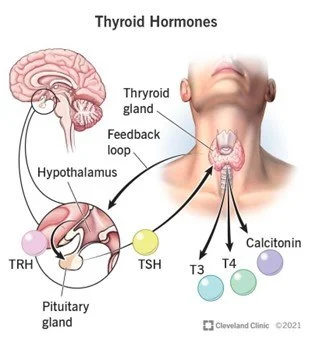
Finally, we must connect the dots between the diseases we’re suffering and the PFAS and other toxins that have gained passage to our bodies. Let’s ask Joy about how Perfluorooctanoic Acid, PFOA exposure is linked to liver damage, specifically non-alcoholic fatty liver disease and increased liver enzyme levels. Let’s ask her to explain how the Navy is responsible for the way PFOA disrupts our thyroid hormone transport proteins, competes with hormone binding, and alters feedback loops in the hypothalamic–pituitary–thyroid axis. Maybe throw some abbreviations in there for good measure. Ask her about the various C-8 studies and how PFOA impacts T4 and T3 and have her explain impacts on TSH, PPAR-α, NAFLD, and NASH.
Rise up! Don’t let them play you, Kitsap!