
PFAS at the Pōhakuloa Training Area and the Kilauea Military Reservation, Hawaii
A summary of an analysis of the Final Preliminary Assessment and Site Inspection (PA/SI) of Per-and Polyfluoroalkyl Substances, Pōhakuloa Training Area and Kilauea Military Reservation, Hawaii, July 2023
This is Part 2 of a 4-part series. See Part 1 - The Army Is Quietly Walking Away from Oʻahu to Gain Leverage over the Pōhakuloa Training Area and Kilauea Military Reservation
By Pat Elder
January 19, 2026
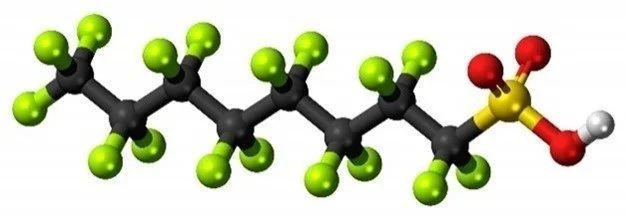
An artist’s rendition of PFOS - 8 black carbon atoms, 16 green fluorine atoms, 1 yellow sulfur atom, 3 red oxygen atoms, and one white hydrogen atom.
The Pōhakuloa Training Area (PTA) is profoundly impacted by PFAS contamination. This shouldn’t be surprising, although Army press releases and news coverage have been lacking.
The Comprehensive Environmental Response, Compensation, and Liability Act (CERCLA) establishes the Preliminary Assessment/Site Inspection process. (PA/SI). This process minimizes the extent of contamination across military installations. Rather than evaluating the full range of documented PFAS uses—including fire-resistant materials, hydraulic and lubricating fluids, munitions components, coatings, textiles, wiring insulation, degreasers, and waste streams, the Army largely confines its investigations to aqueous film-forming foam, (AFFF).
Even within this constrained focus, many AFFF-associated locations are downplayed or eliminated through sketchy interviews with installation subordinates and paper-based screening. This allows stormwater runoff, cesspool and leach-well reliance, and multiple secondary transport mechanisms to be overlooked. The resulting portrayal of PFAS risk conflicts with the intent of the
PA/SI process, which is to identify all potential sources of release and exposure pathways.
While AFFF is an important contributor to PFAS contamination, elevating it as the only source constitutes a regulatory failure that obscures the Army’s multiple uses of PFAS across PTA and undermines the intent of environmental oversight laws.
AFFF is laced with PFAS and was historically used by Army fire department personnel for practice training exercises. They typically dug a pit that was about 50-100 feet in diameter and a few feet deep. They’d fill the crater with jet fuel and other combustibles and ignite it for monthly training. Then, firefighters would extinguish the flames with the carcinogenic foam. They likely used thousands of gallons of AFFF concentrate and injected it into the heart of the Big Island.
The Pōhakuloa Training Area had a designated AFFF training area, and foam was used at the Bradshaw Army Runway. There were two generations of fire pits, as well as Building 39 Fire Station and the Building 390 Fire Station where AFFF use was documented. Foam use was routine and institutional.
Areas of Potential Interest (AOPI’s)
Areas of Potential Interest (AOPI’s) have been repeatedly used by the Army as a screening tool to eliminate dozens of areas and a host of applications from further PFAS investigation. In practice, the table below functions less as a summary and more as a gatekeeping mechanism, allowing the Army to prematurely dismiss sites where PFAS use is plausible but not explicitly tied to AFFF.
Table ES-1. Summary of AOPIs Identified during the PA, PFOS, PFOA, PFBS, PFNA, and PFHxS Sampling at PTA and KMR, and Recommendations
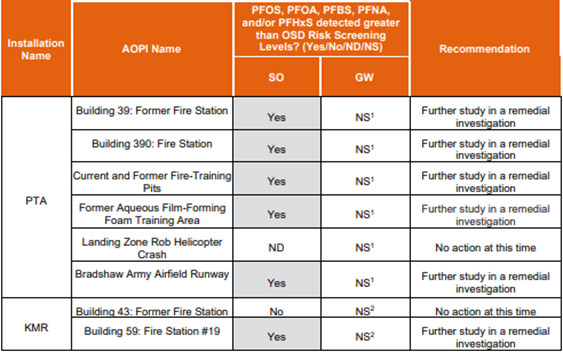
KMR is Kilauea Military Reservation. We’ll look at it below. All of the “Areas of Potential Interest” or AOPIs, are related to AFFF. “SO” stands for soil. “GW” is groundwater. NS is not sampled. “Recommendation” designates the site’s standing in the CERCLA process.
By accepting limited sampling, delayed progression beyond the PA/SI stage, and “no further action” long-term contamination is allowed to persist without meaningful accountability or remediation. The Army failed to test groundwater.
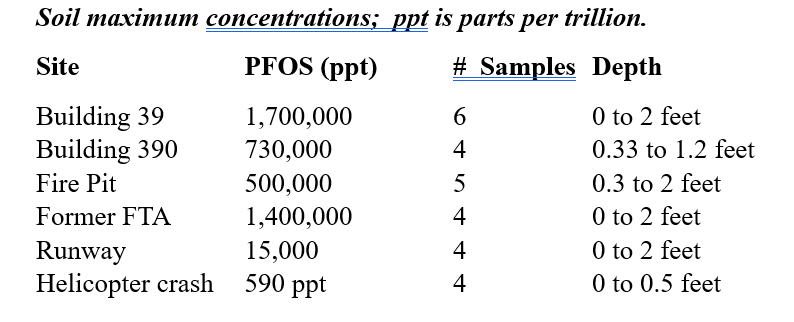
They reported results for just five PFAS compounds in soil—PFOS, PFOA, PFBS, PFNA, and PFHxS when the tests cover 40 compounds. They took soil samples from the 6 AOPIs. The extraordinarily high concentration of PFOS in the soil at these sites represents a serious threat to the environment and human health. This chart shows the 6 sites and their maximum PFOS soil concentrations.
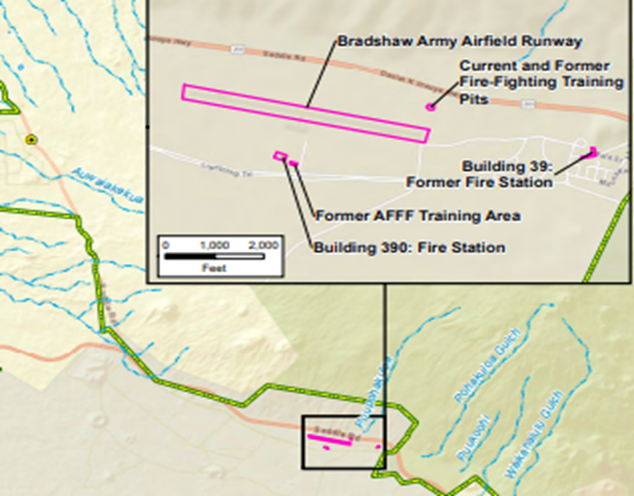
All five of the areas of potential interest are identified in this graphic. - Figure 5-2 PTA AOPI Locations
PFOS concentrations at these levels in shallow soils pose a clear human health risk because PFOS readily migrates from soil into groundwater, can be transported by stormwater, and can become airborne on fine dust that is inhaled or ingested. Because PFOS bioaccumulates and persists in the human body for years, even intermittent exposures can contribute to long-term risks including immune suppression, thyroid disruption, elevated cholesterol, and increased cancer risk.
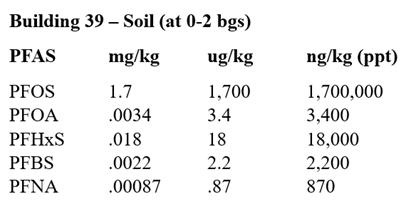
Highest concentrations of 5 PFAS compounds at Building 39 at the Pōhakuloa Training Area
The former fire station was operational from 1969 through approximately 1996. Buckets of AFFF were stacked vertically, which frequently resulted in the bottom buckets becoming cracked due to the weight of the buckets above. Fire trucks were filled with AFFF on the fire station apron. Newly graded material was present at the offsite drainage area, so, a deeper, composite subsurface soil sample was collected from a sampling location from a 2- foot interval of native material concentrations of PFAS to be examined and it suggests that the deeper the sample, the higher the concentration, at least for some distance.
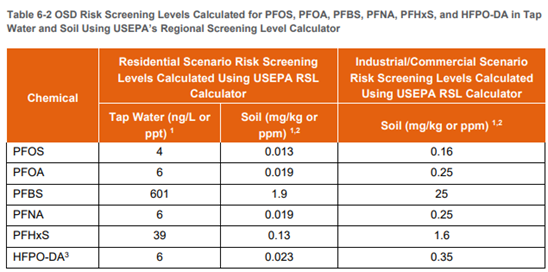
EPA Soil Screening Levels
The U.S. Army’s soil screening level for PFOS is set at 160,000 ppt. See Table 6-2, here.PFHxS, another deadly compound, is set at a level ten times higher than PFOS.
.16 ppm = 160,000 ppt.
The Army relies on EPA’s Risk Screening Levels to decide whether further investigation is warranted. In the case of Building 39, the PFOS levels exceeded the RSLs so the site advanced in the CERCLA process to the remediation stage.
In practice, however, the Army uses the EPA’s Risk Screening Levels as a procedural justification to screen out PFOS-contaminated soils and narrow the scope of CERCLA response actions.
To put these standards into perspective, if levels exceed 100 ppt in Germany, the soil cannot be reused and is considered a threat to groundwater.100 ppt in Germany and 160,000 ppt in Hawaii..
1.7 million ppt PFOS in surface soil threatens human health. Any disturbance: wind, vehicles, grading, foot traffic, helicopter rotor wash, mowing, construction, etc., can generate PFOS-bearing dust and soil contact exposure for people in the area.
Rains carry the concentrated carcinogenic soil into the subsurface. PFOS sorbed to fine sediment is carried in stormwater runoff into ditches and gulches, expanding the footprint downstream. Infiltration can also carry an indefinite supply of PFOS downward through fractured basalt and cinder layers, where it can accumulate in perched zones or deeper soil intervals. This raises concern that PFOS will eventually migrate into drinking water aquifers on an island with limited freshwater resources. It is truly frightening that these chemicals will always poison the Big Island and they may never go away.
Building 390 - The Army reported PFOS at concentrations of 730,000 ppt in soils at this firehouse at very shallow depths. That’s all we know. Tests a hundred feet away could have twice the levels, or half the levels. The DOD has been playing a shell game with the US public on PFAS testing of soils and groundwater.
Current and Former Fire Training Pits
The Army says that, from 1992–1999, there were only six to seven training events, each using roughly 1,000 gallons of water and 100 gallons of 3% AFFF. Army bases across the country often held monthly training exercises.
A 2020 Army report on the use of PFAS at the Kalaeloa Airport claims that the Hawaii Department of Transportation Aircraft Rescue and Firefighting (ARFF) Unit regularly released aqueous film-forming foam (AFFF) containing PFAS during monthly exercises at the former fuel farm area at the airport. Firetrucks were fitted with foam tanks and hose sprayers containing the carcinogenic materials, according to the “Preliminary Assessment” report on Perfluoro Octane Sulfonic acid (PFOS) and Perfluoro Octanoic Acid (PFOA).
The tanks reportedly contained 25 gallons of AFFF concentrate mixed with water. The monthly pump tests occurred at random locations across Kalaeloa Airport.
The PTA PA/SI reports that firefighters used 100 gallons of 3% AFFF concentrate mixed into 1,000 gallons of water. This doesn’t make sense because using 100 gallons of 3% AFFF concentrate that is mixed properly means the system would discharge over 3,200 gallons of water, producing more than 3,300 gallons of foam solution onto the ground.
We can’t trust what the Army is telling us. If the Army used 100 gallons of concentrate monthly - and that use stretched back to 1970 when the practice became institutionalized, the period from 1970 until 2020 stretches over 50 years – or 600 months. (and this is only for one AFFF release area) 600 months x 100 gallons = 60,000 gallons of concentrate.
On November 29, 2022, the Navy released 1,300 gallons of AFFF concentrate at the Red Hill facility in Honolulu. Over the years, the release of AFFF at Pohakuloa might be 46 times this amount. Who knew?
The cumulative volume implied by the Army’s account is orders of magnitude lower than the quantity of AFFF used at similar facilities.
Former FTA
According to the Army, the Former AFFF Training Area, located near the Bradshaw Army Airfield control tower, was used for firefighting training one to two times per year from approximately 1999 to 2009. Foam was sprayed towards and into a brush-filled drainage ditch. It is preposterous that the Army claims that firefighting training occurred just one or two times per year at the former fire training area when they reported 1.4 million ppt of PFOS on the site many years after the fact.
Groundwater at PTA
According to the Army, “Historical reports indicate groundwater at PTA has been identified several hundred to more than 1,000 feet below ground surface (bgs). The significant depth to groundwater precludes collection of groundwater samples as part of this SI; instead, soil samples were collected to verify the presence of PFAS at PTA.”
The State of Hawaii Commission on Water Resource Management has 13 deep monitoring wells across the state and some are drilled deeper than 1,000 feet.
Groundwater and the PFAS it carries can travel much faster and farther at PTA than in typical continental sedimentary aquifers. The actions of the Army at PTA have threatened the Big Island forever.
Cesspools
The Army has historically used large-capacity cesspools at PTA. Cesspools are a Neanderthal-era method of waste disposal, little more than a hole in the ground where human and toxic wastes are dumped and left to seep untreated into surrounding soil and groundwater. The larger systems were legally required to be closed by 2016, and there is no public evidence that some smaller traditional cesspools remain in operation today. The Army has never been readily transparent regarding these sorts of things.
Pesticides
The PFAS report for PTA lists former pesticide storage areas as preliminary locations for use, storage, and/or disposal of PFAS-containing materials. “One building was identified as a potential storage area for PFAS-containing pesticides. During a telephonic interview with the IMCOM Pest Management Consultant, it was noted that products containing Sulfluramid (i.e., associated with insecticides) may have contained PFAS and were phased out in 1996.”
Sulfluramid’s scientific name is N-ethyl perfluorooctane sulfonamide, known as N-EtFOSA, a PFAS compound that degrades in the environment to deadly PFOS.
The Army used sulfluramid at PTA for routine pest control. Dismissing pesticide storage and application areas in the PA/SI due to a lack of “specific evidence” is scientifically indefensible. Sulfluramid degrades into PFOS, and was applied directly to soil.
Landfills
The report says no specific evidence was identified confirming disposal of PFAS containing waste at these landfills. Landfills on military installations are well-established repositories for PFAS,
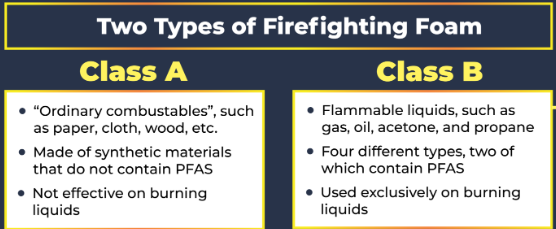
AFFF used on Wildfires
The Army conducted interviews indicating that “the PTA Fire Department may have used aqueous film-forming foam (AFFF) during off-post wildfire responses at the request of Hawaiʻi County.” We don’t know where they sprayed the toxins or how much they sprayed.
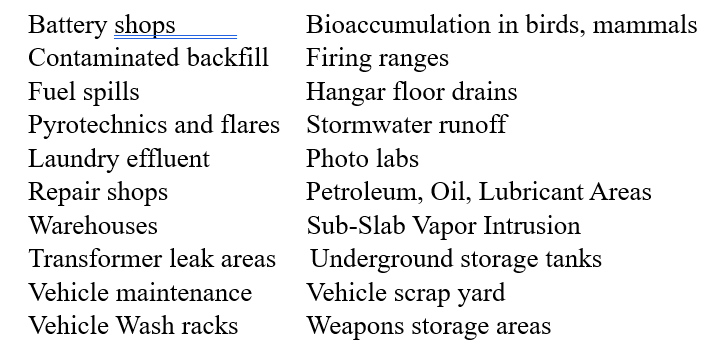
Other likely PFAS release areas or pathways
to human ingestion not investigated by the Army
Conclusion
What emerges from the Army’s own data, despite decades of minimization, selective testing, and regulatory sleight of hand, is a portrait of permanent contamination at the heart of Hawaiʻi Island. Pōhakuloa is not marginally impacted; it is saturated with PFAS at concentrations so extreme that they would trigger emergency action in many countries with modern environmental safeguards. Millions of parts per trillion of PFOS in surface soils, undisputed pathways to groundwater in fractured volcanic geology, unexamined cesspools, landfills, pesticides, and wildfire releases, and the deliberate refusal to test groundwater together form a reckless experiment conducted on an island with finite freshwater. The Army has narrowed the scope of inquiry until the contamination appears manageable, while the chemicals themselves continue to migrate, bioaccumulate, and persist - perhaps forever. This is not a legacy problem that will fade with time. It is a growing, irreversible threat to ecosystems, drinking water, and human health that will outlive the institutions that caused it.
PFAS Contamination at
Kīlauea Military Reservation, Hawaiʻi
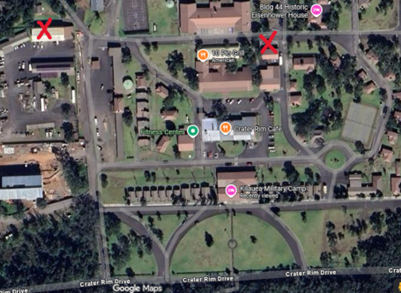
The Red X on the left shows Building 59 while the red X on the right shows Building 43. They are both areas of AFFF use by the Army on the Kīlauea Military Reservation.
Kīlauea Military Reservation occupies approximately 54 acres on the northern rim of Kīlauea Crater within Hawaiʻi Volcanoes National Park on the island of Hawaiʻi. It is approximately 30 miles southwest of Hilo. Although the Army currently characterizes Kīlauea Military Reservation as primarily recreational, available Army records show the facility has functioned as a residential facility for roughly eight decades. Today, the installation functions as a recreational and lodging facility serving active-duty and retired military personnel, reservists, and DOD civilians. Kīlauea Military Reservation contains approximately 90 cottages and apartments.
The distinction between a residential and a recreational installation is critical because it determines both the intensity and continuity of contaminant sources.
In the context of PFAS, this distinction is important due to residential releases of the toxins through sewage systems, septic tanks, cesspools, laundering, and routine fire-suppression readiness. These are pathways that are largely absent at purely recreational sites. By characterizing Kīlauea Military Reservation as recreational rather than residential, the Army narrows the conceptual site model and minimizes chronic exposure potential.
Areas of Potential Interest, (AOPIs)
The Army’s PFAS Preliminary Assessment/Site Inspection (PA/SI) identifies just two AOPIs: Building 43, the former fire station that operated from 1942 to 1994, and Building 59, which has operated since 1994.
While the Army documents the storage of AFFF and the presence of AFFF-equipped fire trucks, it does not describe how or why the foam contained in those vehicles was routinely discharged. At military installations nationwide, AFFF-equipped fire trucks commonly participated in nozzle testing, system checks, hose flushing, and training exercises, all of which required periodic discharge of foam solutions and resulted in intentional releases to pavement, soil, or fire training areas.
Groundwater
The PA/SI asserts that groundwater sampling was precluded because infiltrating water “turns to steam” due to a rapid increase in temperature with depth. Assertions that infiltrated water subsequently “turns to steam” are not entirely supported by hydrologic or geothermal literature.
Under federal law, groundwater must be evaluated as a potential migration and exposure pathway unless it can be demonstrably ruled out based on site-specific evidence. The reliance on unsupported assumptions to justify the absence of groundwater sampling represents a procedural failure that obscures potential long-term and off-site transport risks.
Soil
PFOS is reported to have concentration of 12,000 parts per trillion in the soil at Building 43 and 57,000 ppt at Building 59.
57,000 ppt PFOS in surface soil is a fraction of the 1.7 million ppt, but it’s still a serious indicator of an AFFF-impacted source area. Contaminated soil at this concentration may become airborne to settle in the lungs of people staying nearby. It may settle indoors as dust to threaten infants and toddlers.
Wastewater Management and PFAS Pathways
According to interviews conducted during the PA/SI site visit, Kīlauea Military Reservation historically relied on cesspools for sewage disposal until approximately 1984, when they were replaced with septic tanks. Portable toilets are also used throughout the installation for sanitary waste disposal (USAEC, 2023).
PFAS introduced into cesspools through domestic wastewater, wash water, or contaminated dust would have been discharged directly into the subsurface for decades prior to conversion to septic systems.
Septic systems do not eliminate PFAS contamination but redistribute it between liquid effluent and accumulated solids. Sludge removal transfers PFAS off-site to wastewater treatment plants, landfills, or land-application facilities. The sludge cannot be incinerated or buried without threatening human health.
In a remote installation lacking centralized wastewater treatment, sewage sludge represents one of the most plausible long-term PFAS redistribution mechanisms, both on site and beyond installation boundaries.
Conclusion
The Army’s own documentation demonstrates that Kīlauea Military Reservation has credible, unexamined PFAS migration pathways associated with documented AFFF use, rapid infiltration in fractured volcanic geology, historical cesspools, ongoing septic systems, and uncharacterized sludge disposal practices. The assertion that infiltrating water “turns to steam” and thereby negates groundwater concerns is unsupported by site-specific data and is inconsistent with established Hawaiian hydrogeology.