The Army Is Quietly Walking Away from Oʻahu to Gain Leverage over the Pōhakuloa Training Area
A summary of a 44-page analysis of the state’s rejection of the Army’s Final Environmental Impact Statement (FEIS), focusing on issues related to toxic contamination, especially PFAS. See the full report here.
By Pat Elder
January 17, 2026
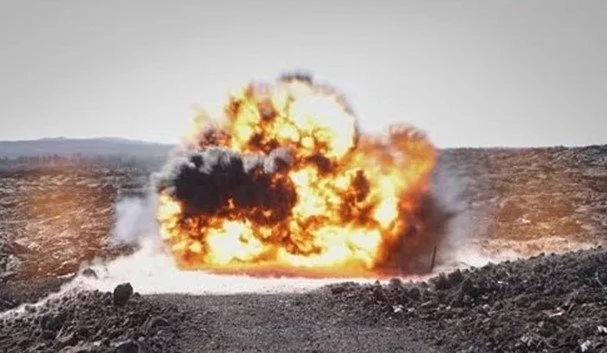
Jan. 24, 2024 - Pohakuloa Training Area - Bangalore torpedoes and M18 claymore mines were detonated during a live-explosives training exercise that likely deposited explosive residues (RDX, HMX, TNT byproducts, toxic metals, etc.) into the fragile environment.
While public attention has focused on the Hawaiʻi Board of Land and Natural Resources’ rejection of the Army’s Final Environmental Impact Statement (FEIS) for the Pōhakuloa Training Area, an equally consequential decision has unfolded largely out of public view. Under its own Record of Decision, the U.S. Army is preparing to vacate thousands of acres of state-leased land on Oʻahu—a move that reshapes the broader negotiations over military land use across the state.
On August 4, 2025, the Army signed its Record of Decision (ROD) for the Environmental Impact Statement governing its Oʻahu training leases. Buried in its conclusions is a stunning outcome: the Army has chosen the No Action Alternative for both Kawailoa-Poamoho Training Area and Mākua Military Reservation, meaning the leases will expire in 2029 and military use will cease.
At Kahuku Training Area, the Army selected Alternative 2, retaining only a portion of the land.
Extracted from the vague language, the decision means the Army will give up all 4,390 acres at Poamoho, all 782 acres at Mākua, and approximately 700 acres at Kahuku. Approximately 5,872 acres of land will return to the state. At Kahuku, the Army will retain 450 of the 1,150 acres it currently leases.
None of this has been reported in local or national media. Instead, spotty coverage has focused almost exclusively on the controversy surrounding Pōhakuloa on Hawaiʻi Island, leaving the false impression that all Army leases remain open for negotiation. They do not.
Under the Army’s final Record of Decision, there is no approved path to renew the Mākua or Poamoho leases. The Army’s obscure language and unwillingness to publicize its departure have hidden its decision to leave. This is part of their strategy.
These quiet withdrawals set the stage for the Army’s real priority, the Pōhakuloa Training Area on the Big Island. Unlike the Oʻahu sites, Pōhakuloa is central to the Army’s Indo-Pacific strategy. From the Army’s perspective, Pōhakuloa is non-negotiable, while the other leased lands are expendable.
Expect the Army to point to the land it is relinquishing on Oʻahu as evidence of good faith, using those “sacrifices” to strengthen its hand in negotiations over Pōhakuloa.
The Board of Land and Natural Resources’ 5–2 rejection reflected a determination that the Army’s Final Environmental Impact Statement (FEIS) did not meet Hawaiʻi law, did not protect public trust lands, and did not justify continued military occupation without enforceable cleanup, accountability, and cultural protections.
Pōhakuloa is the cornerstone of the Army’s Indo-Pacific strategy. From the Army’s perspective, Pōhakuloa is non-negotiable. As the Army seeks to retain long-term control of Pōhakuloa, it is likely to offer modest, carefully scripted and managed “concessions”, like slightly expanded cultural access, additional monitoring wells they control, and, perhaps, stronger language on fire prevention.
The Army will seek to avoid enforceable reporting and cleanup obligations for a host of chemicals, especially PFAS. They will reject demands that the Hawai’i Department of Health or third parties be granted access to the base to independently conduct environmental testing. The Army will endeavor to control environmental testing protocols and the publication of data.
Pro Publica
See ProPublica’s 2017 report on Pohakuloa, based on volumes of data they received from the DOD through a Freedom of Information Act (FOIA) request. Those days are gone now. FOIA requests are no longer honored the way they once were.
ProPublica identified 24 severely contaminated sites at the Pōhakuloa Training Area. This is an important snapshot, but it was produced at a time when PFAS science, monitoring, and public reporting were still in their early stages.
The Army addressed just 8 of the following 24 sites in its Final Environmental Impact Statement and it fails to specifically mention PFAS contamination at any of them. Our full report describes obvious PFAS pathways, like: fire training, fuel and maintenance operations, landfills, wastewater disposal, and munitions-related activities – that are routinely scrutinized at military bases on the mainland, but not here..
(1) PU'U PA'A SITE - Site ID: PTA-003-R-01
(2) FORMER BAZOOKA RANGE Site ID: PTA-004-R-01
(3) HUMUULA SHEEP STATION-West Site ID: PTA-001-R-01
(4) LANDFILL 2 Site ID: POTA-06
(5) FORMER FIRE FIGHTING TRAINING AREA PIT Site ID: POTA-01
(6) FORMER SMALL-ARMS TRAINING AND GUNNERY AREA BEHIND BLDG T-31 Site ID: POTA-02
(7) ARTILLARY FIRING AREA POWDER BURN Site ID: POTA-04
(8) IMPACT AREA Site ID: POTA-07
(9) PETROLEUM, OIL, LUBRICANTS (POL) STORAGE AREA Site ID: POTA-09
(10) UNDERGROUND STORAGE TANKS SITES (7) Site ID: POTA-10
(11) MAINTENANCE AREA (WSC #5) Site ID: POTA-11
(12) AMMUNITION STG MAGAZINES (8) Site ID: POTA-12
(13) FIREFIGHTING FOAM STORAGE SHED Site ID: POTA-13
(14) UNDERGROUND STORAGE TANKS SITE Site ID: POTA-14
(15) FORMER TRANSFORMER STG AREA Site ID: POTA-15
(16) 43 SEPTIC TANKS/12 LEACH WELLS Site ID: POTA-16
(17) UNDERGROUND STORAGE TANKS BLDG 186 Site ID: POTA-17
(18) VEHICLE REFUELING AREA Site ID: POTA-18
(19) EQUIPMENT STORAGE AREA Site ID: POTA-19
(20) ABANDONED LANDFILL 1 Site ID: POTA-03
(21) HUMUULA SHEEP STATION-EAST HUMUULA SHEEP STATION-EAST Site ID: PTA-001-R-02
(22) BRADSHAW FIELD STORAGE AREA Site ID: POTA-08
(23) KULANI BURN PILE Site ID: PTA-002-R-02
(24) KULANI BOYS' HOME KULANI BOYS' HOME Site ID: PTA-002-R
The Board of Land and Natural Resources’ rejection
of the Army’s Final Environmental Impact Statement, (FEIS)
The Army’s FEIS consists of four volumes containing 3,598 pages:
Final EIS – Vol. I
Final EIS – Vol. 2
Final EIS – Vol. 3
Final EIS – Supporting Documents
The Pōhakuloa Training Area (PTA) covers approximately 132,000 acres on Hawaiʻi Island, including a vast federally owned live-fire impact area and approximately 23,000 acres of State of Hawaiʻi land leased to the U.S. Army. The lease expires on August 16, 2029. The Army proposes to retain up to 22,750 acres of State-owned land in support of continued military training.
On May 9, 2025, the Hawaiʻi Board of Land and Natural Resources (BLNR) voted 5–2 to reject the Army’s Final Environmental Impact Statement (FEIS) for the proposed retention of State-owned lands at the Pōhakuloa Training Area (PTA). The Board determined that the FEIS failed to satisfy the disclosure and analytical requirements of the Hawaiʻi Environmental Policy Act (HEPA), Chapter 343, Hawaii Revised Statutes
A core deficiency identified by BLNR, and echoed throughout our analysis, is the Army’s failure to evaluate environmental and contamination impacts originating in the federally owned live-fire impact area (approximately 51,000 acres). The Army limited its analysis to state-leased lands, but BLNR concluded this improperly constrained the FEIS’s area of influence. Under Hawai’i law, environmental review must include reasonably foreseeable impacts, including impacts on connected or adjacent lands. The impact area’s activities—wildfires, UXO, emissions, and contaminant transport—do not respect jurisdictional boundaries.
A major theme is data absence. Across the FEIS’s 3,598 pages, there are no meaningful tables listing groundwater contaminant concentrations beneath state-leased PTA lands (PFAS, explosives, perchlorate, VOCs, metals, etc.), no clearly presented baseline concentrations, no trend data, and no comprehensive, transparent dataset that would allow independent verification of claims. The BLNR explicitly cited the lack of current baseline data as a reason the Army could not adequately assess the magnitude of impacts.
Our analysis advances the political conclusion: Hawaiʻi is under no obligation to weaken its stance. The state has leverage now and should use it. Our analysis argues the Army restricts PFAS evaluation to AFFF-related sources, even though PFAS may be present across many installation functions: munitions handling and fire-response needs, storage areas, maintenance operations, waste streams, wastewater disposal, and historic firefighting practices at burn pits and training areas.
Volume 3 of the Army’s FEIS includes the entire Preliminary Assessment and Site Inspection of PFAS for the Pohakuloa Training Area and Kilauea Military Reservation. We will examine the deficiencies of this report in the next part of this investigative series. The Army ignores the bulk of PFAS contamination at the Pōhakuloa Training Area.
The Army claims contaminants are unlikely to mobilize because of arid conditions, lack of streams, and deep groundwater.
Of course, episodic heavy rainfall and the rapid flow of toxic water in fractured volcanic rock spread PFAS contaminants. The perched aquifers, erosion, dust transport, and wildfire ash are all plausible mobilization mechanisms that are not analyzed by the Army.
If any new PTA lease is imposed, it must compel full transparency regarding the locations, extent, and concentrations of contamination. The state must require robust infrastructure improvements, including modern wastewater treatment and PFAS filtration. It must mandate independent third-party monitoring with public reporting and impose enforceable deadlines and significant penalties. Of course, Hawai’i must include a termination clause requiring cessation of operations if limits and obligations are violated. Anything less would shift long-term environmental and public-health risk onto Hawaiʻi while further insulating the Army from responsibility.
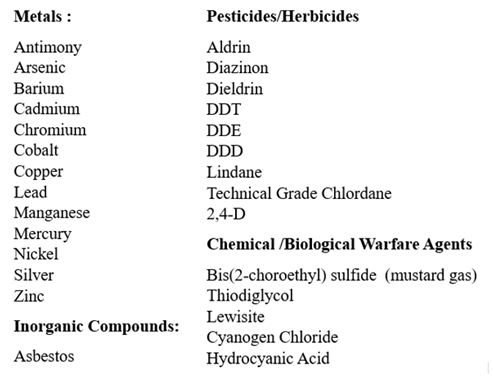
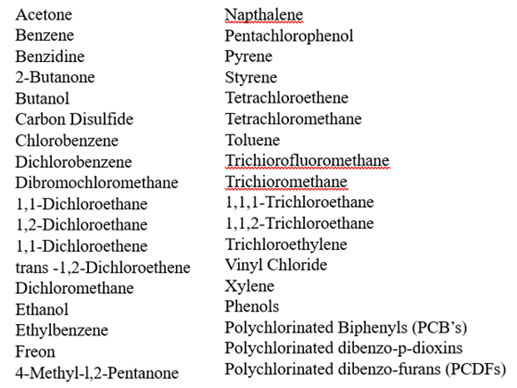
The Army claims to disclose the full scope of environmental impacts, as required under Hawaiʻi Environmental Policy Act. The Army’s response is preposterous. At Schofield Barracks, the examination of dozens of chemical compounds occurred as part of the initial CERCLA process that preceded the Federal Facilities Agreement (FFA). The Pōhakuloa Training Area is much larger, more intensively used for live fire, and, generally, much more heavily contaminated than Schofield Barracks. Just look at the toxins examined at Schofield Barracks the Army ignored at Pōhakuloa.
Organic Compounds analyzed in the Schofield Barracks Federal Facilities Agreement (FFA),
This project is supported by financial assistance from the Sierra Club of Hawaii.
Please consider donating to the Sierra Club of Hawai’i. Your donation will continue efforts to achieve Hawaiʻi’s 100% renewable energy goal, defend our oceans and forests, and build a more self-reliant and resilient community that prioritizes justice, enhances natural and cultural resources, and protects public health over corporate profit. Donate Here.