
Pituffik Space Base, Greenland
PFAS Results Raise More Questions Than Answers
Part 1 of a 3-part series. Part 2 will examine U.S.-caused contamination at each of the 36 individual facilities in Greenland. Part 3 will survey the appeals U.S. veterans have filed with the U.S. Veterans Administration, claiming cancers and disease as a result of their exposure to toxins in Greenland.
By Pat Elder
July 4, 2026
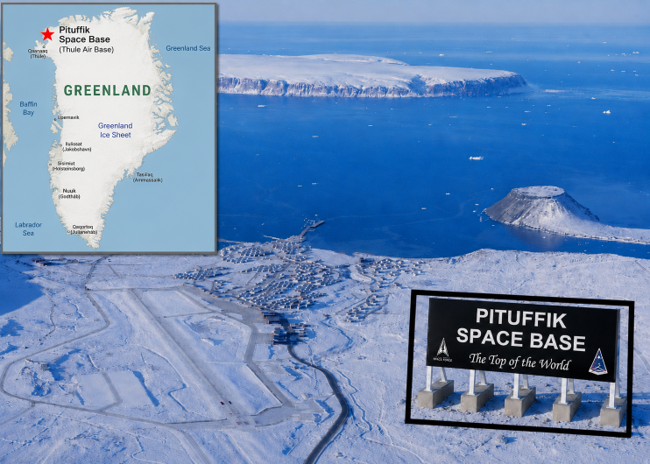
Pituffik Space Base is likely to be heavily contaminated with PFAS, but the U.S. Department of War refuses to divulge pertinent data.
When the Danish newspaper Politiken reported on July 1, 2026, that groundwater at the U.S. Pituffik Space Base in Greenland contained 1,100 parts per trillion (ng/L) of PFOS, the finding immediately attracted international attention. The concentration greatly exceeds current European drinking water standards and adds to growing alarm over PFAS contamination at former and active U.S. military installations worldwide.
1,100 parts per trillion of PFOS? What exactly does the reported number represent? Searching for the answer provides insight into the U.S. military’s sloppy culture of non-disclosure in Greenland and around the world.
Based on the results, the public cannot determine:
the exact sampling location,
whether the sample came from a drinking water well or a monitoring well,
the depth of the well,
the screened interval,
whether the water was collected before or after treatment,
Without this information, we don’t have a clue.
This is not only an issue for Greenland. Communities living near active and former U.S. military installations in England, Germany, Japan, and elsewhere are asking the same questions as they seek to understand how decades of military firefighting activities have poisoned their environment and what can be done to protect their health. They’re not getting much help from the Americans.
The U.S. military uses carcinogenic aqueouos film-forming foam ( AFFF ) in about 1,500 facilities and over 6,800 mobile assets worldwide. Release of AFFF into the environment, either through accidental releases, or for fire training and emergency use, has resulted in PFAS detections in drinking water and groundwater in and around DOD installations, according to the U.S. General Accounting Office in 2024.
Public resentment around the world is building because the American public knows a great deal more about the specifics of the contamination in the U.S. than “foreigners” do at any of these places. Individual states are taking actions, based on The PFAS data released by the Department of War, to protect the health of their citizens.
The lack of accountability for U.S. military pollution in Greenland stems from Article XI of the 1951 Defense of Greenland Agreement. This clause freed the U.S. from any legal obligation to clean up or restore its military bases. The treaty states:
It is understood that any areas or facilities made available to the Government of the United States of America under this Agreement need not be left in the condition in which they were at the time they were thus made available.”
This sentence is extraordinarily broad. It contains no environmental standard, no restoration requirement, no cleanup obligation, and no obligation to compensate for environmental damage, so the U.S. can tell Denmark to go to hell when it complains of environmental tyranny. The same is largely true under the SOFA agreements (Status of Forces Agreements) that set the tone between the great Goliath of 1945 and its many subjects today.
Section 345 of the 2022 National Defense Authorization Act, (NDAA)
When Congress mandated that the Department of Defense test off-base drinking water for PFAS contamination, it effectively left the Pentagon to police itself. By assigning the execution, reporting, and oversight of the PFAS program to the military's own internal PFAS Task Force, Congress created an inherent conflict of interest that complicates independent accountability.
The DOD is fundamentally stonewalling its statutory reporting requirements. Despite identifying 723 domestic bases that utilized PFAS-containing firefighting foams, the Pentagon has only submitted data for 86 installations in response to Section 345 of the FY2022 NDAA. Even this minimal disclosure is functionally hollow, leaving major gaps where critical concentration metrics are omitted entirely.
A close examination of the records associated with Pituffik Space Base in Greenland raises serious questions about how the data have been organized and presented to the public.
What the Pentagon’s Website Says
Marketed as a sophisticated public transparency initiative, the Department of War’s PFAS database ostensibly delivers the final results of off-base drinking water testing mandated by Section 345 of the FY2022 NDAA. According to the Pentagon, these assessments are designed to determine whether military-related PFAS contamination has migrated beyond base boundaries into local drinking water supplies. However, a closer look at the data reveals that this transparency is largely performative.
The Unexpected Discovery of Pituffik’s PFAS data
The structural flaws of the DOD’s PFAS database are not limited to missing values; the platform’s underlying data architecture displays bizarre anomalies that further obscure transparency. For example, querying the database for Colorado’s Peterson Space Force Base (SFB) mistakenly returns data records for Pituffik Space Base in Greenland.
A broader examination of the eight primary U.S. Space Force installations reveals a stark institutional disparity: while six bases yield "no records found" and one returns just 11 rows, Pituffik SB accounts for a staggering 27,595 rows of data. This erratic indexing and massive data imbalance strongly suggest that the database is functionally compromised, undermining its statutory utility under Section 345 of the 2022 NDAA.
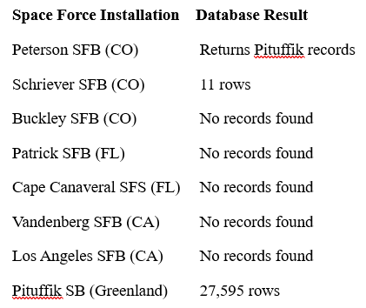
U.S. Dept. of Defense, Off-Base Drinking Water Information: PFAS Testing Database, Office of the Assistant Secretary of Defense for Energy, Installations, and Environment, https://www.acq.osd.mil/eie/eer/ecc/pfas/map/pfasmap.html (last visited July 3, 2026) (demonstrating indexing anomaly where a query for "Peterson SFB (CO)" returns records for "Pituffik SB (Greenland)" via the "Advanced Search" interface).
Looking Inside the Exported Spreadsheet
A granular look inside the exported spreadsheet reveals profound structural anomalies that challenge basic data integrity protocols. While the Pituffik dataset resembles a conventional laboratory database on the surface, a deeper audit reveals irreconcilable duplication errors.
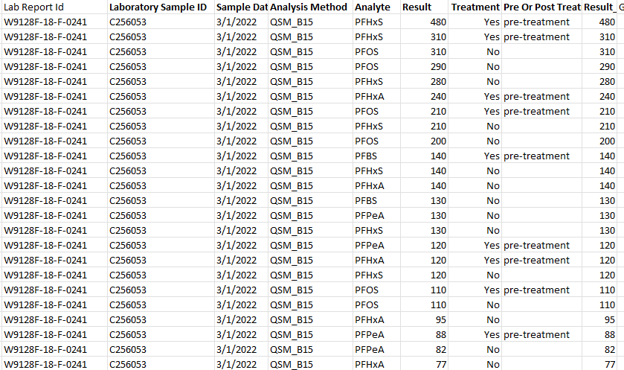
A raw snapshot of the DOD’s exported Pituffik spreadsheet sorted by analyte concentration. A single physical water sample (ID: C256053) displays impossible redundancy, containing multiple, varying numeric results for identical compounds (like PFHxS and PFOS) taken on the exact same date.
When sorted by Laboratory Sample ID, individual identifiers contain numerous repeated measurements of identical compounds. For example, a single sample identifier—C256053—contains 252 analytical rows detailing eighteen unique PFAS analytes. Crucially, each analyte appears exactly fourteen distinct times under the same sampling date, analytical method (QSM_B15), and laboratory contract number. Even more perplexing is that these repeated records are simultaneously split across three conflicting treatment categories: No Treatment, Pre-Treatment, and Post-Treatment.

Ask the Artist Blue what he meant by this.
In standard environmental engineering and legal chain-of-custody protocols, a single Laboratory Sample ID isolates one physical sample. It cannot simultaneously represent pre-filtered and post-filtered water. The Pentagon’s platform offers zero documentation or methodology to explain why these contradictory treatment phases are compressed into single identifiers, rendering the data functionally uninterpretable. What were they thinking?
Putting the Pituffik Results into Context
To accurately assess the Pituffik database concentrations, it is critical to distinguish between different regulatory sampling methodologies. The Pentagon states that this portal tracks off-base drinking water under Section 345 of the FY2022 NDAA. This represents point-of-consumption monitoring, which is fundamentally distinct from the source-zone groundwater investigations that initially brought military PFAS contamination to national attention.
For context, the Environmental Working Group’s (EWG) landmark 2019 report analyzed raw groundwater directly beneath or adjacent to 100 military installations.
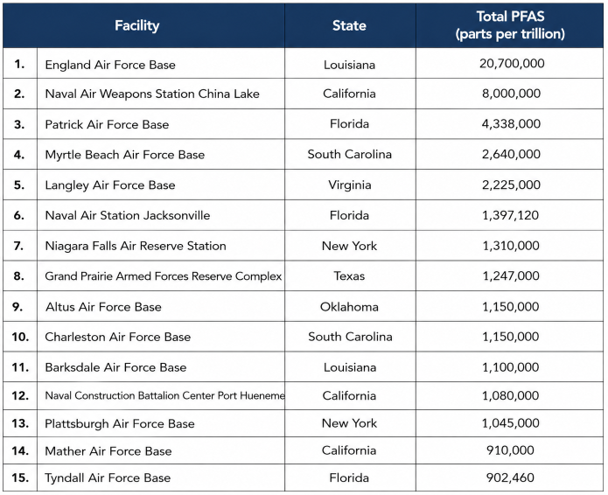
Figure 2: Top 15 U.S. military installations ranked by maximum historical PFAS concentrations detected in groundwater (measured in parts per trillion / ppt). Data adapted from historic source-zone investigations.
Concentrated near historic fire-training areas where aqueous film-forming foam (AFFF) was heavily discharged, those groundwater samples yielded extraordinary concentrations. Because these monitoring wells target undiluted source zones, their metrics are predictably orders of magnitude higher than finished drinking water supplies.
Groundwater monitoring wells located immediately adjacent to historic fire training areas are designed to locate contamination near its source. They examine highly contaminated groundwater before a great deal of dilution occurs. Establishing these historical baselines remains vital to understanding what is to be expected when examining military installations.
To illustrate the scale of these historical source-zone investigations, Figure 2 highlights the peak groundwater concentrations compiled from these landmark military assessments.
As documented above, raw groundwater adjacent to historic fire-training areas reached extraordinary levels. At the most impacted sites—such as England Air Force Base in Louisiana and Naval Air Weapons Station China Lake in California—total PFAS concentrations reached 20.7 million and 8 million parts per trillion (ppt), respectively.
These extreme values represent the raw, undiluted toxic footprint at the source of the discharge. They serve as an important baseline when evaluating the available data from the six U.S. Space Force bases, allowing us to determine if Pituffik's anomalies extend to its actual toxicological profile.
Domestic Baselines: Space Force Groundwater Concentrations
To evaluate what might be expected within the hidden records of Pituffik Space Base, we can isolate historical source-zone groundwater data from six primary U.S. Space Force installations. Because these metrics target undiluted groundwater near historical fire-training zones, they illustrate the raw scale of baseline contamination prior to environmental migration or dilution.
Figure 3 compiles the peak total PFAS concentrations and specific compound counts reported across these domestic facilities.
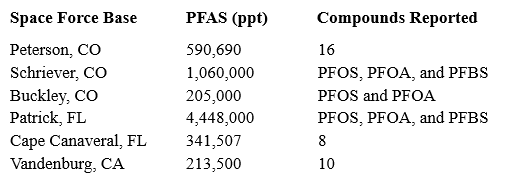
Figure 3: Peak historical total PFAS concentrations (measured in parts per trillion / ppt) and corresponding compound distributions across six domestic U.S. Space Force installations.
The mathematical average across these six domestic installations sits at approximately 1,143,000 ppt of total PFAS. To put this into perspective, this historical groundwater baseline is more than a thousand times higher than the 1,100 ppt concentration recently reported by the Danish newspaper Politiken regarding Pituffik.
Critically, this comparison represents a distinct methodological asymmetry. We are comparing apples to oranges. While the domestic Space Force data captures raw, undiluted source groundwater, the Pentagon’s Section 345 testing theoretically targets off-base drinking water supplies used by neighboring communities. These two testing frameworks evaluate entirely different phases of the human exposure pathway—moving from the heavily contaminated source zone to the finished public tap.
However, tracking this migration remains a profound regulatory challenge. By routinely omitting critical metadata—such as exact GPS coordinates and sample well depths—the Department of Defense leaves independent scientists, lawyers, and the public to guess how these toxic source zones physically connect to public drinking water supplies. and how the contamination impacts multiple environmental media.

Welcome to the U.S. Military’s International PFAS Testing Dog and Pony Show!
Playing a shell game with the depth of testing
Sometimes we will see results in a PFAS Site Inspection from a surficial aquifer near the surface at a fire training area and the levels may be surprisingly low because the carcinogens may have seeped deeper into the ground. We may also see data at the same location taken from 200 feet below the surface, showing low, or even non-existent levels. To get the real picture we would need to examine results from every ten feet down or so. This way, we might find concentrations of total PFAS exceeding hundreds of thousands of parts per trillion somewhere in between.
By withholding both geographic coordinates and depth metadata, the Pentagon leaves the world’s public with a spatial blackout.
The Politiken Disclosure: Unmasking a Fabricated Baseline
The recent investigation by the Danish newspaper Politiken drew vital international attention to a reported PFOS concentration of 1,100 nanograms per liter (ng/L or ppt) associated with Pituffik Space Base. While this reporting represents a critical contribution to public awareness—offering a stark glimpse into a broader legacy of environmental degradation left by decades of U.S. military operations in Greenland—the metric itself originates from a deeply flawed source.
While the Pentagon's exported spreadsheet does contain raw PFOS entries that match this1,100 ppt figure, the underlying architecture of the dataset severely undermines its credibility. Because individual Laboratory Sample IDs are structurally compromised, confounding the data with unexplained duplicate rows and overlapping treatment categories, the entire database lacks the baseline integrity required for scientific or legal validation.
Ultimately, these pervasive structural errors create an information vacuum. Because the data lacks fundamental reliability and the Department of War provides no public transparency channels, independent investigators are left with a chaotic dataset that raises far more questions than it answers, completely obscuring the true scale of the toxic footprint at Pituffik.
Regulatory Miscalculations: Disentangling Water Concentrations from Dietary Limits
The Politikenreport quotes an expert claiming that the 1,100 ppt PFOS finding at Pituffik represents “about 250 times the EU limit.” This assertion conflates two distinct toxicological metrics.
The European Union’s statutory framework handles these limits through separate mechanisms:
EU Drinking Water Directive: Establishes a maximum contaminant level of 100 ng/L for the sum of 20 individual PFAS compounds (including PFOS).
European Food Safety Authority (EFSA) : Sets a Tolerable Weekly Intake (TWI) of 4.4 nanograms per kilogram (ng/kg) of body weight per week for the combined mass of PFOS, PFOA, PFNA, and PFHxS.
Dividing the reported 1,100 ng/L by the media's stated factor of 250 yields exactly 4.4 - confirming that the source material mistakenly swapped an ambient drinking water threshold with a physiological dietary intake ceiling.
Let’s make this real
Data from the Forever Pollution Project illustrates the staggering discrepancy between regulatory limits and dietary reality. Fish from the Damhussøen reservoir in Copenhagen have been recorded containing 311,000 ng/kg (311 ng/g) of PFOS.
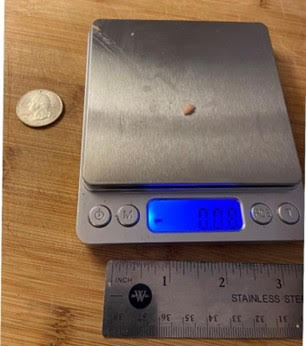
A minuscule 0.08-gram fleck of this fish (portrayed here) contains 24.88 ng of PFOS. (.08 × 311 ng/g) This single crumb accounts for nearly 23% of the total weekly allowance (110 ng) for a 25-kilogram child under EFSA’s guidelines.
A typical 200-gram meal of this same catch delivers a massive 62,200 nanograms of PFOS. For that same child, this single meal represents 565 times the recommended weekly toxicological limit—and over 190 times the weekly ceiling for an average adult.
=========================
An expanding consensus among international toxicologists on both sides of the Atlantic maintains that no level of exposure to these bioaccumulative carcinogens is safe.
There’s so much more!
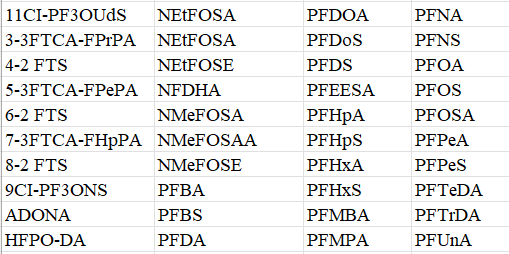
There are actually 40,000 types of PFAS. The Pentagon is providing compromised results for 40 compounds at Pituffik. That’s .1% of all the compounds potentially out there.
40 PFAS compounds reported by the U.S. Military
Ask British, German, and Japanese scientists and environmentalists if they are frustrated by the lack of U.S. transparency. The dutiful corporate media is doing a lousy job reporting on the lack of data, the sobering science, and the world’s frustration.
Polar Bears and the Arctic Marine Food Web
PFAS contamination in the Arctic is not confined to military bases. Scientific reviews show that PFAS also reach the Arctic through long-range atmospheric and oceanic transport, also contaminating seawater, sediments, aquatic organisms, seabirds, marine mammals, and polar bears. In Arctic marine food webs, PFOS and related compounds can biomagnify, with the highest burdens often found in top predators such as polar bears and seabird eggs. Beyond accumulating in polar bears and other Arctic predators, PFAS have been linked to altered gene expression, immune suppression, reproductive impairment, and epigenetic changes that may affect future generations.
Biologists, toxicologists, and geneticists are actively investigating whether the polar bear (Ursus maritimus) can survive the dual threat of climate change and genetic modification or if we are watching the final generations of the species as it has historically existed. The people who run this world just don’t give a damn. For them, if there’s no market-based solution or lucrative capitalist incentive for carrying it out, well then, there’s no solution.
And just one more parting shot, in U.S. military parlance.
In addition to PFAS, petroleum-related contaminants are commonly associated with military installations in Greenland. Releases from fuel storage areas, pipelines, refueling operations, vehicle maintenance facilities, and spills often result in contamination by benzene, toluene, ethylbenzene, and xylenes (BTEX), along with a wide range of petroleum hydrocarbons. We know that certain American bases in Greenland have been severely and permanently contaminated with nuclear radiation.
Other compounds that may be present include vinyl chloride, which can form as chlorinated solvents degrade in the environment, as well as metals, polychlorinated biphenyls (PCBs), pesticides, and combustion byproducts associated with historical military activities. At Arctic bases such contaminants can become trapped in frozen soils and permafrost for decades, only to be mobilized as permafrost thaws, potentially creating long-term sources of contamination to groundwater, streams, wetlands, and the broader ecosystem.
Bummer.
How do we talk sense into these knuckleheads?