By Pat Elder
October 25, 2026

President Trump to veterans seeking compensation for severe illness: “If we don’t win, there’s no money.”
Fox News - “The Trump administration is closing in on $1 billion in payments to American veterans, families and civilian employees who were exposed to toxic drinking water at Marine Corps Camp Lejeune in North Carolina between 1953 and 1987. For many, the payouts would finally rectify a decades-long battle for justice. According to the Department of Justice, claimants have received more than $919.7 million since President Donald Trump began his second term in office in January 2025. The administration has paid out about 3,300 people who made claims under the 2022 law. From that year to the beginning of 2025, before Trump retook office, only 459 settlements had been paid, totaling $59.6 million.”
Political illusion vs. systemic reality
President Trump claims his administration will resolve all remaining Camp Lejeune claims, but he has attached a strict partisan ultimatum, threatening on the campaign trail, “If we don’t win, there’s no money.” By reducing a human rights crisis to a political bargaining chip, the administration leverages Camp Lejeune as a kind of a prop to showcase a commitment to military veterans. This promised payout functions as a highly localized concession—one designed to obscure a sprawling, global US military contamination crisis.
This approach to veteran care ignores a darker history. For decades, under both Republican and Democratic control, the U.S. government has systematically neglected hundreds of thousands of military veterans exposed to lethal contamination worldwide. Weaponizing this singular case as proof of a pro-veteran agenda is a calculated political move. It hides the federal government's staggering liability for a massive population of sick service members who have suffered identical exposures at hundreds of other military installations, but who receive a pittance, or are denied compensation.
The "poster child" anomalies
Congressional investigations documented that Marine Corps officials received warnings about water contamination as early as 1980. Affected wells were removed from service in 1984–85, but the Tarawa Terrace water system continued operating until 1987.
This institutional negligence handed lawmakers a clear "bad actor" narrative, turning Camp Lejeune into low-hanging fruit for political action. Similar failures to investigate or address contamination have been documented at other military bases.
Lejeune veterans also organized masterfully, driven by advocates like retired Marine Master Sergeant Jerry Ensminger, whose daughter died of leukemia. They spent decades testifying, filming documentaries, and walking the halls of Congress to build a powerful, single-issue lobby. Most other contaminated bases simply lack the population density or unified advocacy required to force similar national political capital.
Because Lejeune became the primary focus, it spawned a massive, multi-billion-dollar legal industry that siphoned the media spotlight away from other contaminated locations. Constant TV and radio advertisements for "Camp Lejeune Water Litigation" transformed a localized environmental disaster into household knowledge.
The contrast was personal for veterans at other contaminated bases. Veterans from Wurtsmith, George AFB, Fort Ord, and other bases described Lejeune’s presumptive recognition for eight diseases as a gut punch, while comparable illnesses at their bases remained outside that path.
The core contaminants driving the Lejeune case were TCE and PCE, alongside benzene, vinyl chloride, and trans-1,2-dichloroethylene (DCE). However, a comparison of these chemical concentrations reveals that Lejeune’s levels are frequently eclipsed by groundwater contamination at other ignored bases across the country.
Camp Lejeune’s contamination compared to other bases
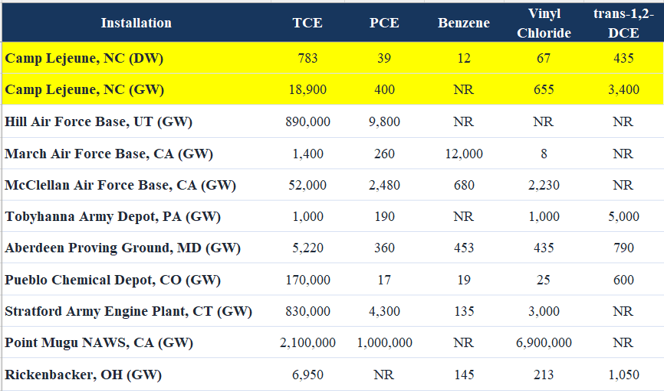
Source: ProPublica, Bombs in Your Backyard. Its underlying Defense Environmental Restoration Program (DERP) data was last updated in 2015. These results may come from different sites, wells, and dates.
A fractured system of exclusion
This "Lejeune Model" is fundamentally unfair. By carving out piecemeal legislation for a single installation, Congress created a tiered system of justice. A veteran who developed kidney cancer from TCE exposure at Camp Lejeune can sue the government; a veteran who developed the exact same cancer from the exact same chemical elsewhere is often confined to standard, routinely denied VA disability claims.
This exclusion extends to hundreds of thousands of veterans denied compensation for domestic Agent Orange exposure. To avoid liability, the Pentagon claimed that the defoliant used at over a hundred U.S. bases was a "commercial" grade rather than the "tactical" grade deployed in Vietnam. Dr. Alvin Young, VA Director of the Agent Orange Projects Office, served as the chief architect of this narrative, effectively blocking thousands of sick domestic veterans from receiving compensation. Young said many veterans are “freeloaders,” making up ailments to “cash in” on the VA’s compensation system.
1.6 million soldiers coursed through the Army’s Fort Ord, California and many have claimed cancers and illness attributed to exposure to Agent Orange. The Army routinely sprayed Agent Orange on 9,000 acres. However, their claims to the Veteran Administration are summarily rejected because the DOD says the tactical variety of Agent Orange was never used. Meanwhile, the evidence of its use is very clear at this base, and at military installations across the country. Many also claim that their children suffered birth defects although they never became poster children.
For children of male veterans, VA’s Agent Orange-related birth-defect presumption covers spina bifida alone. Other birth defects are excluded from that presumption, while a separate, broader benefit applies to certain birth defects in children of women veterans who served in Vietnam.
A 2016 ProPublica report said that since 2001 the VA had received claims from more than 8,100 people citing spina bifida and other birth defects, and 1,325 had received benefits. That means more than 6,775 had not received benefits by then.
Deconstructing the VA's math
To put the Trump administration’s 3,300 Camp Lejeune settlements into perspective, one must look at the sheer volume of the broader veterans' benefits system. In fiscal year 2024, the VA processed a staggering 2,517,519 disability rating claims. However, midyear data revealed a grant rate of just 64.6%, meaning roughly 35.4% of claims did not receive a grant at that time. While this remaining percentage includes deferred or pending files rather than outright denials, applying it across the full year yields an estimated 891,202 claims left without a grant. Annual claim counts are not counts of unique veterans. They include original claims and supplemental claims from people who have filed before.
Now, let’s look at VA’s six exposure categories.
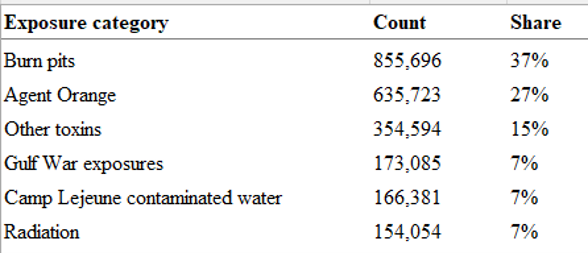
This table shows 2,339,533 VA records distributed across six exposure categories.
Source: VA Diffusion Marketplace
Examine the Camp Lejeune contaminated water number. Where are the other bases? Camp Lejeune became the poster child for military toxic exposure because of unrelenting civil and political pressure when it became clear contamination reached drinking-water systems while a critical mass of activists organized an effective political campaign. That synergy is missing elsewhere.
At Lejeune the exposure history was reconstructed, and the VA created presumptive benefits for these eight diseases:
· Adult leukemia
· Aplastic anemia and other myelodysplastic syndromes
· Bladder cancer
· Kidney cancer
· Liver cancer
· Multiple myeloma
· Non-Hodgkin’s lymphoma
· Parkinson’s disease
While the VA tracks millions of records across various exposure categories, it notably isolates Camp Lejeune into its own distinct category. This specific data structure completely omits hundreds of other contaminated installations.
The ratings among the 457,919 veterans who newly began receiving compensation are sobering too: 127,510—more than one in four—were rated at 10%, the largest single category. Nearly half were rated from 10% through 40%. Conversely, just 15.3% of these new recipients received a 100% rating. This statistical distribution underscores that even when veterans clear the complex hurdles required to establish a service connection, the system overwhelmingly heavily weights its final awards toward minimal compensation levels
The VA does not publish a national breakdown of disability claims by specific chemical exposure or the exact disease claimed. While veterans submit claims for a wide array of environmental hazards—including Agent Orange, PFAS, nuclear radiation, PCBs, and volatile organic compounds like TCE and PCE, publicly available data does not clarify which exposures or conditions are most frequently compensated.
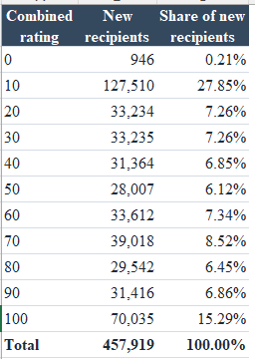
VA VBA Annual Benefits Report, FY2024, Compensation, pp. 76 and 78.
VA press release, July 23, 2024, grant rate and FY2024 claims.
Next, let’s examine FY2024 service-connected disabilities awarded to veterans who just began receiving compensation.
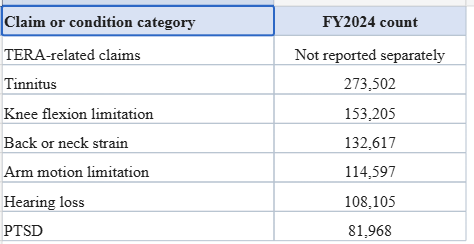
FY2024 Annual Benefits Report, Compensation section, https://department.va.gov/vba/annual-benefits-reports/
TERA stands for Toxic Exposure Risk Activity. It is not itself a medical condition or a separate disability claim. It is a legally defined toxic-exposure activity that may require VA to obtain a medical examination and opinion when a veteran seeks compensation for a disability.
VA’s published FY2024 reporting does not provide a standalone count of claims developed under the TERA process. Its aggregate figures—including claims involving PACT Act conditions—therefore do not show how many claims received TERA development or what happened to them. That gap limits public understanding of the process’s scale and outcomes.
Over the two fiscal years VA reported, it received 4,414,334 disability-compensation claims; 1,774,158, or 40.2%, included PACT Act conditions. Veterans may also seek compensation for disabilities they attribute to exposures such as TCE, PCE, benzene, PFAS, PCBs, or herbicides. But evidence that a contaminant was present at a facility does not, by itself, establish that a particular veteran was exposed or that a resulting disability is service-connected.
The PFAS cover-up
At Camp Lejeune, PFOS was reported in groundwater at 172,749 parts per trillion (ppt) while PFOA was reported at 25,100 ppt. These are extraordinarily dangerous levels, considering that the EPA is regulating these chemicals in drinking water at 4 ppt. The Camp Lejeune settlement only covers a relatively brief period and does not cover PFAS at all.
The Camp Lejeune water case grew from documented contamination of specific drinking-water systems and years of work reconstructing exposure to several volatile organic compounds. PFAS investigations came later and followed a separate, more secretive and confounding environmental-review track. There is an astounding lack of transparency regarding the impact to human health posed by these cancer-causing chemicals.
The high PFOS and PFOA figures discussed above are groundwater results; by themselves, they don’t show that those concentrations were present in household tap water during the historic exposure period. The Department of War likes to make this case ad nauseum at bases worldwide.
The reality is far more dangerous. These "forever chemicals" attach to tiny soil fragments and become airborne, settling deep in our lungs. In groundwater, PFAS poisons drinking supplies and seeps into surface water, bioaccumulating up the entire food chain—from aquatic sediments and invertebrates to terrestrial wildlife and human life. We don’t know how to properly dispose of them and they never go away.
While Camp Lejeune families were likely poisoned by these carcinogens, the federal government actively suppresses the issue. Acknowledging a PFAS crisis opens a Pandora’s box of catastrophic financial liability. To avoid writing millions of compensation checks, the government prefers to keep the public in the dark.
We must also revisit the Environmental Working Group’s Top 100 bases with PFAS contamination. These ten bases have reported more than a million parts per trillion in groundwater that may have been used for drinking water at sometime in the last 50 years.
· Naval Air Weapons Station China Lake California
· Patrick Air Force Base Florida
· Myrtle Beach Air Force Base South Carolina
· Langley Air Force Base Virginia
· Naval Air Station Jacksonville Florida
· Niagara Falls Air Reserve Station New York
· Grand Prairie Armed Forces Reserve Complex Texas
· Altus Air Force Base Oklahoma
· Charleston Air Force Base South Carolina
· Barksdale Air Force Base Louisiana
· Port Hueneme California
· Plattsburgh Air Force Base, New York
It is frightening to consider, but it is likely that millions of service members and their dependents drank water for 40-50 years at bases worldwide containing these endocrine disrupting carcinogens. We know from our experiences at Fort Ord and bases across the country that the Agency for Toxic Substances and Disease Registry, and the EPA have apparently conspired with the DOD to keep it all hush. And that’s because of the potentially staggering liability for the Pentagon. We’ve seen how disease caused by Agent Orange has been treated by the U.S. government and its myriad of mind-boggling machinery. The potential liability from the PFAS may dwarf Agent Orange. In the minds of military planners, this is every bit of a threat to national security (as they define it) than those pesky Iranians, Russians or Chinese.
DOD refusal to test blood for PFAS
It is outrageous to consider that the VA does not offer PFAS blood testing. Doing so would pry open Pandora’s Box of liabilities.
From the VA: “The VA does not currently offer PFAS blood testing. This is because PFAS blood tests have limited clinical value in that they can detect levels of certain PFAS in an individual's body at one point in time, but they cannot be used to determine when an individual was exposed, the source of exposure, or whether it could affect an individual's health now or in the future.”
The Department of Veterans Affairs’ assertion that PFAS blood testing lacks clinical value fundamentally disregards established medical and scientific consensus, most notably outlined by the National Academies of Sciences, Engineering, and Medicine (NASEM). In their landmark report, Guidance on PFAS Exposure, Testing, and Clinical Follow-up, NASEM explicitly recommends that clinicians offer PFAS blood testing to individuals with a high risk of exposure, as measuring serum concentrations is a vital diagnostic tool to inform personalized clinical surveillance for conditions like kidney cancer, testicular cancer, and thyroid disease. (I contributed to this report as a community liaison.)
A compelling primary study is “Serum Concentrations of Per- and Polyfluoroalkyl Substances and Risk of Renal Cell Carcinoma,” published in the Journal of the National Cancer Institute. Researchers measured PFAS in blood collected before diagnosis from 324 kidney-cancer cases and matched controls. A doubling of serum PFOA was associated with higher kidney-cancer odds; the association remained in cases diagnosed eight or more years after the blood draw.
A lead test can’t tell you which drinking water source caused the exposure. That doesn’t make the result useless; it tells you lead is in the body and gives a clinician information to consider. A smoke alarm can’t tell you where a fire started or what caused it. You don’t silence it for that reason. A thermometer can’t say when an infection began or where it came from. It can still give a doctor useful information about what to do next.
Where’s the outrage?
Conclusion
By maintaining this fragmented approach, the federal government leverages sovereign immunity, complex reporting regimes, and insurmountable legal burdens to divide and conquer veteran claims. While historic payouts at Camp Lejeune are utilized as a convenient political talking point, they mask a broader strategy of containment that leaves hundreds of thousands of service members at other toxic installations entirely stranded. Siloing claims by individual base, specific chemical compounds, and disconnected VA programs shields the government from the staggering financial liability of a global contamination crisis. This structural defense forces sick veterans to wage isolated, decades-long battles against a hostile and restrictive bureaucracy, transforming a universal obligation of service care into a crap-shoot, a lottery won only by the luckiest or most politically astute.
The "Lejeune Model" exposes a fundamentally unfair, tiered system of justice where a veteran poisoned by TCE at one base can sue for damages, while another suffering from the exact same disease from the exact same chemical elsewhere is likely denied. Congress must stop carving out piecemeal, reactionary laws for single, headline-grabbing installations while ignoring the broader, systemic military crisis. It is time to dismantle this unequal framework and establish a unified, transparent environmental standard across all domestic and international bases. All servicemembers and their sickened familes deserve equal protection and identical criteria for compensation.